
Why Our Nervous Systems Are Failing in Digital Spaces
How the attention economy reshaped human stress physiology — and why environmental design may become the next frontier of wellness

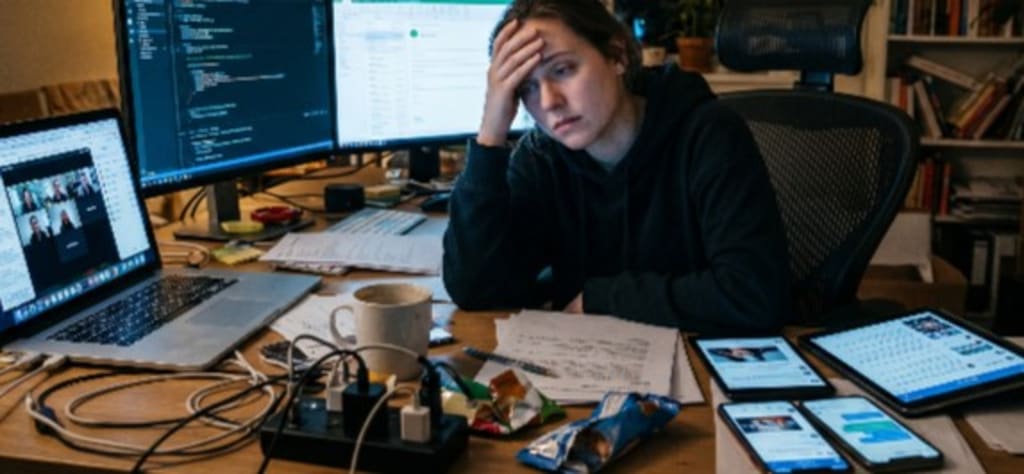
There is a specific feeling most of us have learned to normalize. It arrives around 2 p.m. on a Tuesday — or a Monday, or a Thursday, it doesn't really matter anymore. You've been online since you woke up. Your inbox refreshed itself seventeen times before breakfast. You've scrolled through opinions, alerts, metrics, and memes that your brain processed and mostly discarded before you could consciously register them. And now, sitting at your desk or in your kitchen or on your couch that has quietly become your office, you feel simultaneously exhausted and unable to stop. Wired and depleted. Frantic and hollow.
We've been told this feeling is a personal failure. A discipline problem. A focus problem. We've been sold productivity systems, digital detox retreats, blue-light glasses, and an entire galaxy of meditation apps — all built on the same foundational assumption: that if you, the individual, would simply try a little harder, you could manage the fire hose.
You cannot. No one can. And it's time we stopped pretending otherwise.
The Unmanaged Input Feed
The modern digital ecosystem was not designed with your nervous system in mind. This is not a conspiracy — it is just the honest truth of how these systems were built and for whom. Social platforms, notification architectures, content algorithms, and real-time data streams were engineered to maximize engagement. Engagement, in the neurological sense, means activation. And activation, when it is constant and unrelenting, is indistinguishable from threat response.
Your sympathetic nervous system — the ancient, elegant biological machinery responsible for mobilizing you in the face of danger — does not meaningfully distinguish between a predator in the grass and an inbox with 300 unread messages. Both register as demands. Both require scanning, sorting, and response. Both keep the body in a low-grade state of alert that, over time, becomes the baseline.
Research tracked by the Global Wellness Institute points to a growing body of evidence that chronic connectivity is actively reshaping not just our attention spans, but our stress physiology at a structural level. Heart rate variability — one of the clearest markers of nervous system resilience and parasympathetic recovery, and a central measure in Stephen Porges' influential Polyvagal Theory of autonomic regulation — declines in populations with high digital load. Studies on open-plan office environments have documented measurable cortisol elevation tied to chronic low-level noise and interruption. Research on blue light exposure has established its suppression of melatonin and disruption of circadian rhythms, compounding the physiological cost of screen time well into the evening. The autonomic nervous system, which should oscillate fluidly between activation and restoration, gets stuck. It learns, through sheer repetition, to stay on.
This is not merely burnout in the popular sense, nor is it simply a mood. It is a measurable physiological state — documentable and increasingly common — in which the body's regulatory systems are being overridden by the pace and volume of the information environment.
The Myth of Individual Adaptation
The wellness industry's answer to this crisis has been, with few exceptions, to ask more of the individual. Meditate more. Sleep hygiene. Digital boundaries. Dopamine fasting. The advice is not wrong, exactly. Rest matters. Intentional disconnection matters. But there is something deeply inadequate — and, I would argue, quietly cruel — about a cultural framework that responds to a systemic environmental problem by demanding that individuals simply adapt harder.
We do not ask factory workers to develop a personal tolerance for airborne toxins. We recognize that the environment itself requires intervention. We do not tell children in noisy, overcrowded classrooms to concentrate harder. We (when we are thinking clearly) redesign the classroom. The same logic should apply to the cognitive and physiological hazards of unregulated digital environments — and yet, here we are, selling apps to fix the damage that other apps caused.
The adapt-or-fail framing also carries a specific harm for people whose nervous systems are already sensitized: those with anxiety disorders, ADHD, trauma histories, or any of the many conditions that make the baseline level of digital noise not just exhausting, but genuinely destabilizing. For these people, "just set better boundaries" is not a wellness tip. It is a dismissal.
What if, instead of asking the nervous system to tolerate an environment it was never built to handle, we designed environments that actively worked with the nervous system's actual operating requirements?
Enter the Neuro-Regulated Environment
This is the idea at the center of what is emerging, quietly but with gathering momentum, as one of the more genuinely interesting developments in applied wellness: the neuro-regulated environment.
The concept is straightforward in principle, even if the implementation is technically sophisticated. Rather than relying on conscious willpower, a neuro-regulated environment continuously monitors physiological stress signals in real time. The space then adjusts its sensory conditions to support recovery automatically.
Heart rate variability sensors and other biometric inputs act as continuous feedback loops. When the data signals that a person's sympathetic nervous system is elevated — that they are moving into or stuck in a stress response — the environment responds. Lighting shifts toward warmer, lower frequencies associated with parasympathetic activation. Acoustic conditions adjust, introducing low-frequency sound or reducing stimulation. Temperature and airflow can be modulated. The goal is not to sedate or distract, but to provide the body with the sensory conditions under which its own regulatory systems can restore balance.
Picture an open-plan office by late afternoon. Biometric monitoring across the space detects a sustained elevation in sympathetic activation — not in one person, but as a pattern across the room. Without anyone filing a request or even consciously noticing the shift, the environment responds: lighting temperature warms toward amber, reducing cortisol-spiking blue frequencies. Notification density across shared systems quietly decreases. Acoustic dampening increases, softening the ambient pressure of overlapping sound. Scheduled break prompts appear — not as productivity hacks bolted onto a calendar, but as autonomic recovery intervals built directly into the architecture of the workday. Nobody had to remember to take care of themselves. The building did it for them.
The same logic scales. A neuroadaptive hospital waiting room that modulates sound and light to reduce pre-procedure anxiety. A public library reading space that holds genuine acoustic quiet rather than performing it. A school classroom whose sensory environment shifts between focused engagement and active recovery rather than sustaining a single stimulation register across six hours. These are not fantasies. They are design decisions — ones we are only beginning to have the tools, and the will, to make.
This is not science fiction. It is, increasingly, applied science — drawing on decades of research in environmental psychology, psychoacoustics, chronobiology, and autonomic neuroscience. The components exist. The data frameworks exist. What is new is their convergence into coherent design systems, and the growing cultural recognition that space itself is a health variable.
Why This Matters More Than Mindfulness
To be clear: I am not dismissing mindfulness, or therapy, or the genuine value of individual practices that support nervous system health. These things matter. But they operate at the individual level, requiring conscious effort, trained attention, and the cognitive resources that are, by definition, depleted in the people who need them most.
Neuro-regulated environments work differently. They operate at the environmental level, shifting the conditions of the space automatically, without requiring the person inside it to first notice they're struggling and then summon the executive function to do something about it. This is the critical distinction. When we are in a stress response, our capacity for top-down self-regulation is precisely what becomes compromised. We are least able to help ourselves at the moment we most need to. Research on what cognitive scientist Sophie Leroy has termed "attention residue" suggests that the cognitive cost of task-switching — the mental static that lingers after each interruption — accumulates in ways people rarely perceive in real time but that measurably degrade performance and increase stress load across the day.
An environment that responds to the body's state — rather than waiting for the mind to catch up — meets people where they actually are, not where we wish they were.
There are also implications that extend well beyond individual performance optimization. If we accept that the design of environments has measurable effects on nervous system regulation, then environmental design becomes a public health question. Schools. Hospitals. Open-plan offices. Public transit systems. Housing. These are all, in a very real sense, nervous system conditions. We have spent decades making them more stimulating, more efficient, more connected — and essentially zero time asking what that has done to the bodies inside them.
The Honest Reckoning
There is a harder conversation underneath all of this, and it would be dishonest to avoid it entirely.
Neuro-regulated environments, at least in their current iteration, are expensive. They are the province of high-end wellness architecture, corporate wellness campuses, and the kind of design-forward workspaces that appear in glossy technology publications. The irony that the same economic system generating digital overload is also producing its premium-priced antidote is not lost on anyone paying attention.
But the irony runs deeper than cost. Attention economies are not neutral actors in this story. Platforms that profit from engagement have a structural incentive to maintain activation states — because highly activated states often correlate with longer engagement duration, compulsive attention, and habitual return behavior. Overstimulation is not an unfortunate side effect of the attention economy. In a meaningful sense, it is the product. The mechanism that is quietly fragmenting our cognitive health is also, for a concentrated set of actors, enormously profitable. This does not make neuro-regulated environments less relevant — it makes the systemic critique behind them more necessary. We are not dealing with accidental harm. We are dealing with monetized harm.
This matters. Solutions that are only accessible to people with money are not solutions — they are amenities. And the neuroscience of chronic stress load is, if anything, a story about inequality: who bears the cognitive costs of always-on environments, who has the resources to escape them, and who is left to simply manage.
But the existence of an equity problem does not make the underlying insight wrong. It makes it more urgent. If the design of environments demonstrably affects nervous system health, then the question of who has access to well-designed environments is a question of health justice, not just interior design. It deserves the same policy attention we give to air quality, food access, and occupational safety.
Designing for the Body We Actually Have
The nervous system is not a technology problem. It is not going to be upgraded to handle more inputs. It is not going to evolve, in any meaningful human timeframe, to be comfortable with the cognitive load of 2025 or 2026 or whatever accelerated version of now we are currently living through.
What can change — what has always been changeable — is the environment. Human beings have always modified their surroundings to make them more survivable, more restorative, more aligned with what the body needs. We built shelters from cold. We created firelight. We designed cathedrals with specific acoustic and luminous properties, intuitively, long before we had the neuroscience to explain why they felt the way they did.
Neuro-regulated environments are, in this sense, not radical. They are the logical extension of a very old human instinct: the understanding that wellbeing is not purely an inside job. That the world outside the body shapes the body inside it. That space is not neutral.
The digital ecosystem has made an unmanaged experiment of us all. It has flooded the environment with a volume and velocity of input that has no evolutionary precedent, and watched, largely without intervention, as attention fractured and stress physiology shifted and people searched for individual solutions to a collective problem.
It is time to stop asking people to adapt to environments that are harming them. It is time to start designing environments that are built around the actual, biological, non-negotiable requirements of the nervous system they contain.
Not as a luxury. As a standard.
Because human physiology cannot be indefinitely optimized against itself.
Sources and further reading: Global Wellness Institute trend reports on neuro-wellness and environmental design; Stephen Porges, Polyvagal Theory (autonomic nervous system regulation); Sophie Leroy, "Why Is It So Hard to Do My Work?" (attention residue research, 2009); research literature on open-plan office environments and cortisol elevation; blue light, melatonin suppression, and circadian disruption studies; heart rate variability as a marker of autonomic flexibility; environmental psychology studies on sensory regulation and cognitive performance.
About the Creator
Khali Sollis
Khali Sollis is a writer and independent researcher exploring the science of the human mind and behavior. Her work examines questions at the intersection of neuroscience, psychology, cognition, mental health, and everyday human experience.
Enjoyed the story? Support the Creator.
Subscribe for free to receive all their stories in your feed.
Comments
There are no comments for this story
Be the first to respond and start the conversation.