
Why "Emotional Fitness" Is Replacing the Digital Detox — and Why That Matters
Why More People Are Training Their Nervous Systems Instead of Unplugging

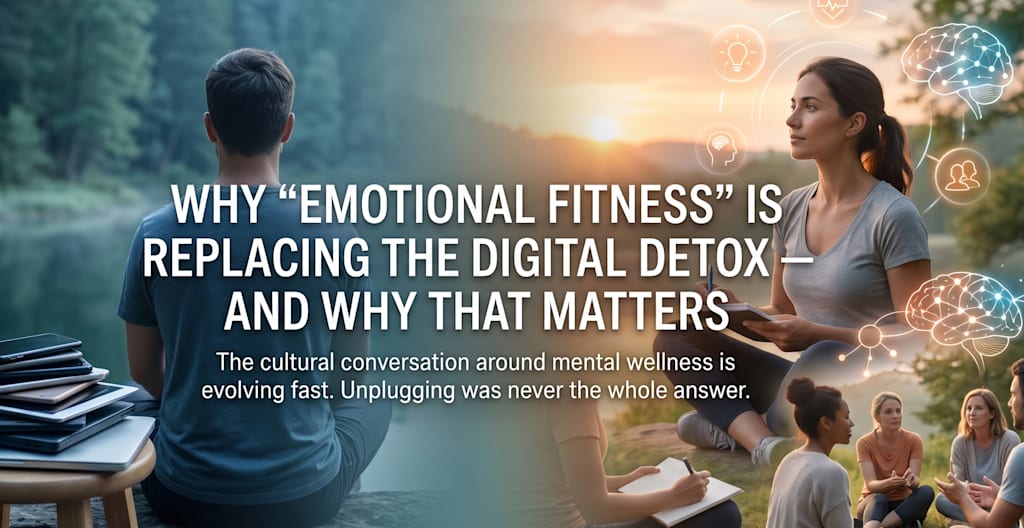
There's a particular kind of person who announces a digital detox on a Sunday night. They put their phone in a drawer, maybe swap it for a novel or a walk, and by Tuesday they're back on the timeline, scrolling with the same low-grade dread they had before. Nothing has changed — because nothing structural has changed.
The digital detox addressed an important symptom, but often missed the deeper problem. Yes, compulsive phone use can fray your attention and hollow out your sleep. But the anxiety, the dysregulation, the emotional volatility that sends you reaching for the screen in the first place — those don't live in the device. They live in the body.
That's why the cultural conversation is shifting. The term emotional fitness is gaining serious traction among clinicians, wellness practitioners, and a public that has grown quietly skeptical of the detox promise. And it's arriving as a deliberate counterweight to detox culture — one that asks something harder and more useful of us than simply logging off.
The Detox Was Often a Workaround
The digital detox emerged from a real and valid concern: that modern technology had outpaced our capacity to regulate our relationship with it. The dopamine loops, the notification cascades, the always-on work culture — these were genuinely new stressors layered onto a nervous system that evolved for an entirely different pace of life.
But the detox solution was, at its core, avoidance. Remove the trigger, reduce the exposure, survive the weekend. It was a pressure-release valve, not a redesign of the system. And like most avoidance strategies in psychology, it provided relief without building capacity.
The problem isn't that people spend time on their phones. The problem is that many people have no reliable way to return themselves to a state of calm after disturbance — no practiced pathway back to regulation when cortisol spikes, when the news cycle floods them with dread, when a three-second social media comparison leaves a bruise. A week offline doesn't teach you that skill. It just postpones the test.
What "Emotional Fitness" Actually Means
Emotional fitness isn't a rebranding exercise. It represents a genuinely different framework — one rooted in neuroscience, somatic therapy, and the kind of daily behavioral discipline we associate with physical training.
The analogy to physical fitness is intentional and instructive. We don't expect someone to get strong by avoiding the gym for a week. We expect strength to come from repeated, progressively challenging exposure — from building the body's capacity to handle load and recover from it. Emotional fitness applies the same logic to the nervous system.
This means training regulation, not just seeking relief.
Heart rate variability (HRV) monitoring has become a central tool in this practice. HRV — the subtle variation in time between heartbeats — is widely regarded as one of the best objective proxies for nervous system resilience. HRV is not a direct measure of emotional health, but it can provide a useful window into recovery capacity and autonomic nervous system balance. A high HRV signals that your parasympathetic system (the rest-and-digest counterweight to fight-or-flight) is robust and responsive. A chronically suppressed HRV signals that your system is stuck in a state of sympathetic dominance — reactive, depleted, rigid. Wearables like the Oura Ring, WHOOP, and Apple Watch have made this data accessible to everyday people, not just athletes or cardiac patients, and a growing cohort of users is treating their morning HRV score the way they might treat a resting heart rate or a sleep stage summary — as a daily signal about where they actually are, physiologically and emotionally.
Somatic regulation is the other pillar. Somatic practices — breathwork, body scanning, movement-based therapies, bilateral stimulation, cold exposure — work through physiological pathways, engaging the nervous system directly alongside the cognitive layer. The relationship between mind and body in emotional experience is bidirectional: thoughts shape physiological states, and physiological states shape thought. Cognitive strategies remain valuable and carry substantial clinical evidence, particularly for longer-term reappraisal and meaning-making. But during periods of acute activation — the racing heart, the tight chest, the flooded mind — somatic tools can often provide a faster route back to regulation, precisely because they engage the body states where the distress is most immediately alive.
Structural nervous system resilience tracking ties these practices into a daily architecture. Rather than an occasional retreat from the world, emotional fitness asks you to build small, consistent practices into the fabric of your day — a morning HRV check, a two-minute cyclic sigh before a hard meeting, a ten-minute body scan before sleep.
"The goal isn't to feel good all the time. The goal is to shorten the window between disturbance and recovery, and to widen your window of tolerance for the full range of human experience."
Why This Moment, Why Now
Several cultural streams are converging to make emotional fitness not just compelling but necessary.
First, there is the post-pandemic hangover. The sustained stress of 2020–2022 produced a mass dysregulation event at civilizational scale. People who had never thought much about their nervous systems found themselves unable to concentrate, unable to sleep, cycling between numbness and overwhelm. The demand for tools that actually address nervous system health — not just mindfulness platitudes — became acute.
Second, for the first time in history, millions of people are carrying a real-time dashboard of their physiological state on their wrists. HRV monitoring was once confined to elite sports science labs and cardiac clinics. Now it arrives on your wrist every morning with a colored ring. This isn't a minor convenience upgrade — it's a genuinely novel development in human self-knowledge. The democratization of continuous biometric data has created a form of embodied self-awareness that differs from what journaling or occasional retreats can provide. It's personalized, continuous, and honest in ways that self-reporting never quite is. When people can actually see their recovery score drop after a hard week, the abstract concept of "nervous system load" becomes concrete and actionable.
Third, the cultural conversation around mental health has matured. There is a growing fatigue with both the toxic positivity camp ("just meditate and journal!") and the nihilist camp ("everything is broken and there's nothing to be done"). Emotional fitness occupies a pragmatic middle ground: things are genuinely hard, the nervous system is genuinely under strain, and there are concrete, evidence-informed practices that build real resilience over time. That's a message people are ready to receive.
The Harder Ask
None of this means that time offline is useless. Rest is a legitimate part of recovery, and an overstimulated nervous system does benefit from reduced input. But rest without skill-building is incomplete. It's the difference between taking a week off from the gym when you're injured and actually rehabilitating the injury.
Emotional fitness is a harder ask than a detox precisely because it doesn't let you off the hook. You can't do it for a weekend and consider yourself sorted. It requires showing up to yourself daily — reading the morning data, doing the breath work, noticing what dysregulates you and practicing the return. It requires building the kind of relationship with your own interior life that most of us were never taught to cultivate.
But that's also why it's promising. Because the detox was, in many cases, a workaround, and workarounds stop working the moment you put the phone back in your pocket. Fitness — real fitness, the kind that compounds — stays with you.
The nervous system is not the enemy. It is the instrument. And like any instrument, it rewards practice.
The next phase of mental wellness may have less to do with escaping technology and more to do with becoming harder to destabilize by it. The question is no longer whether we can unplug. The question is whether we can build the capacity to remain regulated when we plug back in.
If you're beginning to explore emotional fitness practices, HRV tracking apps like Elite HRV and the health dashboards on most modern wearables are accessible starting points. For somatic work, look for practitioners trained in Somatic Experiencing (SE) or EMDR, or explore breathwork protocols like physiological sighing or box breathing as low-barrier entry points.
About the Creator
Khali Sollis
Khali Sollis is a writer and independent researcher exploring the science of the human mind and behavior. Her work examines questions at the intersection of neuroscience, psychology, cognition, mental health, and everyday human experience.
Enjoyed the story? Support the Creator.
Subscribe for free to receive all their stories in your feed.
Comments
There are no comments for this story
Be the first to respond and start the conversation.