
Why Compassion Is the Hardest Standard in Healthcare Leadership: The Sheth Jeebun Story
From nursing roots to purpose-led healthcare leadership

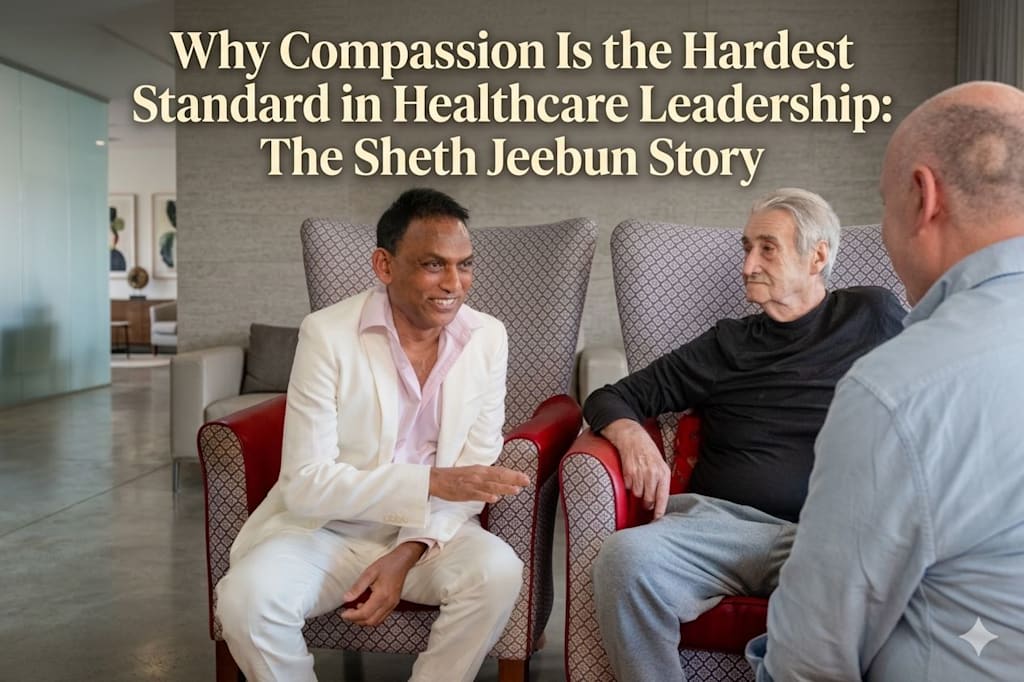
In business, leadership is often described with words like growth, scale, influence, and performance. In healthcare, those measures matter too, but they are not enough. The real test of leadership is much harder: whether the people in your care feel safe, respected, seen, and treated with dignity when they are at their most vulnerable.
That is what makes the story of Sheth Jeebun worth examining.
His professional journey did not begin in branding, boardrooms, or corporate strategy decks. It began in care. With a foundation in nursing and decades of work across the healthcare sector, his path reflects a model of leadership shaped not by distance from patients, but by proximity to them. That distinction matters. Leaders who begin at the human end of care often understand something others miss: healthcare is not only about systems working efficiently. It is about people being treated meaningfully.
This is one reason Sheth Jeebun’s career stands out. Over time, his work expanded from frontline care into leadership, operations, and organisation-building, yet the central idea remained consistent. Care should never become mechanical. It should remain personal, respectful, and rooted in dignity.
That belief is increasingly important in today’s care environment. Across the UK and beyond, healthcare leaders face rising pressure from staffing shortages, changing expectations, tighter regulation, cost challenges, and the growing need for high-quality elderly and specialist care. In that environment, it is easy for leadership to become reactive. It is easy to focus only on compliance, occupancy, efficiency, and expansion. But sustainable healthcare leadership requires something deeper: values that still hold under pressure.
Compassion is one of those values, and it is often misunderstood.
Many people speak about compassion as though it were a soft extra, something emotional rather than strategic. In reality, compassion in healthcare leadership is a discipline. It influences how teams are built, how standards are enforced, how families are communicated with, how environments are designed, and how residents or patients experience everyday life. Compassion is not the opposite of excellence. It is one of the conditions that makes excellence possible.
This is where Sheth Jeebun’s leadership philosophy becomes especially relevant. His work has consistently been associated with a people-first view of care, one that treats quality not as a checklist, but as an experience. Good care is not only clinically sound. It is calm. It is respectful. It protects dignity. It recognises that those receiving support are not cases to be managed, but human beings with histories, preferences, fears, and emotional needs.
There is also another layer to his story that makes it more compelling than a standard business profile. His work has not remained limited to healthcare alone. Publicly available profiles connect his name not only with care leadership, but also with wider themes of sustainability, ethical responsibility, and community impact. That broader vision suggests a leadership style built around long-term value rather than short-term visibility.
And that is a lesson more leaders should pay attention to.
Purpose-driven leadership has become a fashionable phrase, but it only has meaning when it survives real-world complexity. It has meaning when values continue to guide decisions after growth begins. It has meaning when organisations expand without losing their human centre. It has meaning when leadership is not just about being known, but about being trusted.
Trust is especially important in healthcare because families do not choose care providers casually. They choose them during emotional, stressful, and often life-changing moments. They are not simply buying a service. They are placing someone they love into the hands of other people. In that context, leadership is never abstract. It shapes culture, and culture shapes experience.
That is why leaders with a genuine care background often leave a deeper mark than those who approach healthcare purely as a business category. They understand that systems matter because people matter. They understand that dignity is not a slogan. It is a daily operational standard.
The Sheth Jeebun story, at its best, reflects that principle. It shows what can happen when leadership grows out of care rather than away from it. It suggests that the strongest organisations are not always those that speak most loudly about success, but those that remain grounded in service, responsibility, and the practical realities of improving lives.
In a world full of noise, that kind of leadership is rare.
And in healthcare, it may be the kind that matters most.
About the Creator
shoaib hikesol
Welcome to Writer Zone, a vibrant community for writers of all levels. Whether you're a budding author, seasoned novelist, or passionate blogger, Writer Zone offers a supportive environment to hone your craft.
Enjoyed the story? Support the Creator.
Subscribe for free to receive all their stories in your feed.
Comments
There are no comments for this story
Be the first to respond and start the conversation.