
The Salt in the Noodles
A Shanxi native’s hunch about heart disease, checked against the numbers that miss the worksite table
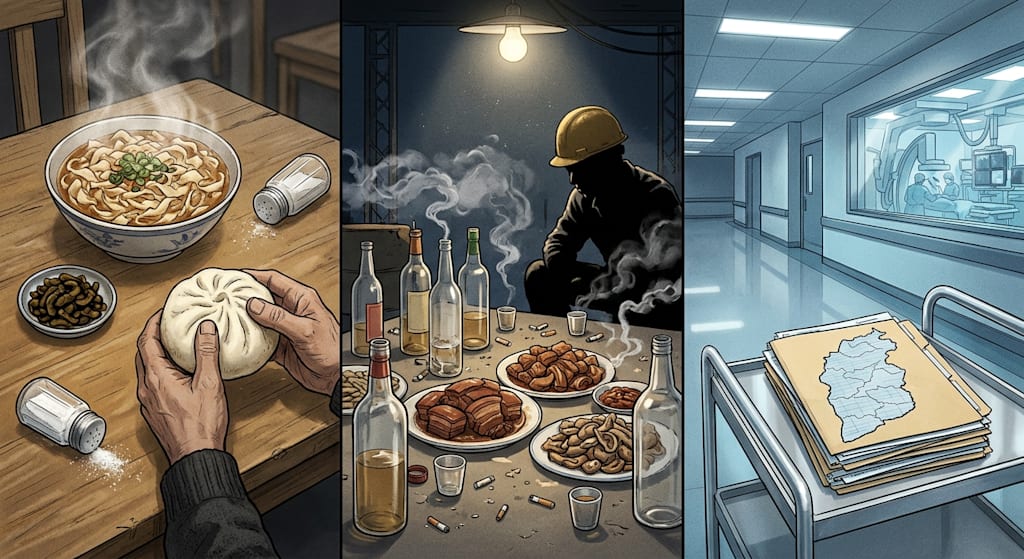
How much salt Shanxi residents actually eat is something the statistical yearbooks cannot fully capture. A 2020 report on chronic diseases and nutrition among Shanxi residents gives one number: average daily salt intake per person, 9.7 grams. Dietary guidelines recommend no more than 6 grams. The extra 3.7 grams does not appear in any meat-consumption ranking, but it shows up more reliably than meat at every meal.
Noodles do not clog arteries by themselves. The salt kneaded into a bowl of knife-cut noodles, the salty broth poured over them, and the pickles served alongside do. The same report puts average daily cooking oil at 34.8 grams per person, against a recommended upper limit of 25 to 30 grams. Insufficient vegetables and fruit, excessive meat, and salt and oil far above recommended levels: that is the most direct official summary of Shanxi’s dietary structure. Noodles are neutral. The problem is the salt and fat layered inside and around a bowl of noodles, repeated daily and yearly.
The old person’s bowl of porridge is not “light and healthy”
You observed that older people in Shanxi eat a bowl of porridge, a piece of steamed bread, and a bit of pickled vegetables, while people elsewhere would stir-fry at least two dishes. The observation is accurate. The conclusion should be reversed.
Pickles are the most typical vehicle for a high-salt diet. A study of older adults in the high-cold mountainous areas of northwestern Shanxi examined the relationship between eating high-salt pickles and the risk of hypertension. It listed high-salt pickles as one influencing factor for hypertension in that population. Porridge and steamed bread provide refined carbohydrates. Pickles provide sodium. High-quality protein and fresh vegetables are absent from the bowl. Another study in urban Taiyuan classified residents’ dietary behaviors. The “excessive cooking oil and salt” type accounted for 68.27%, far higher than the “smoking and drinking” type and the “healthy behavior” type. The old person’s porridge and pickles and the young person’s braised pork sit on the same line of high salt and high oil. They are not in two different worlds. Treating the elderly diet as “light and healthful” will miss the group most in need of intervention: the generation bearing the heaviest burden of hypertension and stroke.
Offal barely exists in the statistics
Your suspicion about that meat-consumption ranking is well founded. The reason is more fundamental than “older people are pulling down the average.”
The “per capita household meat consumption” in the national statistical yearbook counts meat purchased by households and eaten at home. Dining out, takeout, canteens, and worksite meals are not included. Animal offal, head and trotter meat, and blood products are not counted as “meat” in most meat consumption statistics. A young person who eats canteen food at a worksite, adds a portion of braised pork at a noodle shop at noon, and has sheep offal soup with flatbread at night may be recorded as “not eating much meat” under the household per capita meat consumption measure. The most active meat-eating behavior around you is simply not captured by that ranking. This is not a statistical blind spot unique to Shanxi, but Shanxi’s tradition of eating offal makes the blind spot especially large. That ranking cannot be used to argue that Shanxi people actually do not eat much meat.
On the worksite, diet occupies only one position among the variables
Research on the chronic disease burden in Shanxi identifies smoking and drinking as major behavioral risk factors. The coronary heart disease burden attributable to smoking ranks first among the four major chronic diseases. Smoking rates among Shanxi’s agricultural population are relatively high in relevant surveys. Drinking rates and male drinking rates are also higher than in some comparison provinces. The danger of heavy eating and drinking, staying up late, and smoking on a worksite is not in any single meal. Smoke damages vascular endothelium every day. Alcohol pushes up blood pressure and triglycerides every day. Staying up late deprives the body of metabolic repair every day. A high-salt, high-oil diet is the continuous background load in this combination, not the sole protagonist.
Taiyuan can perform bypass surgery, but that does not mean any doctor can do it
Taiyuan has the Shanxi Cardiovascular Hospital, a tertiary Grade A cardiovascular specialty hospital with about 1,000 open beds. It covers coronary intervention, coronary bypass, valve surgery, major vascular surgery, electrophysiology, and pacing. Shanxi Medical University First Hospital, Shanxi Bethune Hospital, and Shanxi Provincial People’s Hospital also have cardiovascular or cardiothoracic surgery departments. A patient with severe coronary heart disease does not have to consider leaving the province first for a bypass operation. That judgment holds.
Coronary bypass is cardiac surgery. Coronary stenting is an interventional procedure. They belong to different subspecialties, each with strict training qualifications and technical accreditation. A regional center having a team that can perform these operations does not mean every doctor in that hospital’s cardiovascular department is qualified to independently perform bypass or complex PCI. The sentence “any doctor can do it” would prompt any cardiac surgeon to ask: which doctor, which procedure, what annual case volume. A more accurate statement is this: Taiyuan concentrates Shanxi’s most mature cardiovascular specialty centers and surgical teams, and finding qualified people there is easier than in most prefecture-level cities in the province. Whether a particular doctor can perform a particular operation, and how well, depends on the hospital, the department, and the operator, not on the place name “Taiyuan.”
“Southern food is much healthier” also needs to be unpacked
Hypertension levels, blood lipid levels, and the prevalence of coronary atherosclerosis are higher in northern China than in the south. High sodium intake, a higher sodium-to-potassium ratio, and lower protein and calcium intake are considered important dietary factors explaining the north-south difference. Salty foods and red meat are more common in the north. Fish and vegetables are more common in southern diets. This pattern difference is reflected in regional differences in cardiovascular mortality. Your overall intuition has epidemiological support.
But “southern food” as a whole label erases the divisions within the south. Cantonese roast meat rice, Hunan rice noodles with cured meat, Sichuan-Chongqing hot pot with an oil dip, and steamed fish with greens can all be called southern food. Southern megacities also have high rates of dining out, late-night eating, and sugar-sweetened beverage consumption. These factors are simply obscured in the broad north-south contrast by the label “southerners eat fish and vegetables.” A more accurate formulation is this: southern dietary patterns on average contain more protective factors from fish and vegetables, while for a specific person, a specific meal, and a specific city’s eating-out environment, the north-south boundary is far less clear than the label suggests.
Move the attribution from taste to variables
The high incidence of cardiovascular disease in Shanxi does not need a moral story about noodles, meat, and offal to explain it. It is closer to a set of things existing at the same time: a base of 9.7 grams of salt and 34.8 grams of oil per day, high smoking and drinking rates, insufficient sleep and physical activity in part of the population, and quality medical resources highly concentrated in the provincial capital. No single variable alone explains everything. Their coexistence on the same land produces the proportion you see among relatives, friends, and on worksites.
The writing task is not to prove what Shanxi people are like. It is to lay out these coexisting variables one by one, so that readers can see that risk here comes from several habits at once: salt from pickles or noodle broth, meat eaten at home or on a worksite, tobacco and alcohol that never appear on the menu but are there every day.
About the Creator
Jin
Writer of reamstories
https://reamstories.com/jin
Enjoyed the story? Support the Creator.
Subscribe for free to receive all their stories in your feed. You could also become a paid subscriber, letting them know you appreciate their work.
Comments
There are no comments for this story
Be the first to respond and start the conversation.