
The Quiet Rise of “Pure Living”
Young people are cooking, saving, and skipping the self-optimization treadmill. The retreat is happening. So is the clarity.
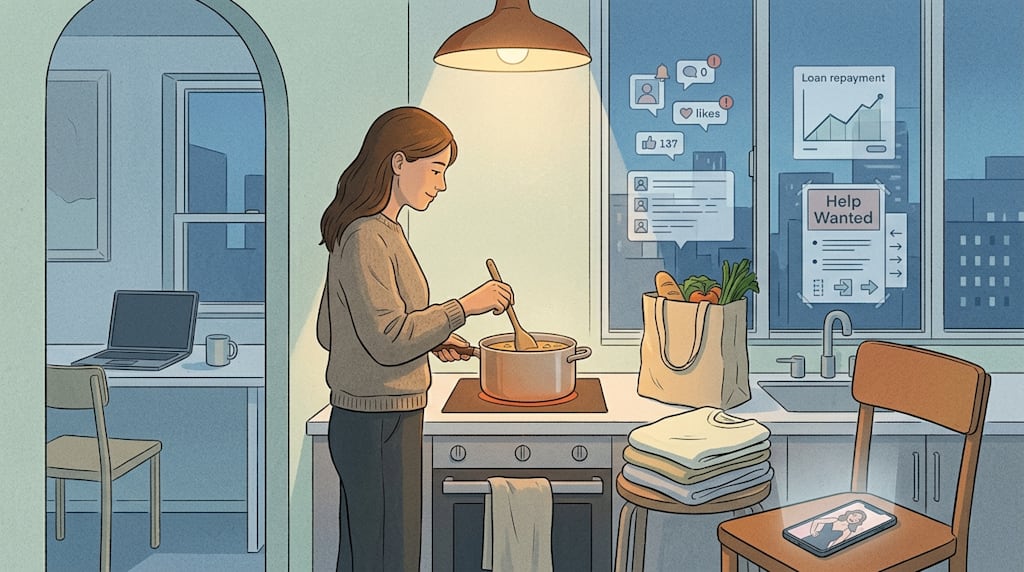
The phrase “pure living” has a strange pull. It describes nothing new: coming home and stewing whatever vegetables in the fridge are about to go bad; skipping the city on weekends; sleeping, airing out the quilt, clearing the desk. Eating because you are hungry. Tidying because the room feels better that way.
That life without grand meaning gives many people a long-lost ease.
The internet spent years turning everything into a self-optimization project. Emotions had to be stable. Cognition had to improve. Hobbies had to be displayable. Rest had to be efficient. Psychological vocabulary moved from a tool for understanding pain to a template for explaining everything. Boil an egg and someone asks where your people-pleasing and anxiety came from. Life sits on social media’s front stage, waiting to be shown and explained. You are not living; you are managing the image of living well.
Pure living appeals first because people are tired of performing. It does not promise you will become better. It promises you can stop proving yourself for a while.
Treat this only as a spiritual awakening, though, and you miss the hard ground underneath.
Households are repairing their balance sheets. In the first half of 2026, household loans posted their first half-year net decline on record. Household loans fell by 1.03 trillion yuan in the first eight months. New medium- and long-term loans dropped from more than 6 trillion yuan in 2021 to 18.8 billion yuan in the first eight months of 2026, close to zero. The share of residents who prefer more saving reached 62.9%. These numbers describe behavior under pressure. When asset prices fall and income feels uncertain, cutting debt and holding cash is the obvious move.
Employment adds its own constraint. There are 12.7 million college graduates in 2026. Youth unemployment for ages 16 to 24 is 14.9%, nearly four times the 4.0% rate for ages 30 to 59. Corporate loans flow into capital-intensive AI and green industries, where ten billion in financing can require only a few hundred people. Growth and jobs are separating. For many young people, not chasing big outcomes is less a choice than a response to how hard those outcomes have become to reach.
So yes, pure living includes forced contraction. It is adaptation to hard limits.
Being forced does not make a person passive.
When someone cannot control big outcomes, pulling energy back to eating, sleeping, cooking, and tidying rebuilds a minimum sense of autonomy. Self-Determination Theory says intrinsic motivation depends on three feelings: autonomy (I decide what to do), competence (I finish something and see the result), and relatedness (I have connections with others). When autonomy and competence weaken at the macro level, small chores create a micro-space where a person still has a say. Groceries get bought. Dinner gets cooked. The desk gets cleared. These tasks start and end. The result is visible. No one has to approve it.
That is why pure living feels lighter. It does not cut off meaning. It cuts off the requirement that meaning be certified by an external scoring system. Life used to need display, explanation, and a place in the become-a-better-self story. Now eating is about hunger, and tidying is about comfort. This is not giving up on life. It is taking back the power to define a good day from the leaderboard outside.
Women leaving the refined and strong-female-lead personas deserve attention here. One woman interviewed recalled spending more than half her monthly salary on other people’s eyes while living in a rented room with almost no savings. Canceling memberships, thinning the wardrobe, and cooking at home look like downgrading. They also cut a specific self-proof loop: no longer confirming your value by looking like you live well. Part of this is forced. Refined living has become expensive. Part of it is clarity. When refinement turns into performative labor that needs constant investment and maintenance, leaving it is a relief.
Consumer society does more than sell objects. It sells a moving standard of decent life: the house, the trip, the clothes, the restaurant, the weekend. In Work, Consumerism and the New Poor, Zygmunt Bauman argues that as society moves from producer to consumer, membership depends more and more on being a good consumer. Miss the standard and the feeling is not just “I cannot afford it.” It is “my life is not good enough” and “I am not successful enough.” A limit on spending becomes a verdict on the self.
Social media turns up the volume. People used to compare themselves with neighbors. Now someone else’s new apartment, trip, promotion, concert, and polished dinner are always on screen. Highlights from everyone nearby pile into a standard life that almost no one can sustain. Social comparison theory says people judge their abilities and position by comparing themselves with others. When value depends on outside evaluation for too long, life becomes a race with no finish line. What you get loses weight fast. New standards keep arriving.
Pure living offers a way out of the scoring system. It stops letting an external leaderboard decide what counts as a life worth living. It tries to build a standard closer to your own needs and pace. With attention back on your own rhythm, it gets easier to tell which goals come from interest and values and which come from pressure, guilt, or the inertia of “everyone else is doing this.”
So is this rational return or forced contraction?
It is both, and the order matters. Forced contraction came first. Rational return is the reconstruction of meaning that happens underneath it. When a person cannot change how reachable big outcomes are, directing energy toward small things they can finish acknowledges the constraint and preserves some agency inside it. It is not heroic. It is not empty. It says: if the distant places are out of reach for now, at least make the life in front of you your own.
There is a fork worth watching. If pure living becomes the only clear-eyed way to live, as if any pursuit beyond the everyday is consumerist brainwashing, it turns into value-based self-closure. If anti-consumption only moves time from shopping to short dramas and short videos, the capture changes from money to attention. Contraction can be a strategic retreat. It should not become the endpoint. Life does not need a demonstration to be legitimate, and meaning is not the opposite of getting by. Meaning is more like a base on a long trip where you rest and recover strength.
After caring about grain and vegetables, you can still care about the people around you, strangers, and the shared world. Not asking about meaning for a while does not stop curiosity, love, and ideals from calling again later.
What pure living admits is simple: not every stage is for charging forward. Sometimes cooking a meal, sleeping well, cleaning the room, paying down debt, and steadying the base of life is clarity enough. It is not giving up on money or meaning. In a period of high uncertainty, it is how you stay someone who can set out again.
First get stable. Then talk about the distant.
About the Creator
Jin
Writer of reamstories
https://reamstories.com/jin
Enjoyed the story? Support the Creator.
Subscribe for free to receive all their stories in your feed. You could also become a paid subscriber, letting them know you appreciate their work.
Comments
There are no comments for this story
Be the first to respond and start the conversation.