
The Overlooked Connection Between Gut Health, Microplastics, and Digital Overload
How three converging forces are reshaping human neurology — and why "trying harder" was never going to fix it.

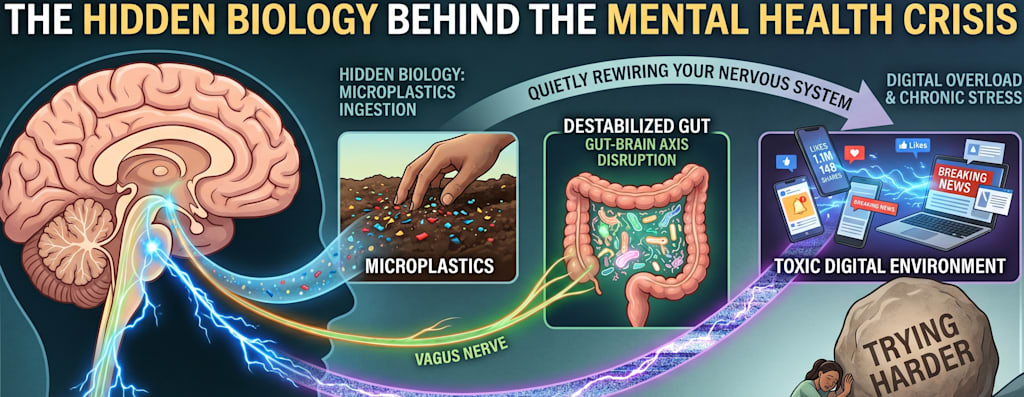
There is a particular kind of exhaustion that comes from being told, repeatedly, that you are the problem.
That if you just meditated more consistently. Journaled with greater intention. Put the phone down earlier. Ate cleaner. That if you tried harder at the business of being well, the brain fog would lift, the anxiety would quiet, the focus would return. Western mental health culture has spent decades handing people self-improvement frameworks for problems that are, in significant part, structural, environmental, and biological.
The science is catching up — and what it's revealing should change everything about how we talk about cognitive wellness.
The Gut Is Not a Metaphor
When ancient physicians spoke of "gut feelings" or described the stomach as the seat of emotion, modern medicine dismissed them as pre-scientific romantics. Researchers are now discovering they were more right than anyone knew.
The enteric nervous system — a dense network of roughly 500 million neurons lining the gastrointestinal tract — is so neurologically sophisticated that scientists have taken to calling it "the second brain." It produces approximately 90% of the body's serotonin and communicates bidirectionally with the central nervous system via the vagus nerve. Mood, cognition, inflammatory response, immune regulation — all of it traffics through this gut-brain axis in ways we are only beginning to map.
The conversation has matured well beyond "eat more yogurt for gut health." Researchers now understand that particular microbial species — Lactobacillus rhamnosus, Bifidobacterium longum, Faecalibacterium prausnitzii — are directly implicated in anxiety regulation, stress resilience, and neuroinflammatory processes (Cryan et al., Nature Reviews Neuroscience, 2019). Disruptions to these populations, through antibiotic overuse, ultra-processed food consumption, or chronic stress, correlate with measurable changes in mood and cognition.
Leaky gut — intestinal hyperpermeability — is no longer fringe terminology. When the tight junctions between intestinal epithelial cells degrade, bacterial endotoxins like lipopolysaccharide (LPS) enter the bloodstream. The immune system reads this as invasion. Systemic inflammation follows. And systemic inflammation is now one of the most consistent biological correlates of depression, anxiety, and cognitive decline (Miller & Raison, Nature Reviews Immunology, 2016).
This is not merely psychological distress. It is a biological cascade: intestinal breakdown, immune activation, systemic inflammation, and neurological consequence.
The Invisible Invasion: Microplastics and the Blood-Brain Barrier
Here is where the story becomes harder to sit with.
Microplastics — fragments smaller than 5 millimeters shed by the vast volume of plastic material now saturating the biosphere — have been detected in human blood, lung tissue, placental tissue, and, most alarmingly, brain tissue. A 2023 study in Environmental Health Perspectives found microplastic particles in the blood-brain barrier of deceased human subjects. A 2024 study in Nature Medicine found higher concentrations of nanoplastics in the brain tissue of people who died with dementia compared to those who did not (Nihart et al., 2024).
The blood-brain barrier is the central nervous system's last great defense — a selectively permeable membrane designed to block pathogens, toxins, and inflammatory signals from reaching neural tissue. Nanoplastics, measured in billionths of a meter, are small enough to breach it.
Once inside neural tissue, these particles do not simply remain inert. Acting like chemical sponges, they accumulate heavy metals, pollutants, and other toxic compounds — concentrating them within brain tissue itself. They may also interfere with the cellular energy systems neurons depend upon to function properly.
The immune dimension is equally concerning. Nanoplastics provoke microglial activation — the brain's primary immune response — triggering sustained neuroinflammation. Many particles carry bisphenol A and phthalates, endocrine disruptors that alter the hormonal signaling implicated in mood regulation, stress response, and neurodevelopment.
Children are particularly vulnerable. The developing brain is exquisitely sensitive to disruption during critical windows of neuroplasticity. Researchers are increasingly investigating whether environmental toxic exposure — including microplastics, endocrine disruptors, and industrial pollutants — may contribute to rising rates of neurodevelopmental and psychiatric disorders. While direct causation has not been established, the overlap between these trends and the timeline of accelerating plastic production has intensified scientific concern and calls for greater precautionary regulation.
Consider an ordinary childhood in an industrialized nation today: formula prepared in plastic bottles, food heated in plastic containers, tap water containing measurable microplastic concentrations, air carrying particulate plastic from synthetic textiles and tire wear. The question researchers are now pressing is not whether such exposures have zero biological consequence, but how significant that consequence is — and who bears the burden of proof.
We have, without consent or warning, run a global experiment on human neurodevelopment. The results are beginning to come in.
The Digital Environment as Neurotoxic Exposure
To speak of environmental neurotoxins without addressing the designed digital environment is to miss half the picture.
Social media platforms are not neutral communication tools. They are engagement-driven systems engineered to maximize attention retention by leveraging well-documented features of human psychology — including reward reinforcement, social comparison, and compulsive feedback loops. Former executives, whistleblower disclosures, and internal documents surfaced through congressional investigations have established that many of these dynamics were understood and built upon, not stumbled into.
The neurobiological consequences are not subtle. Chronic social media use is associated with elevated cortisol baseline, disrupted sleep architecture, reduced attention span, and measurable changes in adolescent prefrontal cortical development — the region responsible for impulse control, long-range planning, and emotional regulation (Twenge & Campbell, JAMA Pediatrics, 2019). This is not about teenagers lacking discipline. It is about a set of design choices whose neurological costs fall disproportionately on developing brains.
Here is the intersection that matters: chronic stress from digital overstimulation degrades the gut microbiome. Elevated cortisol suppresses beneficial microbial populations and promotes inflammatory species. Disrupted sleep — a well-documented consequence of evening screen exposure — reduces the glymphatic system's nightly clearance of neurotoxic metabolic waste, including amyloid-beta proteins associated with Alzheimer's disease.
The digital environment, the degraded gut, and the chemically contaminated physical environment do not operate in isolation. They form a mutually reinforcing system of neurological pressure. Each amplifies the damage of the others.
Why "Trying Harder" Was Never the Answer
The dominant cultural response to this convergence has been to place the burden of adaptation entirely on the individual. Practice mindfulness. Build better habits. Develop resilience. The implicit message: the environment is fixed, so you must be.
This is not only inadequate. It is, in a specific sense, dishonest.
Meditation alone cannot fully address a nervous system shaped by chronic inflammation, environmental toxic exposure, sleep disruption, and digital overstimulation. Journaling does not restore a microbiome degraded by years of antibiotic exposure and ultra-processed nutrition. Individual behavioral strategies have genuine value — but they are not commensurate tools for structural, environmental, and biological problems. They place the weight of systemic failure on individual shoulders and, when those individuals inevitably struggle, supply a ready-made explanation: they simply didn't try hard enough.
What the emerging science demands instead is a reframing at every level.
Biologically, it demands that we treat the gut-brain axis as a primary site of mental health intervention — not wellness adjunct, but clinical priority. Precision psychobiotics, anti-inflammatory nutritional protocols, and targeted interventions for intestinal permeability should be standard tools in the mental health clinician's kit.
Environmentally, it demands an honest reckoning with plastic production and its neurological costs. The regulation of PFAS, phthalates, bisphenol compounds, and the industrial practices that release microplastic into water and food systems are public health issues of the first order — not abstract ecological concerns.
Structurally, it demands that algorithmic media platforms be held to the same accountability we would apply to any industry whose product caused demonstrated neurological harm, particularly in children and adolescents. Regulation, transparency requirements, and design mandates are not censorship. They are public health.
The Body Remembers What the Culture Forgets
We are arriving, through neuroscience and molecular biology, at a truth many traditional healing systems never lost: that the mind is not separate from the body, that the body is not separate from its environment, and that disruption in one dimension reverberates through all the others.
The human nervous system evolved over hundreds of thousands of years alongside specific microbial ecosystems, sensory environments, and rhythms of light, darkness, and social connection. In the span of a few industrial generations, we have disrupted nearly all of these relationships simultaneously — and then expressed bewilderment at the epidemic of mental illness, cognitive dysfunction, and developmental disorder that followed.
The science is not delivering a counsel of despair. It is delivering something more demanding: specificity. It is telling us, with increasing precision, what went wrong and where — and pointing toward interventions genuinely commensurate with the scale of the problem.
But those interventions require us to stop locating the failure in the individual and start locating it where much of it actually lives: in the food systems, the chemical industries, the platform architectures, and the structural conditions that have made human neurological health collateral damage in the pursuit of profit.
Think of the child who has never known a morning without a screen, whose sleep has been fragmented by notifications since early adolescence, whose nervous system learned to regulate itself against a backdrop of algorithmic stimulation and ambient chemical exposure — and who is now told that the anxiety, the fractured attention, the low-level chronic dysregulation, is a personal failing. That child did not fail to be resilient enough. That child is responding, with biological precision, to the environment we built.
Your brain is not the problem. The environment your brain is trying to survive in — that's where the work begins.
The research on microplastic neurological impact is rapidly evolving. Studies cited represent the current frontier of a field where findings are actively being replicated and built upon. If you are experiencing symptoms of cognitive impairment, mood disorder, or neurological change, consult a qualified healthcare provider.
About the Creator
Khali Sollis
Khali Sollis is a writer and independent researcher exploring the science of the human mind and behavior. Her work examines questions at the intersection of neuroscience, psychology, cognition, mental health, and everyday human experience.
Enjoyed the story? Support the Creator.
Subscribe for free to receive all their stories in your feed.
Comments
There are no comments for this story
Be the first to respond and start the conversation.