
The Missing Nutrient Inside Your Anxious Brain
New neuroimaging research raises questions about choline concentrations in the anxious brain—and what that may mean for how we understand mental health from the inside out.

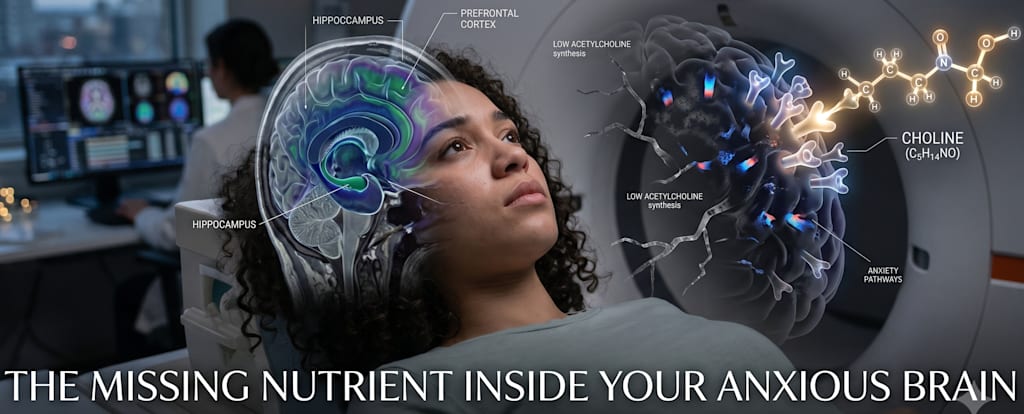
There is a region of your brain sitting just behind your forehead that, on a good day, makes you a functioning human being. It helps you concentrate during a difficult meeting, resist the urge to send a text you'll regret, and feel something like calm when the world gives you every reason not to. Scientists call it the prefrontal cortex. You might call it the part of you that holds everything together.
New research suggests that for millions of people living with severe anxiety disorders, that region may be operating under a distinct biochemical constraint—one that brain imaging is only beginning to make visible.
A systematic review and meta-analysis published in Molecular Psychiatry has identified a noteworthy pattern across 25 existing datasets, comparing neurometabolite levels between 370 patients with anxiety disorders and 342 controls. Using proton magnetic resonance spectroscopy (1H-MRS), researchers measured total choline (tCho)—a composite signal that reflects the concentration of choline-containing compounds in neural tissue. That signal is an indirect proxy for underlying neurochemistry: it can reflect membrane turnover and phospholipid metabolism rather than dietary choline availability alone. The authors interpreted the finding as evidence of reduced total choline, acknowledging that the signal implicates "changes in membrane dynamics or phospholipid metabolism" rather than a straightforward nutrient deficiency. Across the anxiety disorder subtypes included in the analysis—social anxiety disorder, generalized anxiety disorder, and panic disorder—tCho was approximately 8% lower in the prefrontal cortex among those with anxiety disorders compared to controls. In behavioral and neuroimaging research, an effect of this magnitude is generally considered moderate to large, meaning the difference observed was meaningful, not a statistical artifact at the margins of detection. Notably, the effect was observed across multiple anxiety disorders, suggesting that altered cortical choline metabolism may represent a transdiagnostic feature rather than a disorder-specific abnormality—a shared biological signature cutting across conditions that are otherwise clinically distinct.
These are meaningful numbers, but they come with important caveats. The underlying datasets are cross-sectional, meaning they capture a biological snapshot rather than tracking individuals over time. This design cannot establish whether lower tCho precedes anxiety, results from it, or reflects some shared underlying factor. The authors note that while reduced tCho in cortical regions has appeared in prior individual studies, this is the first meta-analysis to examine the pattern systematically across anxiety disorders. Replication in prospective designs will be essential before causal claims can be made.
What Is Choline, and Why Does It Matter Here?
Choline doesn't get the cultural airtime of vitamin D or magnesium, but in the architecture of the brain, it is load-bearing. It is a precursor to acetylcholine, one of the nervous system's primary neurotransmitters—the chemical signal that moves between neurons to support memory, attention, and voluntary muscle control. It also plays a structural role in cell membranes throughout the body, keeping neurons intact and communicating efficiently.
In the prefrontal cortex specifically, acetylcholine is not a minor player. It modulates the kind of top-down control that separates a measured response from a spiral—the cognitive braking system that lets you pause before reacting, assess a threat as manageable, and redirect your attention away from rumination. When that system is compromised, the downstream effects look a great deal like the symptoms of anxiety: difficulty concentrating, emotional dysregulation, hypervigilance, and an exhausting loss of what clinicians call executive function.
The new analysis takes that functional understanding and gives it a tentative physical address. Rather than a diffuse, whole-brain effect, the altered choline-related signal appears localized—concentrated in the region where the work of staying regulated actually happens.
Why This Shifts the Conversation
Mental health research has long grappled with a chicken-and-egg problem. Does anxiety disorder cause changes in the brain, or do underlying biological differences create conditions in which anxiety takes hold? The answer, most researchers now agree, is both—and the relationship is bidirectional. Chronic stress depletes neurological resources. Depleted resources make the brain more vulnerable to chronic stress. The cycle reinforces itself.
What makes this finding significant is that it identifies a measurable biological variable sitting inside that loop. The choline-related signal is something researchers can track, compare across populations, and test in future clinical studies. While no one in responsible science is suggesting that eating more eggs will cure an anxiety disorder, the identification of a specific neurochemical pattern in a specific brain region strengthens interest in nutritional neuroscience as a potential avenue for understanding anxiety disorders.
This matters because the dominant treatment paradigm for anxiety has relied heavily on pharmacological intervention—SSRIs, benzodiazepines, beta-blockers—alongside psychotherapy. These approaches have genuine value for millions of people. But they also have limitations: side effects, access barriers, the fact that a significant percentage of patients don't respond adequately to first-line treatments. If an altered choline-related MRS signal is a reproducible feature of certain anxiety presentations—and not simply an incidental or downstream artifact—then understanding the mechanisms behind that pattern could contribute to a more complete clinical picture.
It's worth situating choline within a broader biological context. Anxiety disorders are not the product of any single nutrient or molecule. They emerge from the intersection of inflammatory signaling, neurotransmitter regulation, stress physiology, sleep architecture, metabolic health, and genetic predisposition. Choline is one thread in a dense web. The significance of this finding is not that it identifies the cause of anxiety, but that it adds a biochemically specific data point to a conversation that has long needed more of them.
Critically, this finding does not establish that choline supplementation treats anxiety disorders or restores prefrontal function in affected individuals. No clinical trial evidence currently supports that conclusion. Whether blood or dietary choline levels reflect brain choline concentrations, and whether correcting a deficit produces meaningful symptom change, are open empirical questions.
The Prefrontal Cortex Under Pressure
To understand why an altered neurochemical signal in this particular region is worth paying attention to, it helps to appreciate just how much is being asked of the prefrontal cortex every day.
This is the region that handles working memory—keeping information active and usable while you're in the middle of a task. It regulates emotional responses by sending inhibitory signals to the amygdala, the brain's alarm system, telling it when a perceived threat doesn't require a full emergency response. It supports cognitive flexibility, helping you shift strategies when a situation changes rather than getting locked into one pattern of thinking. And it governs impulse control, the quiet, constant work of not reacting to every stimulus your environment throws at you.
People with anxiety disorders often describe a system that has gone haywire in precisely these areas. The alarm goes off and won't stop. Concentration dissolves under the weight of intrusive thought. Emotional responses feel disproportionate and difficult to pull back from. Decision-making becomes exhausting. These are not character flaws. They are, at least in part, neurological events—and the choline-signal data suggests that some of those events may have a neurochemical dimension that has been systematically underexamined.
What We Don't Yet Know
Science earns trust through restraint, and intellectual honesty requires naming the limits of this research. A single analysis, however rigorous, is a beginning. It generates hypotheses more than it closes questions.
We don't yet know whether choline supplementation in individuals exhibiting reduced cortical tCho produces measurable improvement in executive function or symptom severity. We don't know whether the deficit is a cause, a consequence, or a marker of some third factor. We don't know how this finding interacts with genetic differences in choline metabolism, since some individuals carry variants that affect how efficiently the body produces and uses choline endogenously. We don't know whether the pattern holds uniformly across different anxiety disorder subtypes—generalized anxiety, panic disorder, social anxiety, and OCD are related but distinct conditions.
What we do know is that the prefrontal cortex is producing a distinct choline-related signal in people who are suffering, and that the neurochemical territory in question is one we have real knowledge of and real means to study further. That is not a small thing.
A Different Way of Thinking About Mental Nutrition
There is a cultural tendency to separate mental health from physical health—to treat the brain as a psychological space rather than a biological organ with metabolic needs. That separation has always been scientifically untenable, but it persists in how we talk, how we treat, and how we fund research.
The brain is roughly two percent of body weight and consumes roughly twenty percent of the body's energy. It requires a continuous supply of oxygen, glucose, and a long list of micronutrients to maintain the electrochemical signaling that is thought and feeling and consciousness. When those inputs are insufficient—whether due to diet, absorption problems, metabolic irregularities, or the depletion that comes from chronic stress—the organ underperforms. Not always dramatically. Sometimes subtly. Sometimes in ways that look exactly like anxiety.
The emerging science of nutritional psychiatry is beginning to map those connections with the precision that earlier researchers could only approximate. Iron and dopamine synthesis. Omega-3 fatty acids and inflammatory signaling in the brain. Magnesium and NMDA receptor function. Vitamin B12 and myelin integrity. And now: a choline-related neurochemical signal in the prefrontal cortex that may prove relevant to understanding how regulation and executive control become disrupted in anxiety disorders.
None of these connections suggest that mental illness is simply a matter of eating the right foods. The biology of psychiatric conditions is complex, multifactorial, and still being understood. But the idea that the brain's nutritional environment is irrelevant to its function—or irrelevant to suffering—is no longer defensible.
What This Might Mean Going Forward
For clinicians, the research raises the possibility that nutritional assessment should become a more routine part of evaluating anxiety disorders, particularly severe presentations that haven't responded well to conventional treatment. Choline status isn't currently a standard lab panel. Perhaps it should be discussed.
For researchers, this finding invites clinical trials: what happens when choline-deficient individuals with anxiety disorders receive targeted supplementation? Does prefrontal function improve? Do symptoms shift? Do brain scans look different six months later?
For individuals navigating anxiety—which is to say, for a very large number of people—the science offers something more grounded than either false hope or reflexive dismissal. It suggests that the biological underpinnings of how you feel are real and increasingly measurable. It does not suggest that choline is a cure, that supplements are the answer, or that dietary changes will resolve a clinical disorder. It suggests that your brain is an organ, that organs have metabolic needs, and that studying those needs rigorously is not a fringe pursuit but a necessary one.
The prefrontal cortex is working hard to hold things together for you. The least science can do is pay closer attention to what it needs.
The information in this essay is intended for general educational purposes and should not be taken as medical advice. Anyone experiencing anxiety symptoms should consult with a qualified healthcare provider.
Source: Smucny J, et al. "Transdiagnostic reduction in cortical choline-containing compounds in anxiety disorders: a 1H-magnetic resonance spectroscopy meta-analysis." Molecular Psychiatry, 2025. nature.com/articles/s41380-025-03206-7
Effect size for the primary finding: Hedges' g = −0.64 for cortical tCho across anxiety disorder subtypes.
About the Creator
Khali Sollis
Khali Sollis is a writer and independent researcher exploring the science of the human mind and behavior. Her work examines questions at the intersection of neuroscience, psychology, cognition, mental health, and everyday human experience.
Enjoyed the story? Support the Creator.
Subscribe for free to receive all their stories in your feed.
Comments
There are no comments for this story
Be the first to respond and start the conversation.