
The Architecture of the Maintenance Persona
How People Learn to Confuse Being Needed With Being Loved

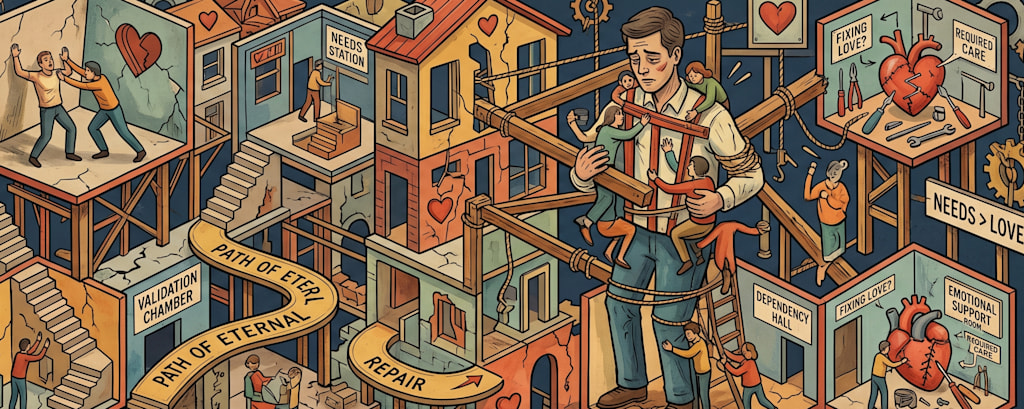
Every dysfunctional system eventually identifies its unofficial support structure.
Not through formal agreement. Through behavioral repetition.
One person becomes responsible for emotional equilibrium. Another for anticipation. Another for preventing escalation before escalation occurs. Over time, these responsibilities stop feeling optional. They become identity.
You stop asking: Who am I?
And start asking: What still collapses if I stop managing it?
This is the Maintenance Persona. A self-concept built around preventing failure in surrounding systems. And the dangerous part — the part that makes it so difficult to dismantle — is that maintenance work is rewarded inconsistently enough to create psychological dependency. Sometimes gratitude. Sometimes praise. Sometimes temporary peace. Sometimes simply the absence of conflict.
The nervous system interprets all of it as evidence that self-sacrifice is operationally necessary.
So the maintenance expands.
The Blueprint
Every structure follows a logic, and the Maintenance Persona is no different. Understanding the architecture is not the same as being free of it — but it is the prerequisite.
The blueprint is almost always drawn in response to a specific environmental condition: unpredictability. Not cruelty, necessarily. Not even neglect in the conventional sense. The defining feature of the environment that produces a Maintenance Persona is that calm is intermittent and its conditions are unclear. Safety arrives and then recedes. The emotional climate shifts without obvious cause. Think of the oldest child who learns to read a parent's footsteps on the stairs — heavy and slow means something is wrong, and something needs to be done before the door opens. You cannot predict when stability will hold and when it will fracture — but you begin to notice, very early, that your behavior seems to influence the probability.
This is the foundational discovery. Not that the world is unsafe. That the world's safety is, at least partially, a function of you.
From that discovery, a particular kind of child develops a particular kind of attention. Hypervigilant. Externally directed. Finely calibrated to the emotional states of the people around them. This attention is not a disorder — it is an adaptation. An entirely rational response to an environment where reading the room correctly has consequences. But it is also an attention that, once developed, does not easily turn inward. Because inward means unguarded. And unguarded means the room goes unread. And an unread room, the nervous system insists, is a dangerous room.
The blueprint, then, is this: Monitor outward. Regulate inward. Repeat until self and function become indistinguishable.
How Roles Calcify
There is a concept in family systems theory called role differentiation — the process by which individuals in a system come to occupy distinct, complementary functions. Healthy families do this too. But in healthy systems, roles remain permeable. People can step outside them. The parentified child can sometimes just be a child. The peacemaker can sometimes express a conflict. The caretaker can sometimes be cared for.
In dysfunctional systems, roles calcify. They harden from behaviors into identities, and identities into expectations, and expectations into obligations that no one formally assigned but everyone implicitly enforces.
The person who has always handled the emotional temperature of family gatherings will be looked to, automatically and without acknowledgment, to handle it again this year. The colleague who has always absorbed friction between departments will continue to absorb it, not because anyone asked, but because the role has become invisible infrastructure — present enough to rely on, invisible enough that no one thinks to redistribute it.
What makes this particularly insidious is that the person occupying the role often participates in its calcification. They show up early. They preempt the conflict. They smooth the exit from the difficult conversation. Not because they are required to, but because the anxiety generated by not doing so has become intolerable. The role has trained them to maintain the role.
This is the self-reinforcing loop at the heart of the Maintenance Persona: the more reliably you perform the function, the more the system structures itself around your performance, and the more catastrophic stepping back feels — not just to others, but to you.
The Intermittent Reward Problem
Behavioral psychology has long understood that intermittent reinforcement — reward that arrives unpredictably rather than consistently — produces stronger behavioral conditioning than reliable reward does. It is the mechanism behind gambling. Behind certain patterns of romantic attachment. And behind the Maintenance Persona.
The maintenance worker does not receive consistent gratitude. That would actually be easier to metabolize — and easier to eventually assess as insufficient. Instead, they receive gratitude sometimes. Recognition occasionally. The warm, specific acknowledgment that what they do matters — but only enough times, and at enough irregular intervals, to keep the behavior running.
The nervous system does not experience this as exploitation. It experiences it as evidence. Each instance of gratitude becomes proof that the labor is seen. Each instance of peace becomes proof that the management worked. The partner who defuses the tension at dinner and watches the table relax — that moment of relief is not nothing. It registers. It reinforces. Each absence of conflict becomes proof that vigilance is necessary, because when vigilance lapses — and sometimes it does — something goes wrong, and the nervous system files that as confirmation of what it already suspected.
I am the variable. My presence is the difference between stability and chaos.
This belief does not require the person to be arrogant. It is often held with tremendous self-effacement — not I am powerful, but I am responsible. Not I control everything, but I cannot stop trying. The grandiosity, if it exists at all, is inverted. It lives in the catastrophizing: what falls apart without me, rather than what I can build.
The Invisible Contract
Every system that relies on a Maintenance Persona has, embedded within it, an unspoken contract. The terms are rarely articulated — because articulation would require acknowledgment, acknowledgment would require renegotiation, and renegotiation might destabilize the arrangement entirely.
The contract reads, roughly, as follows:
You will manage what is difficult. We will not ask you to. We will not thank you consistently. We will, however, rely on the results. In exchange, you will receive belonging. You will receive necessity. You will receive the particular security of being the person without whom things fall apart. This is not love, exactly. But it will feel adjacent to it, and you will not always be able to tell the difference.
The tragedy of the invisible contract is not that it is exploitative — though it often is. It is that the person performing the labor often signed it willingly. Because at the time, the exchange felt fair. Because at the time, being necessary felt like enough. Because at the time, they did not yet know what it would cost to be only that.
The contract does not come with an expiration date. It does not include provisions for exhaustion, growth, or the emergence of needs the person didn't previously know they had. It is written for the person they were at seven, or twenty-two, or the first week of a new job — and it runs indefinitely, renewed automatically, without review.
What the System Does When You Stop
At some point — through therapy, or exhaustion, or love, or simply the slow accumulation of evidence that the arrangement is not sustainable — the Maintenance Persona begins to withdraw from the contract.
This is when the system reveals its architecture most clearly.
Systems that have been organized around a central support structure do not respond to its withdrawal with gratitude, or with reorganization, or with the sudden discovery of their own capacity. They respond, almost universally, with pressure. Sometimes explicit: You've changed. You used to be easier. You're being selfish. I don't know what's gotten into you. Sometimes implicit: the wounded silence, the escalating crisis, the conspicuous inability to manage what was always managed before.
This pressure is not always malicious. Frequently it is unconscious — the system genuinely does not know how to function without its load-bearing element, and the distress is real. But the effect is the same regardless of intent. At exactly the moment they most need evidence against the belief, the system appears to confirm it: Without me, this collapses.
And some things do collapse. That is the part that is important to say clearly and without softening: some things do fall apart when the Maintenance Persona stops maintaining. Some relationships cannot survive the redistribution of labor. Some family systems lack the underlying resilience to function without the unofficial regulator. Some workplaces will, in fact, become more chaotic.
The question is not whether things will be harder. The question is whether harder now is preferable to unsustainable indefinitely.
The Difference Between Care and Compulsion
The Maintenance Persona is not defined by caring about other people. Caring about other people is not pathological. It is one of the more valuable things a person can do.
The Maintenance Persona is defined by the inability to stop — which is a categorically different experience from the choice to continue.
The distinction lives in the body, if you know to look for it. Care that comes from genuine desire has a quality of expansion — you move toward the person or the situation, and something in you opens toward it. Compulsion has a quality of contraction — you move toward it because the alternative has already generated anxiety, and the movement is less about wanting to help than about needing to stop the internal alarm.
Most people carrying the Maintenance Persona have, over time, lost reliable access to which one is operating. The two have blurred. They care, genuinely, about the people they maintain. And they cannot stop maintaining, compulsively, even when care is absent. The feelings fuse together over time. Separating them requires sustained attention to internal experience — precisely the kind of attention the architecture trained them away from.
This is one reason recovery is not a simple matter of deciding to stop. The behavior is not held in place by choice. It is held in place by a nervous system that learned, across years of intermittent reinforcement, that vigilance is survival. Deciding to stop is necessary. It is also insufficient.
The Moment of Reorientation
There is a particular moment that people in recovery from the Maintenance Persona often describe — not a breakthrough, exactly, but a reorientation. A shift in the quality of attention.
It happens when they notice the internal alarm activating and, for the first time, do not immediately act on it. They feel the pull toward management. They watch someone struggle with something they could easily resolve. They notice the anxiety rising. And then they wait.
And in that waiting — which can be deeply uncomfortable, which can feel nearly unbearable — they make a discovery: the alarm is not the same thing as a fact. It is a very old, very efficient mechanism. But it is running on old data, from a time when danger was real and constant action was required. It has not been updated to reflect a present in which other people are, in fact, capable of managing their own experience.
Waiting does not mean indifference. It means pausing long enough to ask: Is this mine to carry? Do I actually want to carry it? What happens if I don't?
Sometimes the answer is yes, and they carry it — freely, with the particular lightness that comes from chosen labor. Sometimes the answer is no, and they don't — and they find that the world does not, in fact, end. That other people rise to meet what they were previously never required to meet. That the system, deprived of its unofficial support, locates capacities it never knew it had.
And sometimes things do fall apart. And even then, they are still standing. Which is, it turns out, the most important evidence of all.
A Final Note on Structure
The Maintenance Persona is not a character flaw. It is not weakness. It is not even — and this is worth saying slowly — dysfunction in the self.
It is a functional response to a dysfunctional structure. It developed because it worked. It persists because it continues to work, at the cost of the person it works through.
The goal of understanding the architecture is not to dismantle care. It is to locate choice inside it. To know, at each moment, whether you are giving because you want to or managing because you are afraid — and to understand that you have, in fact, the right to tell the difference.
That right was always there. It was just never pointed out to you.
The structure that organized itself around your labor did not do you a favor by needing you.
It simply found, in you, someone who had already learned to say yes.
The work now is learning that no is also available. That it was always available. That the people and systems around you are more capable of bearing their own weight than the original conditions led you to believe.
And that you — the actual you, not the function — are allowed to find out what remains when you stop holding everything else up.
The architecture was built around your absence. It is time to begin inhabiting the space.
About the Creator
Khali Sollis
Khali Sollis is a writer and independent researcher exploring the science of the human mind and behavior. Her work examines questions at the intersection of neuroscience, psychology, cognition, mental health, and everyday human experience.
Enjoyed the story? Support the Creator.
Subscribe for free to receive all their stories in your feed.
Comments
There are no comments for this story
Be the first to respond and start the conversation.