
The Alchemical Brain — How Trauma Can Reshape Creative Cognition
Trauma, neuroplasticity, and the complex relationship between survival and creativity.

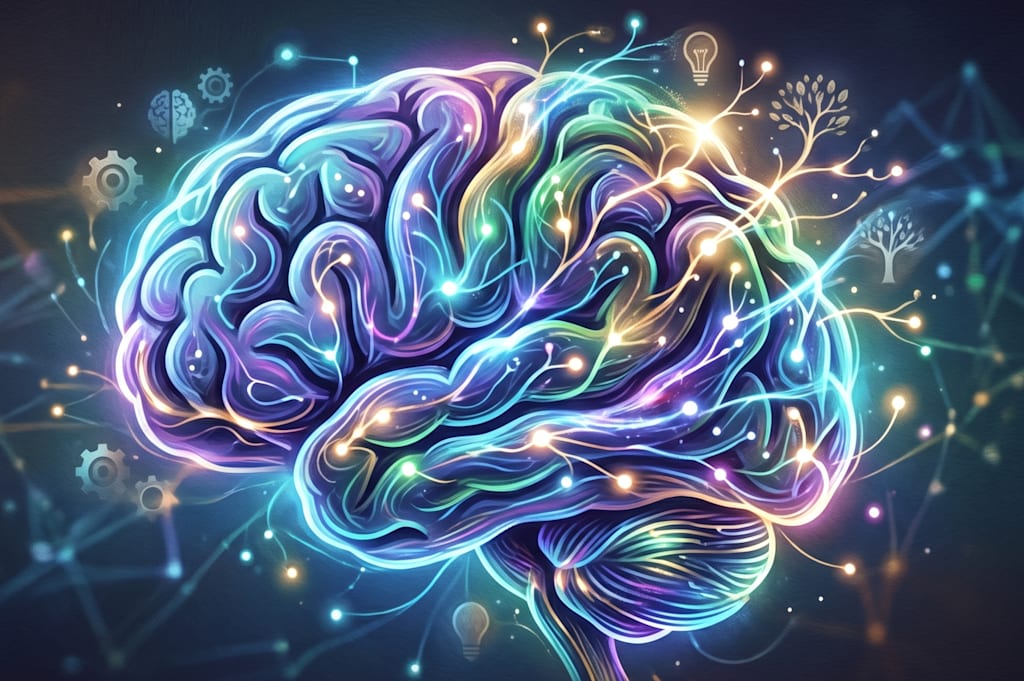
In neuro-architecture — the study of how physical environments influence cognition and emotion — we examine how external structures shape internal states. The most profound architectural shifts, however, may occur within the brain itself — not through deliberate design, but through significant disequilibrium.
The Default Mode Network and Altered Connectivity
In a neurotypically developing brain, the Default Mode Network (DMN) — associated with self-reflection, narrative thinking, and internal simulation — activates primarily during rest and quiets during focused tasks. In individuals who have experienced prolonged trauma, emerging research suggests this network may be significantly altered. Some studies have observed disrupted coordination between the Default Mode Network, salience network, and executive-control systems — potentially contributing to persistent internal monitoring, altered attentional filtering, and heightened sensitivity to environmental cues.
Some researchers have hypothesized that, in certain individuals, these adaptations may later contribute to unusual forms of associative thinking once safety and integration are established. The relationship, however, remains an active area of investigation. In practical terms: a child who once learned to detect subtle shifts in tone, posture, or emotional atmosphere for safety may later find that same sensitivity expressed through art, writing, music, or storytelling.
Trauma does not inherently reorganize cognition toward creativity. However, some researchers have suggested that certain adaptations associated with chronic vigilance may, in some individuals, support forms of associative thinking that conventional development rarely demands.
The Costs Cannot Be Separated From the Adaptations
The same adaptations that may contribute to unusual associative thinking often carry substantial costs. The writer who perceives emotional subtext with unusual precision may also find a crowded room overwhelming. The musician whose ear catches what others miss may struggle to quiet that same sensitivity enough to sleep. Hypervigilance, attentional fragmentation, emotional overwhelm, and chronic physiological stress can impair creativity as often as they enhance it. Trauma is also associated with disrupted memory consolidation, reduced cognitive flexibility, depression, and anxiety — none of which are minor footnotes. Any creative advantages that do emerge arise not from trauma itself, but from how an individual eventually integrates and reorganizes around those experiences — a process that is neither automatic nor guaranteed.
Biological Necessity vs. Aesthetic Choice
For many, creative work is a deliberate practice or aesthetic pursuit. For the survivor, it often functions closer to a cognitive necessity — a mechanism for integrating experiences that resisted coherent narrative formation at the time they occurred. The poem written at 2am is not always a stylistic choice; sometimes it is the only available container for something that has no other form.
Where art is sometimes approached primarily through form and technique, people whose nervous systems developed under chronic stress are frequently driven toward synthesis and meaning-making: the compulsion to extract structure from experiences that refused to resolve. This may explain why certain artists produce work that functions less as entertainment and more as transmission — offering listeners and readers a container for their own fragmented experiences. A lyric that seems to describe one thing and mean another. A novel whose tension lives entirely beneath the surface. A painting that feels like it already knows you.
They function, in a psychologically meaningful sense, as translators of internal states that language alone often struggles to carry.
Conclusion
The same systems once organized around survival may eventually become systems capable of extraordinary synthesis. But this does not mean trauma is a gift. No form of suffering is required for creativity, and many creative minds emerge from stable and nurturing environments. Yet human neurobiology possesses a remarkable capacity for transformation. Under certain conditions, systems built for survival can become systems for insight. The vigilance once used to anticipate danger may become the ability to perceive connections others miss. Not because trauma improves the brain, but because the brain remains capable of reorganizing itself long after the original threat has passed.
About the Creator
Khali Sollis
Khali Sollis is a writer and independent researcher exploring the science of the human mind and behavior. Her work examines questions at the intersection of neuroscience, psychology, cognition, mental health, and everyday human experience.
Enjoyed the story? Support the Creator.
Subscribe for free to receive all their stories in your feed.
Comments
There are no comments for this story
Be the first to respond and start the conversation.