
Shaving Women’s Heads in the Streets
20,000 women were stripped and humiliated in front of the public…

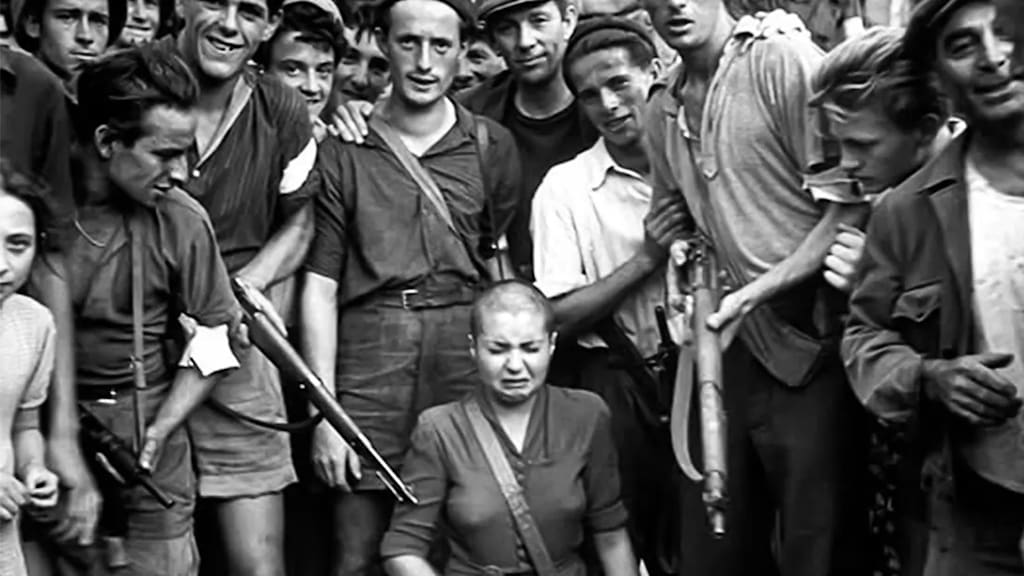
Shaving Women’s Heads in the Streets
20,000 women were stripped and humiliated in front of the public…
After a war, the world generally focuses on victory, defeat, and political changes. But behind these big headlines, there are human suffering stories that are often ignored.
One such story came to light after the Second World War—a dark chapter that showed how easily justice can turn into cruelty.
In many parts of Europe, especially in countries recently freed from occupation, an estimated 20,000 women were accused of having relations with enemy soldiers. What was their crime? Relationships—whether real or just based on suspicion.
What followed was not justice, but a punishment meant solely for humiliation, degradation, and destruction.
A Punishment Designed to Humiliate
In cities and towns, people would gather in public places. Women were dragged out of their homes, often without any evidence or trial.
Their heads were forcibly shaved—this was a symbolic act meant to strip them of their honor, identity, and femininity.
But for many women, this humiliation did not end there.
They were paraded through the streets, sometimes half-dressed or completely naked, while people shouted at them, spat on them, and targeted them with hatred.
Their bodies became symbols of society's anger.
All of this was done openly, not in secret.
The purpose was clear: to make an example of them.
The Psychology of Collective Anger
War leaves deep scars not just on the land but also on the human mind. After years of fear, oppression, and occupation, anger accumulates within people, which comes out in some form or the other.
When freedom was achieved, people had to blame someone.
These women became easy targets.
The military or high officials often fled or went into hiding, but these women were visible—vulnerable, helpless, and within the circle of blame.
But the reality was often far more complex than that.
Some relationships were forcibly established, some were just attempts to survive, and some were based on genuine human emotions. Meanwhile, in many cases, the accusations were based only on rumors, jealousy, or personal enmity.
But at that time, no one cared about the truth.
The crowd wanted not the truth but relief.
When justice turns into oppression
The most frightening thing about this incident is that it erases the line between justice and revenge.
There was no formal trial. There was no investigation. There was no opportunity for defense.
The punishment was immediate and irreversible.
For many women, its effects lasted a lifetime. The shaved heads remained their identity for months. Their honor was destroyed. Some lost their families, homes, and future—everything.
Even after their hair grew back, the notoriety did not end.
Thus, society created a new form of oppression in the name of justice.
Silence and Forgotten Stories
For decades, these events remained buried in silence.
These women rarely shared their stories. Shame, fear, and social pressure kept them quiet. History also ignored them, focusing only on war victories and political changes.
But silence cannot erase the truth.
In recent years, historians have begun to bring these stories to light again, presenting these women as human beings—not merely as symbols of accusation.
A Look at Human Nature
This incident forces us to ask some difficult questions.
What happens when anger overpowers compassion?
How easily can society justify cruelty?
And ultimately, who decides justice?
It was not just punishment but an attempt to restore order after power, control, and chaos.
But it also revealed a dangerous aspect of human nature—that we can harm others when driven by anger and fear.
Its Importance in Today's Era
Although these events are part of the past, their lessons are still alive today.
Even today, public humiliation, mob mentality, and making decisions without knowing the full truth exist—only the form has changed. Now all of this happens on social media.
History teaches us that justice should not be based solely on emotions.
It is necessary for it to include justice, evidence, and humanity.
Final Word
The story of these 20,000 women is not just about the past but also serves as a warning for the future.
It reminds us that in difficult times, the line between right and wrong can become blurred. And even in moments of victory, a person can lose their humanity.
The most important thing is that we should ask questions—not just what happened, but why it happened.
Because the answers to these questions help us prevent such events from happening again.
About the Creator
Mohib Ullah
I write about crime, justice, and political affairs, focusing on real cases and current events. My goal is to deliver clear, research-based content that informs readers about law, society, and government systems.
Enjoyed the story? Support the Creator.
Subscribe for free to receive all their stories in your feed.
Comments
There are no comments for this story
Be the first to respond and start the conversation.