
Pediatric Interventional Cardiology Market 2026–2034: Advancing Life-Saving Heart Care for Children
Rising congenital heart disease cases, minimally invasive procedures, and technological innovation are driving growth in pediatric cardiac interventions.

Pediatric Interventional Cardiology Market: Transforming Pediatric Heart Care
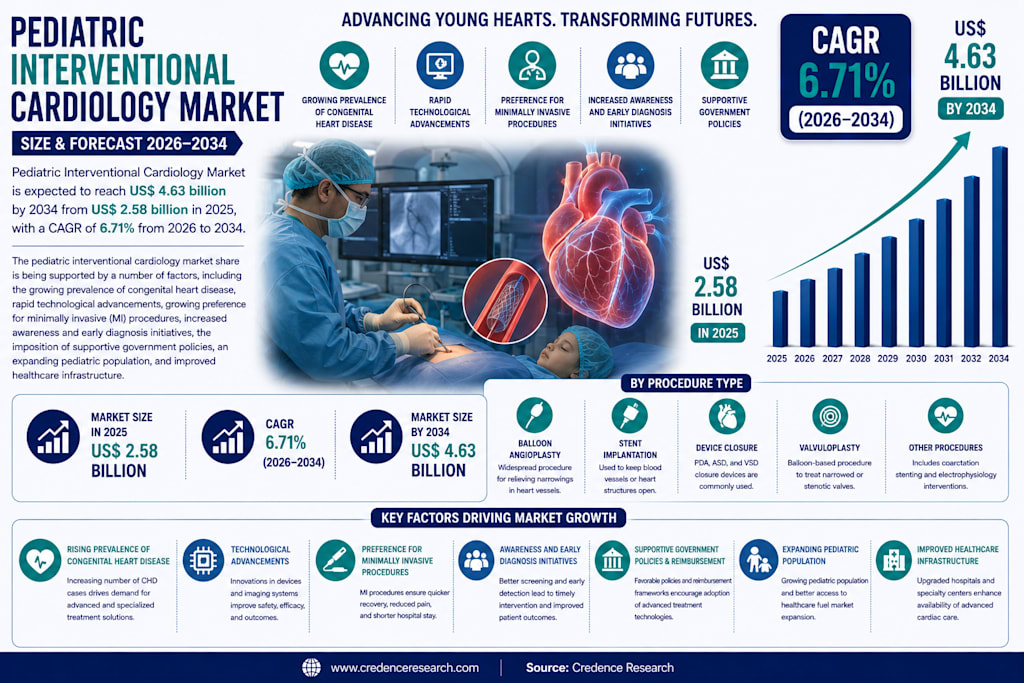
The global healthcare industry is witnessing significant advancements in pediatric cardiac care, with minimally invasive techniques playing a central role. According to Renub Research, the Pediatric Interventional Cardiology Market is projected to grow from US$ 2.58 billion in 2025 to US$ 4.63 billion by 2034, expanding at a CAGR of 6.71% from 2026 to 2034.
This growth reflects a shift toward safer, less invasive procedures that improve outcomes for infants, children, and adolescents with heart conditions. As awareness, diagnosis, and treatment capabilities improve, this specialized field is becoming increasingly important in modern healthcare systems.
What Is Pediatric Interventional Cardiology?
Pediatric interventional cardiology focuses on the diagnosis and treatment of congenital and acquired heart conditions in children using catheter-based, minimally invasive procedures instead of open-heart surgery.
These procedures address conditions such as:
- Septal defects (holes in the heart)
- Valve abnormalities
- Vascular obstructions
Key tools and devices used in these procedures include:
- Catheters and guidewires
- Balloons and stents
- Occlusion devices
- Implantable heart valves
These technologies allow cardiologists to perform complex interventions with greater precision, reduced recovery time, and lower risk compared to traditional surgery.
Key Growth Drivers Fueling the Market
Increasing Prevalence and Early Diagnosis of Congenital Heart Disease
One of the most important drivers of market growth is the rising prevalence of congenital heart disease (CHD) and improvements in early diagnosis.
Advancements in prenatal screening, fetal echocardiography, and neonatal diagnostics enable early detection of heart defects, allowing timely intervention and improved outcomes.
Additionally:
- Increased awareness among parents and healthcare providers
- Improved survival rates of infants with cardiac conditions
- Expanded screening programs
are contributing to a growing patient population requiring interventional procedures.
Technological Advancements in Devices and Imaging
Innovation in medical devices and imaging technologies is significantly enhancing the capabilities of pediatric cardiology.
Recent advancements include:
- Specialized stents and occluders designed for small anatomies
- Implantable valves that accommodate patient growth
- 3D imaging and mapping technologies for precise guidance
These innovations improve procedural safety, accuracy, and long-term outcomes, encouraging wider adoption of minimally invasive techniques.
Expansion of Specialized Pediatric Cardiac Centers
The growth of dedicated pediatric cardiac centers is another major factor driving the market. Hospitals are investing in advanced catheterization labs and specialized care teams to handle complex cases.
Key benefits include:
- Higher procedural success rates
- Improved patient safety
- Access to multidisciplinary expertise
Training programs and medical education initiatives are also increasing the availability of skilled interventional cardiologists, further supporting market expansion.
Market Segments Driving Demand
Device Types: Core of Interventional Procedures
The market includes a range of specialized devices designed for pediatric use:
- Catheters and guidewires: Essential for navigating blood vessels
- Stents and balloons: Used to open narrowed vessels
- Closure devices: Used to seal heart defects
- Transcatheter valves: Advanced solutions for valve replacement
Each device plays a critical role in enabling minimally invasive procedures tailored to pediatric patients.
Procedures: Expanding Treatment Options
Pediatric interventional cardiology procedures include:
- Congenital heart defect correction
- Catheter-based valve implantation
- Angioplasty
- Coronary thrombectomy
These procedures reduce the need for open-heart surgery, offering faster recovery and improved patient comfort.
End Users: Hospitals Lead the Market
Hospitals and specialized pediatric cardiac centers are the primary end users of interventional cardiology devices and procedures.
Ambulatory surgical centers and specialty clinics are also emerging as important contributors, providing efficient and accessible care for selected procedures.
Regional Insights: Global Market Trends
United States: Leading Innovation and Adoption
The United States is a major market for pediatric interventional cardiology, supported by advanced healthcare infrastructure, specialized centers, and technological innovation.
High awareness, early diagnosis, and access to cutting-edge treatments drive strong adoption in this region.
Germany: Advanced Healthcare and Research
Germany’s market benefits from a robust healthcare system and strong emphasis on clinical research and innovation. Early diagnosis and advanced imaging technologies support high-quality care.
India: Emerging Growth Potential
India’s market is expanding rapidly due to increased awareness, improved healthcare infrastructure, and rising demand for minimally invasive procedures.
However, challenges such as high device costs and limited access in rural areas remain.
United Arab Emirates: Growing Healthcare Investments
The UAE is witnessing steady growth in pediatric cardiology, supported by advanced healthcare facilities and government initiatives.
Medical tourism and increasing healthcare expenditure are also contributing to market expansion.
Challenges Facing the Market
Limited Pediatric-Specific Devices and High Costs
Developing devices specifically for pediatric patients is complex and expensive due to smaller anatomies and the need to accommodate growth.
The relatively small patient population further limits economies of scale, making it challenging for manufacturers to invest in innovation.
Regulatory and Reimbursement Barriers
Strict regulatory requirements and complex approval processes can delay the introduction of new devices.
Additionally, reimbursement challenges may limit access to advanced procedures, particularly in regions with less developed healthcare systems.
Competitive Landscape
The market includes major players such as Abbott Laboratories, Boston Scientific Corporation, General Electric, Medtronic, Siemens AG, and Cardinal Health Inc.
These companies are focusing on:
- Development of pediatric-specific devices
- Advanced imaging technologies
- Strategic collaborations and acquisitions
- Expansion into emerging markets
Final Thoughts
The pediatric interventional cardiology market is a highly specialized yet rapidly growing segment of the healthcare industry. With projections reaching US$ 4.63 billion by 2034, the market reflects increasing demand for safer, more effective treatments for children with heart conditions.
The future of this market will be shaped by continued innovation, improved access to care, and advancements in minimally invasive technologies.
As healthcare systems prioritize early diagnosis and patient-centered treatment, pediatric interventional cardiology will continue to play a vital role in improving the lives of children worldwide—offering hope, healing, and a stronger foundation for the future.
About the Creator
Enjoyed the story? Support the Creator.
Subscribe for free to receive all their stories in your feed.
Comments
There are no comments for this story
Be the first to respond and start the conversation.