
New Royal Navy Ancilia Decoy Launcher Passes Operator Trials: A Major Upgrade in British Naval Defence
The Royal Navy's next-generation Ancilia decoy launcher has received positive feedback from electronic warfare specialists, marking an important step towards improving protection against modern anti-ship missile threats.
Introduction
The Royal Navy has taken an important step towards strengthening the protection of its warships after its new Ancilia trainable decoy launcher successfully completed operator trials in Devon, England. The next-generation system is designed to improve how British naval vessels respond to incoming missile threats by deploying defensive countermeasures more accurately and efficiently.
On November 17, 2026, the Royal Navy announced that four electromagnetic warfare specialists had tested the new launcher and its control systems over two days. Their feedback was positive, with operators describing the technology as a significant improvement over the existing equipment.
The development is part of Britain's wider effort to modernise naval electronic warfare capabilities and prepare its fleet for increasingly sophisticated threats.
What Is the Ancilia Decoy Launcher?
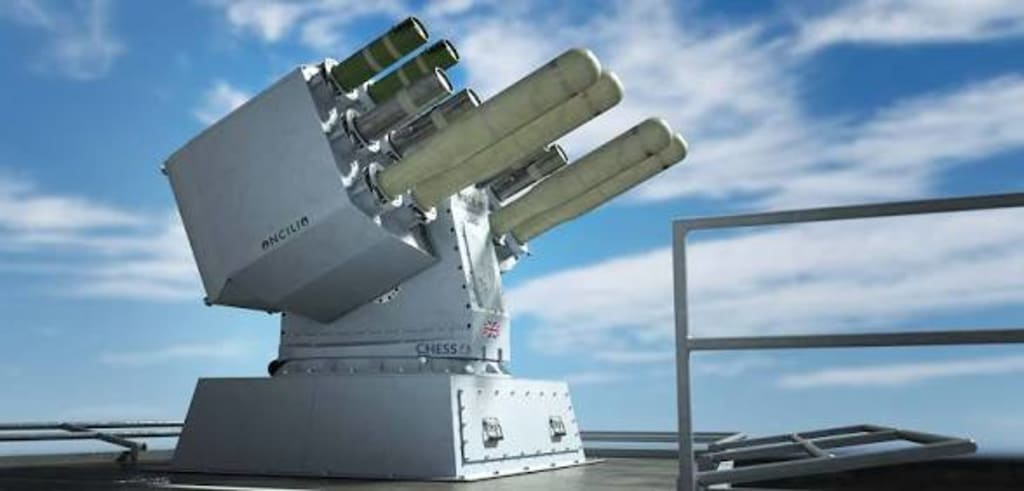
Ancilia is a trainable naval decoy launcher developed by British defence company Systems Engineering & Assessment (SEA), based in Barnstaple, Devon.
Unlike traditional fixed launchers, which are installed at a particular angle, Ancilia can rotate and adjust its firing direction to respond to different threats.
This flexibility is important because modern anti-ship missiles can approach naval vessels from different directions. A ship needs to respond quickly without unnecessarily changing its own course.
The launcher is designed to deploy 130mm countermeasure rounds, including chaff, smoke and infrared flares. These defensive materials can confuse or distract certain types of incoming missiles, making it more difficult for them to identify and follow their intended targets.
Ancilia is therefore an important part of the Royal Navy's soft-kill defence capability.
Successful Operator Trials in Devon
The latest trials took place at SEA's facilities in Barnstaple, where four Royal Navy electromagnetic warfare specialists examined the launcher and its operating interfaces.
The specialists came from the Fleet Operational Sea Training organisation, the Joint Electronic Warfare Operational Support Centre and the Electromagnetic Warfare Training Element at HMS Collingwood.
During testing, operators assessed how easily they could control the equipment from the ship's operations room and from a local control panel positioned near the launcher.
They also tested the equipment under different lighting conditions and while wearing protective equipment.
These conditions included anti-flash clothing, chemical, biological, radiological and nuclear protective gloves, respirators and protective eyewear.
The purpose was to determine whether sailors could operate the equipment effectively in challenging operational environments.
The feedback suggested that the new interface would make operating and maintaining the system easier for naval personnel.
Why Trainable Launchers Are Important
One of the biggest advantages of Ancilia is its ability to change direction.
Older fixed launchers have limitations because their firing direction is restricted by their installation position. This can create additional demands on a ship's navigation and defensive manoeuvres.
Ancilia offers greater flexibility by allowing the launcher itself to turn towards the required direction.
This means a warship can deploy defensive countermeasures without having to position itself specifically to align fixed launchers with an approaching threat.
The ability to respond from different directions could become increasingly valuable as naval forces face more complex missile environments.
However, decoys are only one element of a warship's overall defence. They work alongside radar, electronic warfare equipment, missiles, guns and other protective systems.
Protection Against Modern Missile Threats
Anti-ship missiles represent a serious challenge for modern naval forces.
Some missiles use radar guidance, while others rely on infrared sensors to identify and track targets.
Chaff can create misleading radar reflections, while infrared flares are designed to attract heat-seeking missiles away from a vessel. Smoke and other countermeasures can also contribute to confusing particular targeting systems.
The effectiveness of any decoy depends on the missile's guidance technology, the operational environment and the defensive system's ability to deploy the appropriate countermeasure.
Ancilia's trainable design is intended to improve the accuracy and flexibility of this process.
It does not make warships immune to missile attacks, but it provides another important layer of protection.
£135 Million Investment in British Naval Technology
The Ancilia programme is supported by a £135 million contract awarded to SEA in March 2024.
The agreement covers the supply of 38 trainable decoy launchers for Royal Navy warships, with installations planned across the Type 26, Type 31 and Type 45 fleets.
The programme also supports Britain's domestic defence industry by involving specialist engineering and technology companies.
The investment demonstrates the importance of improving naval protection as military technology continues to evolve.
It also supports skilled employment and advanced engineering capabilities in the United Kingdom.
Which Royal Navy Warships Will Receive Ancilia?
The new launcher is intended for three important classes of Royal Navy surface combatants.
The Type 45 destroyers provide advanced air-defence capabilities and protect British naval forces from aerial threats.
The Type 26 frigates are designed primarily for anti-submarine warfare, while the Type 31 frigates will provide flexible general-purpose naval capabilities.
Equipping these ships with modern trainable decoy launchers will help establish a more consistent countermeasure capability across the Royal Navy's major escort fleet.
The programme is part of a wider Maritime Electronic Warfare Programme that also includes improvements to electronic warfare sensors and command systems.
The Future of Royal Navy Electronic Warfare
The successful operator trials represent an encouraging development, but further integration, testing and preparation are necessary before the system becomes fully operational across the fleet.
The open architecture design is another important feature. It is intended to allow future countermeasure technologies to be integrated as requirements change.
This could help the Royal Navy adapt to new threats without replacing the entire launcher system.
Modern naval defence increasingly depends on combining sensors, software, electronic warfare and physical countermeasures.
Ancilia represents one part of that wider technological transformation.
Conclusion
The successful operator trials of the Royal Navy's Ancilia decoy launcher mark an important milestone in Britain's naval modernisation programme.
With improved directional flexibility, modern control interfaces and compatibility with existing countermeasure rounds, the system is designed to strengthen the defensive capabilities of British warships.
As the Royal Navy prepares for increasingly complex maritime security challenges, technologies such as Ancilia will play an important role in protecting sailors and maintaining the operational effectiveness of the fleet.
The positive feedback from operators in Devon suggests that this new generation of naval defence equipment is moving in the right direction.
About the Creator
Enjoyed the story? Support the Creator.
Subscribe for free to receive all their stories in your feed.
Comments
There are no comments for this story
Be the first to respond and start the conversation.