
Japan Diabetes Devices Market Size, Share, Trends, Growth, and Forecast 2026–2034
Aging Population, Smart Monitoring Systems, and Rising Adoption of Advanced Diabetes Care Devices Are Reshaping Japan’s Market

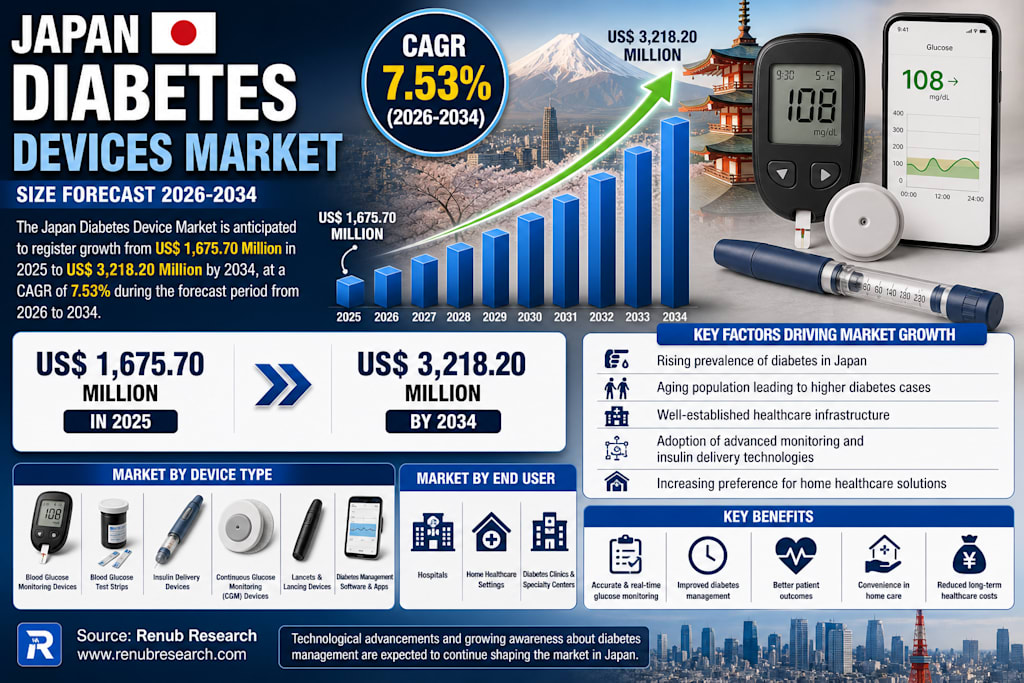
Japan’s diabetes devices market is moving into a strong expansion phase, supported by an aging population, rising diabetes prevalence, and the country’s deep acceptance of advanced medical technologies. According to Renub Research, the market is expected to grow from US$ 1,675.70 million in 2025 to US$ 3,218.20 million by 2034, reflecting a CAGR of 7.53% during 2026–2034.
This growth is being shaped by a healthcare environment that strongly favors preventive care, early diagnosis, and continuous disease management. In Japan, diabetes devices are no longer seen as optional tools; they are becoming a necessary part of long-term chronic care.
Japan Diabetes Devices Market Outlook
Diabetes devices are used to monitor blood glucose levels, improve insulin delivery, and support better diabetes self-management. The market includes self-monitoring blood glucose meters, continuous glucose monitoring systems, insulin pens, insulin pumps, and glucose test strips. These devices are important because they help patients maintain better glucose control and reduce the risk of complications such as cardiovascular disease, neuropathy, and kidney-related disorders.
Japan offers a highly favorable environment for these devices because of its world-class healthcare infrastructure, widespread insurance coverage, and strong patient awareness. Doctors in the country increasingly recommend glucose monitoring and insulin delivery solutions, while patients are generally willing to adopt advanced healthcare technologies when they improve convenience, precision, and outcomes.
Key Growth Drivers
1. Aging Population and Higher Diabetes Burden
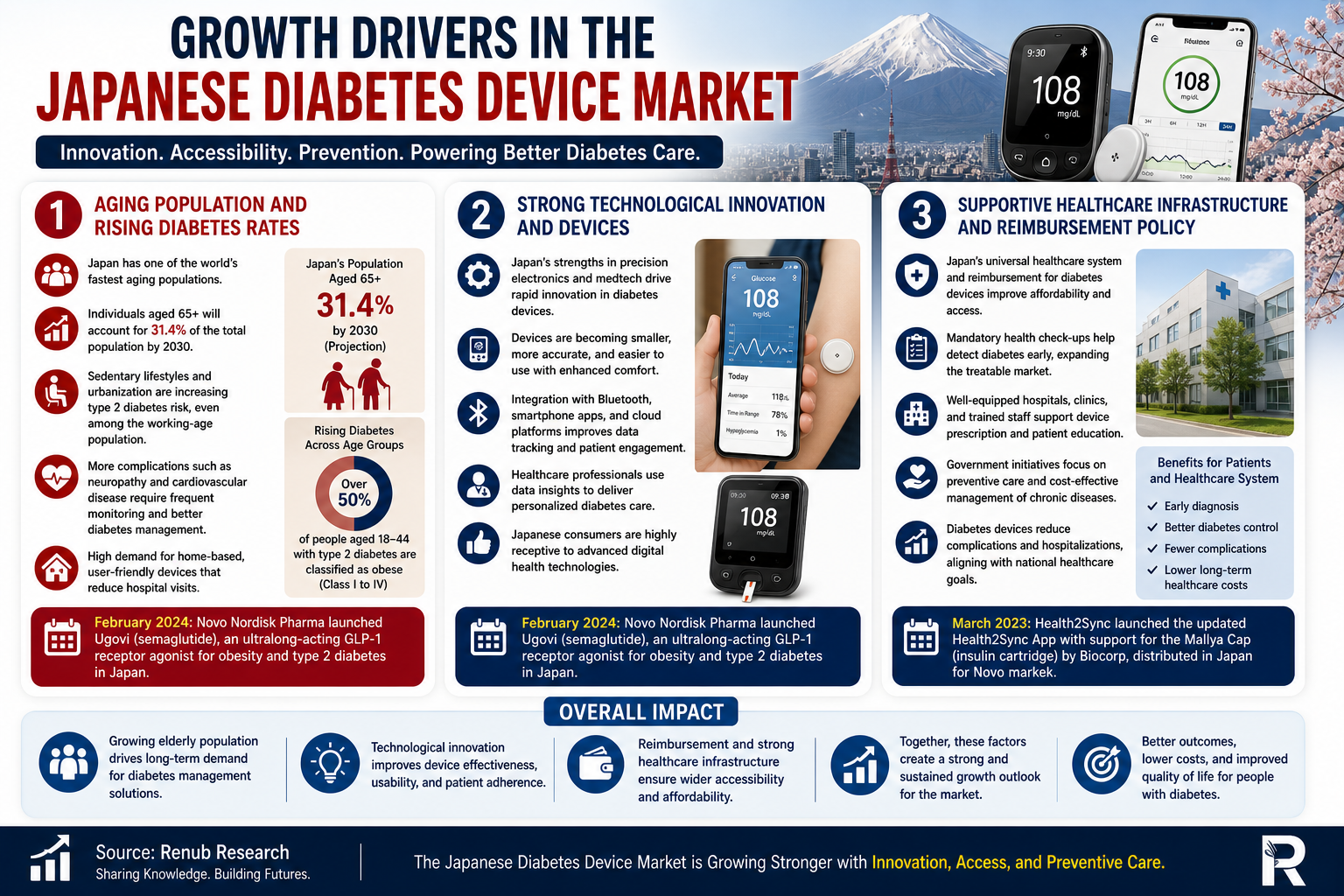
Japan is one of the fastest-aging countries in the world, and this demographic trend is one of the biggest forces behind market growth. Older adults are more likely to develop type 2 diabetes because of reduced physical activity, metabolic changes, and associated conditions such as obesity and hypertension. The file notes that individuals above 65 years are projected to account for a very large share of the population by 2030.
This creates strong demand for easy-to-use devices that help patients monitor glucose levels at home, reduce hospital visits, and manage complications more efficiently. Continuous monitoring solutions and smart insulin devices are especially important for elderly users who need more frequent support.
2. Strong Technological Innovation
Japan’s medical device sector is supported by its highly developed precision electronics industry. This gives local and global manufacturers a strong base for innovation. Devices are becoming smaller, more accurate, more user-friendly, and more connected.
The adoption of Bluetooth-enabled devices, smartphone apps, cloud-based data storage, and remote sharing tools is improving patient compliance and making treatment more personalized. This is particularly relevant in a market like Japan, where users often value reliability, quality, and technological sophistication.
3. Supportive Healthcare Infrastructure and Reimbursement
Japan’s universal healthcare system is a major advantage for diabetes device adoption. Reimbursement support for glucose meters and insulin delivery systems helps improve affordability and increases patient access. Regular health checkups also improve the chances of early diagnosis, which expands the addressable patient pool.
Hospitals and clinics in Japan are also well-equipped to introduce patients to advanced diabetes care technologies. This combination of access, reimbursement, and clinical support continues to support long-term market growth.
Market Challenges
1. High Pricing Pressure
Even with reimbursement support, pricing remains a major concern. Japan tightly regulates medical device pricing to control healthcare costs. For manufacturers, this creates a difficult balance between innovation and profitability, especially for advanced products such as CGMs and insulin pumps that require significant research and development investment.
2. Strict Regulatory Approval
Japan’s regulatory environment is known for being rigorous. While this helps ensure patient safety and product reliability, it also means new diabetes devices may take longer to reach the market. Companies must comply with detailed documentation, local testing, and clinical evidence requirements, which can increase cost and delay launches.
Segment Analysis
Self-Monitoring Blood Glucose (SMBG) Devices
SMBG devices continue to hold a stable position in Japan. They are widely used by type 2 diabetes patients, people on oral therapy, and those who prefer traditional monitoring systems. These devices remain important because they are familiar, accessible, and often more affordable than newer technologies.
Innovation in this segment is focused on smaller meters, faster test strips, greater precision, and smartphone connectivity. Even with the growth of CGM, SMBG remains a core part of diabetes care in Japan.
Continuous Glucose Monitoring (CGM) Devices
CGM is one of the fastest-growing segments in the Japanese diabetes devices market. These systems provide real-time glucose data and reduce the need for repeated fingerstick testing. They are particularly valuable for patients with type 1 diabetes, insulin-intensive type 2 diabetes, and those who experience hypoglycemia.
Patients and physicians value CGM because it offers continuous insight into blood sugar patterns, helps improve time-in-range performance, and supports better treatment decisions. The integration of mobile and cloud platforms is further strengthening adoption.
Insulin Pump Devices
The insulin pump segment is smaller than SMBG or CGM, but it is becoming increasingly important for patients who need precise basal-bolus management. Demand is driven by advanced glucose control needs, better algorithms, and integration with CGM systems.
Hybrid closed-loop systems are likely to play a bigger role in the future. However, adoption depends on patient education, product training, and cost considerations.
Insulin Pen Devices
Insulin pens are one of the most widely accepted devices in Japan because they offer convenience, accuracy, and easier use compared with traditional vial-and-syringe methods. They are especially useful for elderly patients and home-based diabetes management.
The market is seeing growing interest in smart pens that offer memory functions, dose tracking, and connectivity features. These technologies help both patients and healthcare professionals improve adherence and treatment monitoring.
Distribution Channel Insights
Hospital Pharmacies
Hospital pharmacies remain one of the most important distribution channels in Japan. Many patients begin treatment or switch products through hospitals and specialist clinics. Hospital pharmacies also play a critical role in education, training, and post-prescription support.
This channel is especially important for CGM systems and insulin pumps, where patient onboarding and technical guidance are essential. Manufacturers often depend on hospital relationships to build trust and secure product adoption.
Online Pharmacies
Online pharmacies are becoming more important, especially for recurring purchases of test strips, lancets, needles, and other consumables. Patients increasingly value convenience, home delivery, and simple reordering, particularly in urban areas and among working households.
This channel also fits well with Japan’s growing digital health ecosystem. As connected devices become more common, online pharmacies will likely become even more relevant for chronic-care management.
Regional Perspective
Tokyo
Tokyo is the most advanced and valuable diabetes devices market in Japan. The city has a strong concentration of specialist hospitals, academic centers, and private clinics that are early adopters of CGM, insulin pumps, and smart insulin pens. Patients in Tokyo also tend to be more digitally aware and more comfortable with app-connected health solutions.
Saitama
Saitama benefits from its role as a major residential area around Tokyo. The market here is shaped by commuters, seniors, and families seeking affordable, easy-to-use diabetes devices. Community hospitals and pharmacies play a larger role than large specialist centers.
Shizuoka
Shizuoka has a mix of urban and rural healthcare needs. The market is driven by aging residents and a growing focus on home care and self-management. SMBG and insulin pens remain important, while CGM adoption is slowly increasing.
Competitive Landscape
The Japanese diabetes devices market is competitive and innovation-led. Major companies operating in this space include Abbott Laboratories, Roche, Medtronic, Novo Nordisk A/S, Terumo Corporation, Eli Lilly, BD, and Dexcom Inc. These players are focusing on digital integration, product improvement, and patient-friendly design to strengthen their positions in the market.
Recent Developments from Leading Companies
Abbott expanded its glucose monitoring portfolio with more advanced sensor-based diabetes solutions.
Dexcom strengthened its CGM offerings with enhanced accuracy and extended wear features.
Medtronic continued advancing automated insulin delivery systems and pump technology.
Novo Nordisk launched Ugovi Subcutaneous Injection in Japan in February 2024, an ultralong-acting GLP-1 receptor agonist used in obesity and type 2 diabetes care.
Roche improved its diabetes monitoring ecosystem with more connected device features.
Terumo focused on user-friendly insulin delivery solutions for Japan’s aging population.
BD strengthened smart injection and insulin management products.
Eli Lilly expanded its diabetes portfolio with updated therapeutic options.
Health2Sync launched an updated app in March 2023 with support for the Mallya Cap developed by Biocorp and distributed in Japan by Novo Nordisk.
Biocorp deepened its presence in Japan through connected insulin accessory partnerships.
Future Market Direction
The future of Japan’s diabetes devices market will be shaped by digital healthcare, remote monitoring, personalized treatment, and stronger patient engagement. Devices that combine accuracy, convenience, and connectivity will be the most successful in the years ahead.
CGM adoption is expected to rise further, insulin pumps will become more sophisticated, and insulin pens will continue to remain essential for home care and senior patients. As healthcare delivery becomes more preventive and data-driven, diabetes devices will play an even bigger role in chronic disease management.
Final Thoughts
Japan’s diabetes devices market is entering a high-growth phase with strong fundamentals. The combination of an aging population, advanced healthcare infrastructure, and increasing use of smart medical technologies is creating sustained demand across SMBG, CGM, insulin pump, and insulin pen segments.
Although pricing pressure and regulation remain key challenges, the outlook is highly positive. Companies that deliver reliable, connected, and patient-friendly solutions will be best positioned to benefit from Japan’s evolving diabetes care landscape. With growing demand for home-based management and digital health integration, the market is expected to remain one of the most attractive healthcare device segments in the region.
About the Creator
Enjoyed the story? Support the Creator.
Subscribe for free to receive all their stories in your feed.
Comments
There are no comments for this story
Be the first to respond and start the conversation.