
Intraocular Lens Market 2026–2034: Premium Vision Care Is Reshaping Cataract Treatment
Rising cataract cases, aging populations, and advanced lens technologies are pushing the global intraocular lens market into a new phase of growth.

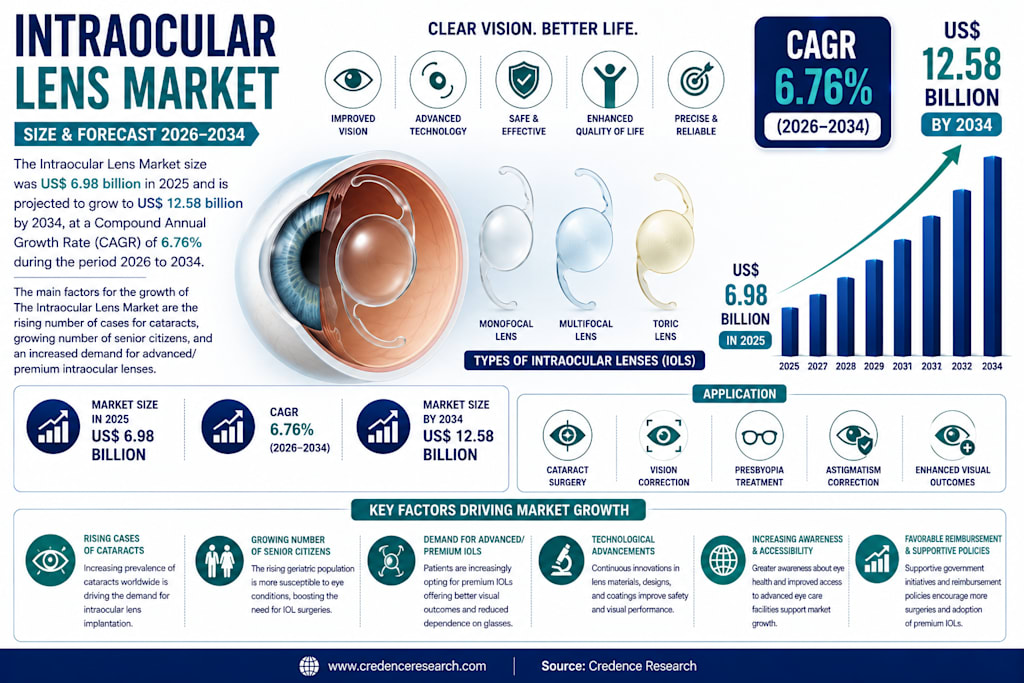
Intraocular Lens Market: A Clearer Future for Vision Care
The global Intraocular Lens Market is on a strong growth path, supported by increasing cataract prevalence, a rising elderly population, and growing demand for premium vision correction solutions. According to Renub Research, the market was valued at US$ 6.98 billion in 2025 and is projected to reach US$ 12.58 billion by 2034, expanding at a CAGR of 6.76% during 2026 to 2034.
This is not just a story about eye surgery. It is a story about how healthcare systems, medical innovation, and patient expectations are coming together to redefine vision restoration. Intraocular lenses, or IOLs, are now central to cataract surgery and refractive correction, helping millions of people regain clearer sight and better quality of life.
What Intraocular Lenses Do
An intraocular lens is a small artificial lens implanted inside the eye after the natural lens becomes cloudy due to cataracts. It helps restore vision by focusing light properly onto the retina. While cataract surgery remains the primary use, IOLs are also used in refractive lens exchange procedures for conditions such as myopia, hyperopia, and presbyopia.
The market includes several lens types, each designed for a specific vision need. Monofocal lenses are the most widely used, but multifocal, toric, and accommodative IOLs are gaining traction as patients look for better visual outcomes and less dependence on glasses.
Why the Market Is Growing
Rising Cataract Burden and Aging Population
The strongest driver of this market is the growing number of cataract cases worldwide. Cataracts are strongly linked to aging, and as life expectancy increases, more people require cataract surgery.
The file notes that in 2026, cataracts accounted for nearly 45% of global blindness, affecting 15.2 million people, and 39% of moderate to severe visual impairment, impacting about 78.8 million people. The burden rises sharply with age, increasing from 3.9% among people aged 55–64 to 92.6% among those aged 80 and above.
That alone explains why the IOL market has such a long runway. Cataract surgery is among the most common surgical procedures in the world, and every successful procedure requires an artificial lens. As more people age into the high-risk group, the demand for IOLs naturally rises.
Premium and Advanced IOL Adoption
A second major growth driver is the shift toward premium lenses. Patients today are more informed and more willing to pay for better visual outcomes. This has increased adoption of multifocal IOLs, toric IOLs, extended depth-of-focus IOLs, and accommodative IOLs.
These advanced lenses offer benefits such as improved clarity, correction of astigmatism, and reduced dependence on glasses. For surgeons, they offer more predictable outcomes. For patients, they provide a more lifestyle-friendly result after surgery. That combination is making premium IOLs a key growth area.
A notable example is Johnson & Johnson’s launch of the TECNIS PureSee™ lens in India in February 2025, designed for presbyopia treatment. That launch reflects the growing momentum around advanced refractive solutions in emerging markets as well.
Better Access to Ophthalmic Surgical Care
Market expansion is also being supported by improved access to cataract surgery and ophthalmic care, especially in developing countries. Government investment in healthcare infrastructure, private care expansion, and charitable blindness-prevention programs are helping more patients receive timely eye treatment.
Better surgical training and modern equipment have increased procedure volumes, which directly benefits the IOL market. In other words, every improvement in eye-care access creates more opportunities for lens adoption.
Product Segments Shaping Demand
Monofocal IOLs Remain the Volume Leader
Monofocal lenses are the most common and widely used segment in the market. They provide vision at one fixed focal point, generally distance vision. Their low cost, reliable outcomes, and broad insurance coverage make them the preferred choice in both developed and developing markets.
Hospitals and eye-care centers continue to rely heavily on monofocal lenses, especially for cataract surgeries. Their affordability keeps them central to public health programs and large-volume surgical camps.
Multifocal IOLs Are Growing Fast
Multifocal lenses are gaining popularity because they reduce dependence on glasses. They allow patients to see clearly at multiple distances, which is especially attractive to people seeking a premium lifestyle outcome after surgery.
The main barrier remains cost, but rising awareness and willingness to pay for advanced vision correction are helping this segment expand steadily. As surgical outcomes improve and patient expectations rise, multifocal IOLs are becoming more common in the premium category.
Material Trends Are Also Important
The material used in IOLs strongly affects performance, safety, and cost.
PMMA lenses remain important in budget-sensitive markets because they are affordable and reliable, even though they require larger incisions and are less suitable for advanced procedures.
Silicone lenses are valued for their flexibility, biocompatibility, and ability to be folded for smaller incisions. They are especially useful in surgeries where faster recovery matters, although they may not be ideal for every retinal condition.
Hydrophobic and hydrophilic acrylic lenses are also gaining attention as the market moves toward premium foldable solutions with better patient comfort and surgical efficiency.
End Users and Surgery Settings
Hospitals remain the largest end-user group because they handle high volumes of cataract surgeries and more complex ophthalmic procedures. Ambulatory Surgery Centers are also growing quickly because they offer efficient, affordable, and high-throughput cataract care.
Ophthalmology clinics and eye research institutes add another layer to the market by supporting diagnosis, patient education, clinical research, and advanced treatment planning. This ecosystem helps drive product adoption across both public and private healthcare settings.
Regional Market Highlights
United States: High Innovation and Premium Demand
The United States is one of the most advanced IOL markets in the world. High cataract surgery volumes, a strong ophthalmic care infrastructure, and openness to innovation support rapid adoption of premium lens technologies.
Demand is particularly strong for multifocal, toric, and extended depth-of-focus lenses. Favorable reimbursement for standard surgeries and rising out-of-pocket spending for premium options are also supporting growth. The FDA approval of BVI’s trifocal lens in October 2025 shows how innovation continues to expand the U.S. premium IOL portfolio.
United Kingdom: Public Care with Private Premium Demand
The UK market is shaped by its public healthcare system and the high prevalence of cataracts among older adults. While NHS cost constraints limit broad use of premium lenses, private care is helping create a market for more advanced options.
Rising awareness of eye health and better access to cataract surgery are helping the UK market grow. Innovation also remains active, as seen in Rayner’s 2024 announcement of an AI-based spiral-shaped intraocular lens.
India: Large-Scale Need and Fast Growth
India has one of the strongest growth stories in the IOL market. A large aging population, a high cataract burden, and widespread blindness-prevention efforts are supporting high surgical volumes.
Monofocal and PMMA lenses still dominate because affordability matters deeply, especially in rural and underserved areas. At the same time, urban private-care centers are increasingly adopting foldable and premium lenses. Alcon’s launch of the Clareon family in India in March 2024 highlights the growing interest in advanced IOLs.
Saudi Arabia: Growing Investment in Eye Care
Saudi Arabia’s market is expanding steadily, supported by healthcare investment and rising age-related eye disorders. Modern hospitals, specialized eye centers, and improved public health services are helping increase cataract surgery access.
As the healthcare system becomes more advanced, demand for foldable and high-end lenses is expected to rise further.
Challenges That Could Slow Growth
Premium Pricing Remains a Barrier
The biggest challenge is the cost of premium lenses. Advanced IOLs are often only partially reimbursed, and in some markets they are largely paid for out of pocket. This makes them less accessible in price-sensitive regions.
Surgical Complexity and Regulatory Pressure
Like any surgical implant, IOLs can involve complications such as lens dislocation, glare, halos, and posterior capsule opacification. These issues can affect patient satisfaction and require skilled surgical management.
Regulatory approvals also remain strict, especially for newer premium products. While this supports safety and quality, it can slow time to market and increase development costs.
Competitive Landscape
The market includes major players such as Alcon Inc., Bausch Health Companies Inc., Hoya Corporation, Johnson & Johnson, STAAR Surgical Company, Carl Zeiss Meditec AG, and Novartis AG.
These companies are focused on product launches, lens innovation, portfolio expansion, and geographic growth. The competition is not just about lens volume anymore; it is increasingly about visual quality, patient convenience, and advanced surgical outcomes.
Final Thoughts
The intraocular lens market is growing because it sits at the intersection of necessity and innovation. Cataracts create a huge and continuing demand base, while premium vision correction is opening new revenue opportunities. The forecast rise from US$ 6.98 billion in 2025 to US$ 12.58 billion by 2034 shows how strong and durable this market is likely to remain.
What makes this market especially compelling is that it is not just treating disease; it is improving quality of life. As access to cataract surgery improves and patients become more willing to choose advanced lenses, intraocular lenses will continue to play a central role in modern eye care.
About the Creator
Enjoyed the story? Support the Creator.
Subscribe for free to receive all their stories in your feed.
Comments
There are no comments for this story
Be the first to respond and start the conversation.