
Infant Phototherapy Device Market Expected to Reach US$ 139 Million by 2034 as Rising Neonatal Jaundice Cases Drive Demand
Growing preterm births, expanding neonatal care infrastructure, and advanced LED-based technologies are accelerating adoption of infant phototherapy devices worldwide

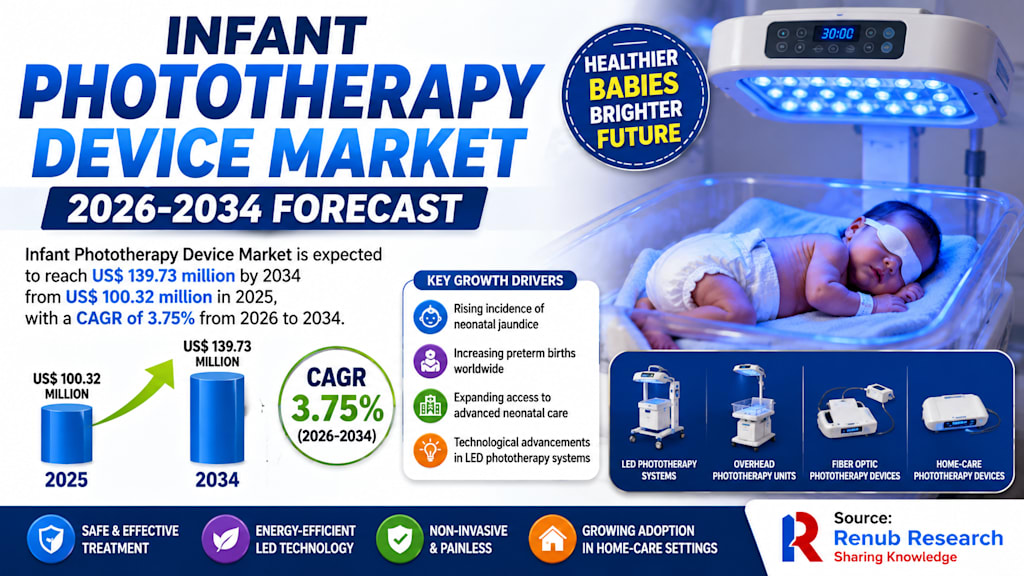
The global infant phototherapy device market is witnessing steady expansion as healthcare systems increasingly prioritize neonatal care and early treatment of jaundice-related complications. Rising preterm birth rates, growing awareness regarding neonatal health, and continuous advancements in phototherapy technologies are strengthening demand for safer and more efficient treatment systems across hospitals and home-care settings.
According to Renub Research, the infant phototherapy device market is expected to grow from US$ 100.32 million in 2025 to US$ 139.73 million by 2034, registering a CAGR of 3.75% during the forecast period from 2026 to 2034.
The increasing global prevalence of neonatal jaundice, combined with broader access to advanced neonatal intensive care units (NICUs), is driving healthcare providers to invest heavily in modern phototherapy equipment. At the same time, technological innovations such as LED-based systems, fiber-optic blankets, and portable home-care solutions are transforming how newborn jaundice is treated worldwide.
Infant Phototherapy Devices Play a Critical Role in Neonatal Care
Infant phototherapy devices are specialized medical systems designed to treat neonatal jaundice, a common condition caused by elevated bilirubin levels in newborn infants.
These devices emit specific wavelengths of blue light that convert bilirubin into water-soluble compounds, enabling the infant’s body to eliminate excess bilirubin naturally and safely.
Untreated neonatal jaundice can lead to severe complications including kernicterus, neurological damage, hearing loss, and developmental disorders. As a result, phototherapy remains one of the most important non-invasive treatments used in neonatal medicine.
Modern phototherapy technologies include LED phototherapy systems, fiber-optic blankets, portable bassinets, and compact treatment chambers designed to deliver continuous and safe exposure with minimal discomfort.
Hospitals, maternity wards, neonatal clinics, and home-care providers increasingly rely on these devices to ensure timely and effective newborn treatment.
Rising Preterm Birth Rates Fueling Market Expansion
One of the strongest growth drivers for the infant phototherapy device market is the increasing global rate of preterm births.
Premature infants are particularly vulnerable to hyperbilirubinemia because their livers are often underdeveloped and unable to process bilirubin efficiently.
Healthcare providers worldwide are therefore investing in advanced phototherapy systems capable of delivering precise, safe, and efficient treatment while minimizing heat exposure and skin irritation.
Government health programs, neonatal screening initiatives, and hospital expansion projects are also increasing awareness regarding early jaundice detection and treatment.
As neonatal care standards continue improving globally, demand for both hospital-based and portable home-care phototherapy systems is expected to rise steadily.
LED Technology Revolutionizing Phototherapy Treatment
Technological innovation remains one of the most transformative forces shaping the infant phototherapy device market.
LED-based phototherapy systems have largely replaced older fluorescent technologies due to their superior energy efficiency, longer operational lifespan, and more consistent wavelength delivery.
LED systems generate lower heat levels, reducing risks of dehydration and skin irritation while improving infant comfort and safety.
Manufacturers are increasingly integrating advanced features such as automated irradiance monitoring, digital timers, smart intensity controls, and real-time treatment tracking into modern phototherapy devices.
Fiber-optic phototherapy blankets and wearable treatment pads are also gaining popularity because they support greater infant mobility and improve mother–infant bonding during therapy.
Portable and battery-powered devices are further expanding treatment accessibility in remote healthcare settings and home-care environments.
Expanding Healthcare Infrastructure Supporting Market Growth
The rapid expansion of neonatal healthcare infrastructure across both developed and emerging economies is significantly contributing to market growth.
Governments and healthcare organizations are investing heavily in neonatal intensive care units, maternity hospitals, rural healthcare centers, and pediatric care facilities to reduce infant mortality rates and improve newborn healthcare outcomes.
Many national healthcare systems now emphasize mandatory bilirubin screening and early neonatal intervention programs, increasing diagnosis rates for jaundice and strengthening demand for phototherapy equipment.
International healthcare organizations and public-private partnerships are also supporting neonatal healthcare improvements through equipment donations, training initiatives, and healthcare modernization projects.
As healthcare systems continue prioritizing maternal and newborn care, hospitals are increasingly adopting advanced LED and hybrid phototherapy systems that provide more precise and effective treatment.
Home-Based Phototherapy Solutions Gain Momentum
Home-care phototherapy devices are becoming increasingly popular as healthcare systems seek to reduce hospital overcrowding and treatment costs.
Portable and user-friendly phototherapy systems now allow healthcare providers to safely manage mild neonatal jaundice cases at home under medical supervision.
Home-based treatment offers multiple advantages, including reduced hospital stays, lower healthcare costs, improved parental convenience, and reduced stress for newborns.
The rise of outpatient neonatal care models and telemedicine monitoring systems is also accelerating demand for portable phototherapy solutions.
Manufacturers are therefore focusing heavily on compact, ergonomic, and battery-powered systems designed specifically for home-care applications.
Challenges in Low-Resource Healthcare Settings
Despite technological progress, limited access to advanced neonatal healthcare remains a major challenge in many low-income and rural regions.
Numerous hospitals and clinics still rely on outdated fluorescent phototherapy systems due to cost constraints and inadequate healthcare infrastructure.
Limited electricity availability, shortages of trained healthcare professionals, and lack of maintenance capabilities further restrict adoption of advanced LED technologies.
These disparities often result in delayed or ineffective jaundice treatment, increasing risks of bilirubin-induced neurological complications among vulnerable newborns.
To address these issues, healthcare organizations and governments are increasingly investing in affordable, durable, and energy-efficient phototherapy systems tailored for resource-constrained environments.
Technical Limitations and Quality Control Concerns Persist
Maintaining consistent treatment quality remains another important challenge within the infant phototherapy device market.
Variations in irradiance intensity, improper device positioning, and inadequate calibration can reduce treatment effectiveness.
Some older devices continue to emit excessive heat, increasing risks of skin irritation and dehydration among newborns.
In unregulated markets, counterfeit and low-quality phototherapy equipment also poses safety concerns and threatens clinical outcomes.
Healthcare facilities therefore require continuous staff training, strict quality control standards, and regular equipment maintenance to ensure safe and effective treatment delivery.
United States Leads the Global Market
The United States remains one of the largest and most technologically advanced infant phototherapy device markets globally.
The country benefits from sophisticated neonatal healthcare infrastructure, high awareness regarding neonatal jaundice detection, and strong adoption of LED and fiber-optic treatment systems.
Healthcare providers increasingly use devices featuring automated irradiance adjustment, digital monitoring, and AI-supported treatment optimization.
The growing popularity of home-based phototherapy systems is also contributing to market expansion across the United States.
Additionally, strong insurance coverage for neonatal care treatments supports widespread access to advanced phototherapy technologies.
Germany Maintains Strong Clinical Standards
Germany’s infant phototherapy device market benefits from a highly developed healthcare system, universal insurance coverage, and strict neonatal treatment protocols.
Hospitals across the country maintain high adoption rates for advanced LED-based systems due to their precision, energy efficiency, and strong clinical safety profiles.
The country’s emphasis on early bilirubin screening and neonatal care standardization further strengthens demand for phototherapy devices.
Germany is also home to several leading medical device manufacturers, supporting innovation and high product quality across the European market.
China Emerging as a Fast-Growing Market
China’s infant phototherapy device market is expanding rapidly due to rising urban birth rates, improving neonatal healthcare infrastructure, and growing awareness regarding jaundice-related complications.
Government initiatives supporting maternal and child healthcare modernization are driving widespread adoption of LED and fiber-optic phototherapy systems.
Domestic manufacturers are also playing a major role by developing affordable devices for hospitals and community clinics across the country.
The rise of private maternity hospitals and expanding home-care services is further supporting demand for portable treatment solutions.
Saudi Arabia Accelerates Healthcare Modernization
Saudi Arabia’s infant phototherapy device market is witnessing strong growth due to increasing government investment in neonatal and maternity healthcare services.
Under Vision 2030 healthcare modernization initiatives, the country is rapidly expanding NICUs and adopting advanced medical technologies across public and private hospitals.
Demand for LED-based phototherapy systems continues rising due to growing awareness regarding infant complications associated with untreated jaundice.
Collaborations with global medical device manufacturers are also improving access to high-quality neonatal treatment equipment across the region.
Kaiyan Medical Introduces New LED Phototherapy Chamber
A major recent development in the market occurred in January 2026 when Kaiyan Medical unveiled a new medical-grade Infant Jaundice Phototherapy Chamber specifically designed for neonatal care.
The system features narrow-band blue LED therapy ranging between 450–475 nm, large-area exposure capabilities, temperature control systems, and vitality monitoring technologies.
The device is manufactured under ISO 13485 quality systems and has received FDA 510(k) clearance, highlighting the industry’s increasing focus on safer, technologically advanced neonatal treatment solutions.
Competitive Landscape Intensifies
The infant phototherapy device market is becoming increasingly competitive as companies focus on innovation, portability, energy efficiency, and digital integration.
Major companies operating in the market include:
- Ningbo David Medical Device Co. Ltd
- Koninklijke Philips N.V.
- General Electric Company
- Inspiration Healthcare Group Plc
- Drägerwerk AG & Co. KGaA
- Ibis Medical Equipment and Systems Pvt Ltd.
- Weyer GmbH
- Natus Medical Incorporated
Recent Developments in the Infant Phototherapy Device Market
Kaiyan Medical launched a new LED-based infant phototherapy chamber.
Koninklijke Philips N.V. expanded neonatal LED phototherapy product offerings.
General Electric Company enhanced digital neonatal monitoring integration capabilities.
Drägerwerk AG & Co. KGaA improved advanced NICU phototherapy solutions.
Natus Medical Incorporated expanded portable neonatal treatment systems.
Inspiration Healthcare Group Plc strengthened neonatal intensive care equipment distribution.
Ibis Medical Equipment and Systems Pvt Ltd. expanded affordable neonatal care device manufacturing.
Ningbo David Medical Device Co. Ltd increased global distribution of LED phototherapy devices.
Weyer GmbH improved fiber-optic neonatal phototherapy systems.
Masimo expanded neonatal monitoring technologies supporting jaundice management.
Final Thoughts
The global infant phototherapy device market is steadily advancing as healthcare systems worldwide intensify efforts to improve neonatal care quality and reduce complications associated with untreated jaundice.
Rising preterm birth rates, growing awareness regarding neonatal health, and rapid technological innovation are strengthening demand for safer, more efficient, and more accessible phototherapy solutions.
LED technologies, portable home-care systems, fiber-optic devices, and digitally integrated treatment platforms are reshaping the future of neonatal jaundice management.
Although healthcare disparities and infrastructure limitations remain important challenges in certain regions, continued investment in maternal and newborn healthcare is expected to sustain long-term market growth.
With the infant phototherapy device market projected to exceed US$ 139.73 million by 2034, the industry is expected to remain a critical component of modern neonatal healthcare systems globally.
About the Creator
Enjoyed the story? Support the Creator.
Subscribe for free to receive all their stories in your feed.
Comments
There are no comments for this story
Be the first to respond and start the conversation.