
How Stanford's SAINT Protocol Is Rewriting the Timeline of Depression Treatment
What if the most significant advance in depression treatment wasn't a new drug — but a machine that rewires your brain in less time than it takes to finish a Netflix series?

The Problem With Six Weeks
Standard Transcranial Magnetic Stimulation — the clinical version most psychiatrists know — is a logistical marathon. Patients drive to a clinic every weekday for up to six weeks. Thirty sessions. Each one lasting thirty to forty minutes. It works for roughly half the people who complete it, which makes it one of the more effective tools in treatment-resistant depression. But the compliance wall is brutal. People lose jobs, miss sessions, abandon the protocol entirely because life won't pause for six weeks of daily brain treatments.
Stanford's neuroscientists looked at that six-week structure and asked a deceptively simple question: what if the long gaps between sessions are less important than clinicians assumed?
Their answer became SAINT: Stanford Accelerated Intelligent Neuromodulation Therapy — now increasingly referred to in the scientific literature as Stanford Neuromodulation Therapy (SNT). And what it does to the conventional treatment calendar is radical in its efficiency.
Inside the Hardware
Before understanding what SAINT changes, you need a working model of what TMS actually does to the brain.
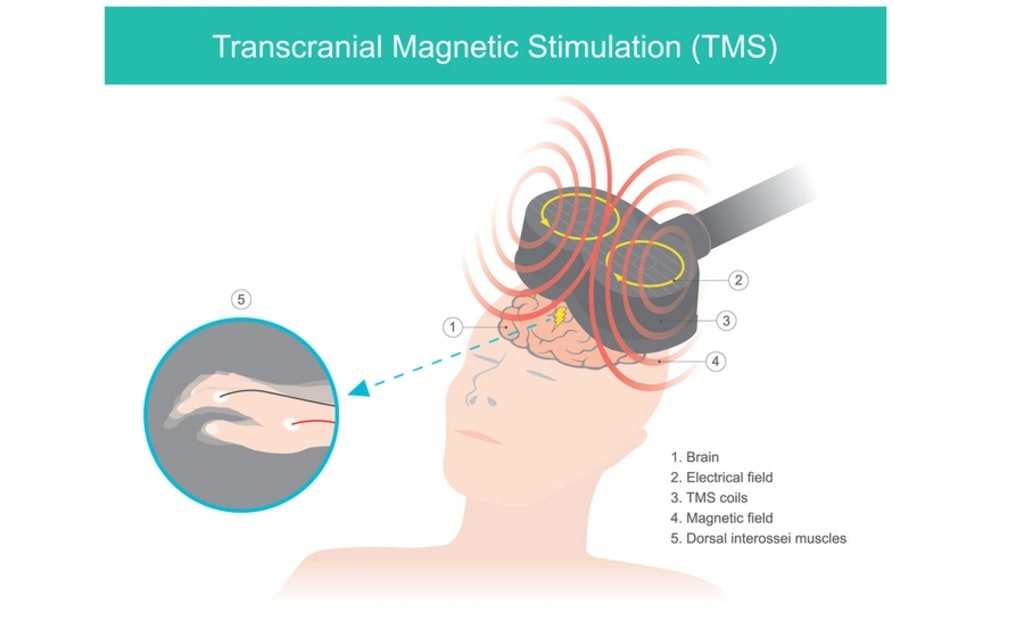
A TMS device is, at its core, an electromagnetic coil held against the scalp. When current pulses through that coil, it generates a rapidly changing magnetic field — one strong enough to pass through bone and scalp without resistance. That magnetic field induces a small electrical current in the neurons directly beneath it. Those neurons fire. The stimulation is precise, painless, and entirely non-invasive. No anesthesia. No electrodes. No alteration of blood chemistry.
The target in depression treatment is the left dorsolateral prefrontal cortex (dlPFC) — one of the brain's major executive-control regions. This area governs planning, emotional regulation, and the suppression of negative rumination. In people with major depressive disorder, particularly treatment-resistant cases, the dlPFC tends to be underactive. It's not generating enough signal to keep the limbic system — the brain's emotional engine — in check. TMS reaches in and manually fires those circuits, session after session, until the brain begins to sustain the activity on its own.
The SAINT protocol uses a specific variant called intermittent theta burst stimulation (iTBS). Where standard TMS pulses continuously for thirty-plus minutes, iTBS delivers bursts of high-frequency magnetic pulses in short, intense volleys — more like a series of precisely timed bursts than a steady stream. Each session takes roughly ten minutes. Then, rather than sending the patient home for twenty-four hours, SAINT stacks ten of those sessions in a single day, separated by fifty-minute rest intervals.
Ten sessions a day. Five days. Fifty total sessions by Friday.
Why Compression Works
The physiological logic here is worth unpacking, because it isn't just about speed.
Standard TMS protocols were designed around the assumption that the brain needs overnight consolidation between sessions — that synaptic changes need time to stabilize before the next round of stimulation. SAINT's designers questioned that assumption. They hypothesized that the therapeutic signal isn't just in each individual pulse, but in the cumulative intensity of stimulation across a compressed window. The brain, flooded with repeated activation of underperforming circuits within a short time frame, may undergo a more dramatic and durable form of synaptic potentiation — essentially a forced upregulation of neural pathways that chronic depression had allowed to atrophy.
This is neuroplasticity under pressure. Rather than coaxing a sluggish circuit back online over six weeks, SAINT delivers something closer to an intensive rehabilitation sprint.
There's another layer of intelligence baked into the protocol: the targeting. SAINT doesn't just aim at the general region of the dlPFC. It uses individualized functional MRI data to locate the precise subregion of the prefrontal cortex most anti-correlated with the subgenual anterior cingulate cortex (sgACC) — a structure implicated in the rumination and mood dysregulation characteristic of severe depression. In plain terms: it identifies the prefrontal target most strongly connected to that patient's depression-related circuitry, not a population average. Standard TMS uses fixed anatomical coordinates. SAINT uses a personalized map.
What the Data Shows
In Stanford's landmark open-label study published in the American Journal of Psychiatry in 2020, twenty-two patients with severe, treatment-resistant depression underwent the five-day SAINT protocol. Within days — not weeks — 90.5 percent met criteria for remission, though the study enrolled only 22 participants and larger replication studies remain essential.
The 2022 randomized, double-blind, sham-controlled trial — also published in the American Journal of Psychiatry — replicated the core finding. At the primary four-week endpoint, roughly 57 percent of SAINT-treated participants achieved remission, compared to none in the sham group; when remission was assessed across the full follow-up window, the figure rose to approximately 79 percent. Notably, the trial enrolled only 29 participants, and the authors themselves flag that larger independent replication is still needed.
For context: standard antidepressant medications produce remission in approximately 30 to 35 percent of patients in initial trials, and that figure drops significantly with each failed medication trial. SAINT's numbers — even discounting for optimism and early-stage research effects — represent a meaningful departure from the existing landscape.
What It Isn't
SAINT is not a cure. It is not permanent for everyone. Some patients maintain remission for months; others experience gradual return of symptoms and require retreatment. The long-term durability question is still being answered in ongoing follow-up studies.
It is also not yet universally accessible. In September 2022, the FDA issued 510(k) clearance to Magnus Medical — a California company founded by former members of the Stanford Brain Stimulation Lab — for the SAINT Neuromodulation System, covering the treatment of major depressive disorder in adults who have not adequately responded to antidepressant medications. Insurance coverage remains uneven, clinic availability is limited to larger medical centers, and the cost for an out-of-pocket course remains prohibitive for most patients without coverage.
The fMRI-guided targeting component, which may be central to the protocol's enhanced efficacy, requires imaging infrastructure and radiological expertise that not every TMS clinic can readily provide. Some commercial implementations use approximated coordinates rather than true individualized mapping — a compromise whose effect on outcomes remains an open question.
Why This Moment Matters
The significance of SAINT isn't just clinical. It's conceptual.
The most interesting thing about SAINT may not be its speed. It may be what that speed suggests about how depression works.
Depression treatment has been, for the better part of seventy years, a chemical story. Drugs that increase serotonin. Drugs that modulate dopamine. Drugs that hit multiple receptor types simultaneously and hope the side effect profile is tolerable. The underlying logic has always been biochemical: the problem is a molecular imbalance, so the solution is a molecular intervention.
SAINT operates on an entirely different logic. It treats depression as a circuit problem — a connectivity failure between specific regions — and addresses that failure mechanically, the way a physical therapist might address a muscle that has forgotten how to fire. It doesn't add or subtract a chemical. It teaches the brain's own hardware to behave differently.
That shift in framing has implications that extend far beyond this single protocol. Ketamine and esketamine work on timescales traditional antidepressants don't, suggesting rapid neuroplasticity is achievable through other routes. Closed-loop neuromodulation devices — implants that detect and respond to abnormal neural patterns in real time — have moved from case reports into active clinical trials at major research centers. The direction of travel in psychiatry increasingly emphasizes neural circuits and network dynamics alongside traditional biochemical explanations.
SAINT didn't invent that idea. But in compressing six weeks of treatment into five days and delivering remission rates that would have seemed implausible a decade ago, it has become the most visible proof-of-concept yet that the mechanical approach works — and works fast.
Five Days
There's something worth sitting with in the sheer compactness of the timeline. Consider the patient who has spent years cycling through antidepressants — three, five, sometimes more — adjusting doses, tolerating side effects, waiting the standard six to eight weeks each time to learn whether this one might be different. Perhaps they completed a standard TMS course that produced partial improvement before fading. Perhaps they've been told, more than once, that their depression is treatment-resistant, a clinical designation that can feel less like a diagnosis than a verdict. For that patient, the prospect of a five-day intensive protocol isn't a matter of convenience. It's a fundamentally different relationship with the timeline of recovery.
Five days. One hundred and twenty hours. Fifty sessions of targeted magnetic stimulation, each one ten minutes long, stacked and timed and aimed at a specific coordinate in a specific hemisphere of a specific human brain.
That represents a significant departure from conventional treatment timelines and expectations for treatment-resistant depression.
The SAINT protocol is still early. The access gaps are real. The durability questions are open. But the biological rationale is compelling, the early findings have been replicated, and the principle it has demonstrated is reshaping how researchers think about depression treatment — that dysfunctional neural circuits can be rapidly and measurably modified from the outside.
For patients who have cycled through medication after medication without relief, the significance of a five-day protocol is not merely convenience. It represents the possibility that years of waiting for the next treatment might someday be replaced by a single intensive week.
The five-day protocol is here. The harder work now is making sure everyone who needs it can get it.
Sources: Stanford University Department of Psychiatry; Cole et al., American Journal of Psychiatry (2020); Cole et al., American Journal of Psychiatry (2022); FDA 510(k) Clearance K213543, Magnus Medical, September 2022.
About the Creator
Khali Sollis
Khali Sollis is a writer and independent researcher exploring the science of the human mind and behavior. Her work examines questions at the intersection of neuroscience, psychology, cognition, mental health, and everyday human experience.
Enjoyed the story? Support the Creator.
Subscribe for free to receive all their stories in your feed.
Comments
There are no comments for this story
Be the first to respond and start the conversation.