
Global Biotechnology Market to Surpass USD 14 Trillion by 2033 as Genomics, Biopharmaceuticals, and Precision Medicine Reshape Healthcare
Advances in gene editing, DNA sequencing, personalized therapies, and sustainable biotechnology applications are accelerating one of the fastest-growing industries worldwide.

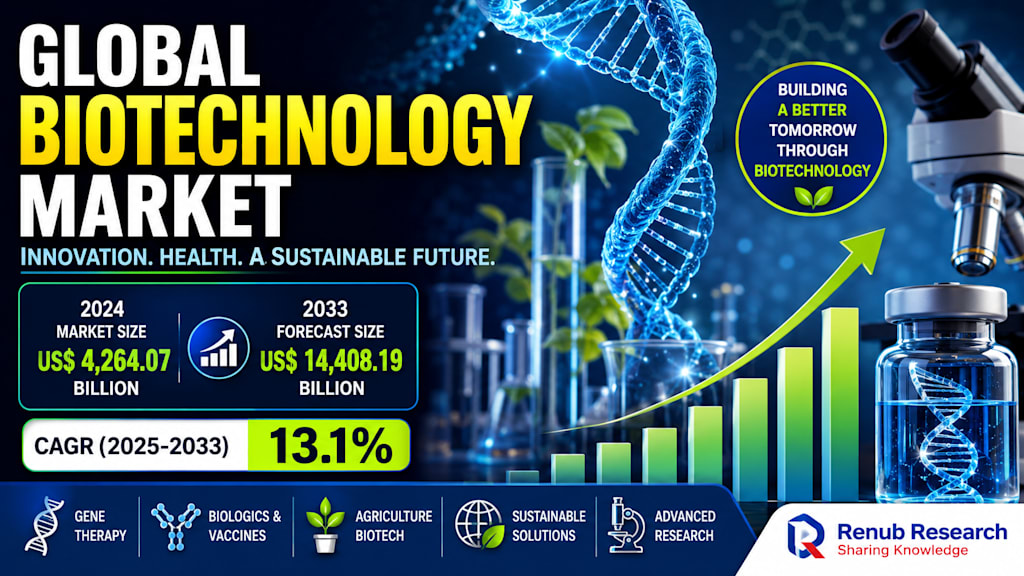
Global Biotechnology Market Size and Forecast 2025–2033
The global biotechnology industry is entering a transformative era driven by rapid scientific breakthroughs, expanding healthcare applications, and increasing investment in research and development. Biotechnology has evolved from a niche scientific discipline into a cornerstone of modern healthcare, agriculture, industrial manufacturing, and environmental sustainability.
According to Renub Research, the Global Biotechnology Market is projected to reach US$ 14,408.19 Billion by 2033 from US$ 4,264.07 Billion in 2024, expanding at a CAGR of 13.1% during 2025–2033.
The remarkable growth trajectory reflects rising demand for innovative therapies, advancements in genomics, increasing use of biologics, and expanding applications across multiple industries. As governments, academic institutions, pharmaceutical companies, and biotechnology startups continue investing heavily in innovation, biotechnology is becoming one of the most influential sectors shaping the future of science and medicine.
Understanding Biotechnology's Expanding Role
Biotechnology refers to the use of living organisms, biological systems, or their derivatives to develop products and technologies that improve human life and industrial efficiency. It combines biology, genetics, chemistry, engineering, and computational sciences to create solutions across numerous sectors.
Modern biotechnology applications include:
Vaccine development
Gene therapies
Personalized medicine
Agricultural biotechnology
Industrial enzymes
Biofuels
Environmental remediation
Diagnostic technologies
Over the last two decades, biotechnology has transformed how diseases are diagnosed and treated. It has also helped address global challenges such as food security, climate change, and sustainable manufacturing.
The COVID-19 pandemic further highlighted biotechnology's importance by accelerating vaccine innovation, genomic surveillance, and rapid diagnostic testing, drawing unprecedented global attention and investment into the sector.
Major Factors Driving Global Biotechnology Market Growth
Genomics and Personalized Medicine Revolution
One of the strongest drivers of biotechnology growth is the rapid advancement of genomic technologies.
The cost of genome sequencing has fallen dramatically, making personalized healthcare more accessible than ever before. Scientists can now identify genetic variations linked to diseases and develop treatments tailored to individual patients.
Technologies such as CRISPR gene editing, next-generation sequencing, and precision diagnostics are enabling healthcare providers to move away from generalized treatments toward personalized therapeutic solutions.
Cancer treatment has particularly benefited from genomic innovation. Precision oncology allows physicians to select therapies based on a patient's unique genetic profile, improving outcomes while reducing unnecessary side effects.
As healthcare systems increasingly adopt precision medicine approaches, biotechnology companies are investing heavily in genomic research and commercial applications.
Growing Demand for Biopharmaceuticals and Vaccines
Biopharmaceuticals continue to dominate biotechnology innovation.
Unlike traditional chemical drugs, biologics are derived from living cells and offer highly targeted treatment options. Products such as monoclonal antibodies, recombinant proteins, cell therapies, and gene therapies are becoming critical components of modern healthcare.
The global rise in chronic diseases, autoimmune disorders, rare genetic conditions, and cancer has significantly increased demand for biologic treatments.
Meanwhile, the success of mRNA vaccines during the COVID-19 pandemic demonstrated biotechnology's ability to rapidly develop effective solutions during public health emergencies.
Researchers are now exploring mRNA technologies for:
Cancer immunotherapy
Influenza prevention
Rare disease treatment
Personalized vaccines
Infectious disease control
This expanding pipeline continues to attract substantial investment from both public and private sectors.
Sustainable Industrial and Environmental Biotechnology
Biotechnology's influence extends well beyond healthcare.
Industries worldwide are increasingly adopting biological processes to improve sustainability and reduce environmental impact.
Industrial biotechnology applications include:
Biofuel production
Biodegradable materials
Industrial enzymes
Waste management
Carbon reduction technologies
Agricultural biotechnology is also helping address food security concerns through genetically improved crops, disease-resistant plants, and microbial biofertilizers.
Environmental biotechnology contributes to pollution control through bioremediation technologies that use microorganisms to remove contaminants from soil, water, and industrial waste streams.
As sustainability becomes a global priority, biotechnology is positioned as a key enabler of environmentally responsible economic growth.
Challenges Facing the Biotechnology Industry
Complex Regulatory Environment
Biotechnology products often face extensive regulatory scrutiny before reaching commercial markets.
Gene therapies, biologics, genetically modified organisms, and advanced diagnostics must undergo rigorous testing to ensure safety and effectiveness.
Regulatory agencies worldwide maintain different approval requirements, creating challenges for companies seeking global commercialization.
Lengthy approval timelines can increase development costs and delay market entry, particularly for smaller biotechnology firms with limited financial resources.
Ethical concerns surrounding genetic engineering, human genome editing, and data privacy further complicate policy development and regulatory decision-making.
High Research and Development Costs
Innovation remains the lifeblood of biotechnology, but it comes at a substantial cost.
Developing a biotechnology product often requires years of research, clinical trials, manufacturing validation, and regulatory approvals.
Many promising candidates fail during development, resulting in significant financial losses.
Smaller biotechnology companies frequently rely on venture capital funding and strategic partnerships to sustain operations through long development cycles.
Maintaining innovation while managing financial risk remains one of the industry's biggest challenges.
Emerging Biotechnology Segments Transforming the Market
Biotechnology Instruments Market
Biotechnology research depends heavily on advanced laboratory equipment.
Instruments such as:
PCR systems
Flow cytometers
DNA sequencers
Mass spectrometers
Automated analyzers
play a critical role in research, diagnostics, and pharmaceutical development.
Artificial intelligence integration, laboratory automation, and cloud-based data management are improving efficiency and accelerating scientific discoveries.
As biotechnology research expands globally, demand for advanced instruments continues to rise.
Nanobiotechnology Market
Nanobiotechnology combines biological sciences with nanotechnology to create highly precise medical and industrial applications.
Nanoparticles are increasingly used in:
Targeted drug delivery
Cancer treatment
Biosensors
Tissue engineering
Regenerative medicine
These technologies improve treatment effectiveness while minimizing side effects.
Ongoing innovations in nanoscale materials are opening new possibilities for healthcare and industrial biotechnology solutions.
DNA Sequencing Market
DNA sequencing remains one of biotechnology's most transformative technologies.
Applications now extend beyond research into routine clinical practice, supporting:
Cancer diagnostics
Infectious disease surveillance
Rare disease identification
Population genomics
Personalized medicine
Advances such as nanopore sequencing and single-cell genomics continue improving speed, affordability, and accuracy.
As sequencing costs decline, broader adoption across healthcare systems is expected to fuel continued market expansion.
Chromatography Market
Chromatography technologies are essential for analyzing and purifying biological compounds.
These systems support:
Drug discovery
Biologics manufacturing
Quality control
Environmental testing
Food safety analysis
The increasing complexity of biologic drugs has created greater demand for high-performance analytical technologies capable of ensuring product quality and regulatory compliance.
Biotechnology Healthcare Market
Healthcare remains biotechnology's largest and fastest-growing application area.
Key innovations include:
Gene therapies
Cell therapies
Companion diagnostics
RNA-based therapeutics
Personalized medicines
Breakthroughs such as CAR-T cell therapy and CRISPR-based treatments are offering new hope for patients with previously untreatable conditions.
Healthcare systems worldwide are increasingly integrating biotechnology into standard treatment protocols, creating significant growth opportunities.
Regional Market Analysis
United States Biotechnology Market
The United States remains the global leader in biotechnology innovation.
Major biotech clusters in Boston, San Francisco, and San Diego continue attracting significant venture capital investment and scientific talent.
Strong intellectual property protection, advanced research infrastructure, and supportive regulatory pathways contribute to the country's leadership position.
The U.S. continues to dominate in:
Biopharmaceutical development
Gene therapy
Cell therapy
Diagnostic technologies
Industrial biotechnology
Collaboration between universities, research institutions, and industry players further strengthens the innovation ecosystem.
Germany Biotechnology Market
Germany has established itself as one of Europe's most influential biotechnology hubs.
The country's strengths include:
Biopharmaceutical manufacturing
Industrial biotechnology
Enzyme technologies
Sustainable bio-based materials
Government support, strong academic institutions, and advanced engineering capabilities continue driving biotechnology innovation throughout the country.
Germany also plays an important role in shaping biotechnology regulations and standards across Europe.
India Biotechnology Market
India has emerged as a major global biotechnology destination.
The country's biotechnology sector benefits from:
Cost-effective manufacturing
Large scientific workforce
Expanding healthcare infrastructure
Strong vaccine production capabilities
India's success during the COVID-19 pandemic demonstrated its ability to supply vaccines at scale to global markets.
Rapid growth in biosimilars, diagnostics, and bio-agriculture is further strengthening India's position in the global biotechnology value chain.
Government initiatives supporting biotechnology parks, startup ecosystems, and research collaborations continue accelerating industry development.
Saudi Arabia Biotechnology Market
Saudi Arabia is making significant investments in biotechnology under its Vision 2030 economic diversification strategy.
The Kingdom is focusing on:
Biomanufacturing
Therapeutic biologics
Food security technologies
Agricultural biotechnology
Research infrastructure
Strategic partnerships with international organizations and investments in scientific talent development are helping build a competitive biotechnology ecosystem in the region.
Competitive Landscape
The biotechnology market remains highly competitive, characterized by continuous innovation, strategic partnerships, acquisitions, and research investments.
Leading companies are focusing on advanced therapeutics, precision medicine, manufacturing technologies, and global expansion to strengthen their market positions.
Major industry participants include:
Lonza Group AG
Amgen Inc.
Syngenta AG
Biocon Limited
Biogen Inc.
F. Hoffmann-La Roche AG
Novartis AG
Novo Nordisk A/S
Pfizer Inc.
Seagen Inc.
10 Recent Developments in the Biotechnology Industry
1. Roche Expands Precision Diagnostics
Roche continues expanding its precision diagnostics portfolio through advanced genomic testing platforms supporting personalized medicine initiatives.
2. Pfizer Advances mRNA Technology
Pfizer is broadening applications of mRNA technologies beyond infectious diseases into oncology and rare disease therapeutics.
3. Amgen Strengthens Oncology Pipeline
Amgen has accelerated investments in targeted cancer therapies and next-generation biologics.
4. Novo Nordisk Expands Biologics Manufacturing
Novo Nordisk is increasing global manufacturing capacity to meet rising demand for innovative biologic treatments.
5. Biocon Advances Biosimilar Development
Biocon continues expanding its biosimilar portfolio for both domestic and international markets.
6. Novartis Invests in Gene Therapy
Novartis is strengthening research efforts focused on gene therapies targeting rare and inherited diseases.
7. Lonza Expands Cell and Gene Therapy Services
Lonza has increased production capabilities to support growing global demand for advanced therapy manufacturing.
8. Syngenta Enhances Agricultural Biotechnology
Syngenta is investing in sustainable crop technologies designed to improve agricultural productivity and resilience.
9. Biogen Advances Neurodegenerative Disease Research
Biogen continues developing innovative therapies targeting Alzheimer's disease and other neurological disorders.
10. Seagen Strengthens Antibody-Drug Conjugate Portfolio
Seagen remains focused on expanding its oncology pipeline through advanced antibody-drug conjugate technologies.
Final Thoughts
Biotechnology is rapidly becoming one of the most influential industries of the modern era. From gene editing and precision medicine to sustainable agriculture and industrial innovation, biotechnology is transforming how societies address healthcare challenges, environmental concerns, and food security needs.
As genomic technologies become more accessible, biologic therapies gain wider adoption, and governments continue prioritizing scientific innovation, the industry's growth potential remains extraordinary. With the global biotechnology market expected to exceed US$ 14.4 trillion by 2033, stakeholders across healthcare, agriculture, manufacturing, and environmental sectors are likely to witness unprecedented opportunities in the years ahead.
The future of biotechnology is not simply about scientific advancement—it is about fundamentally reshaping how humanity improves health, sustainability, and quality of life on a global scale.
About the Creator
Enjoyed the story? Support the Creator.
Subscribe for free to receive all their stories in your feed.
Comments
There are no comments for this story
Be the first to respond and start the conversation.