
Global Biopsy Devices Market Expands as Early Cancer Detection Becomes a Healthcare Priority
Rising cancer prevalence, advancements in minimally invasive diagnostics, and expanding healthcare infrastructure are accelerating demand for biopsy technologies worldwide.

Biopsy Devices Market Overview
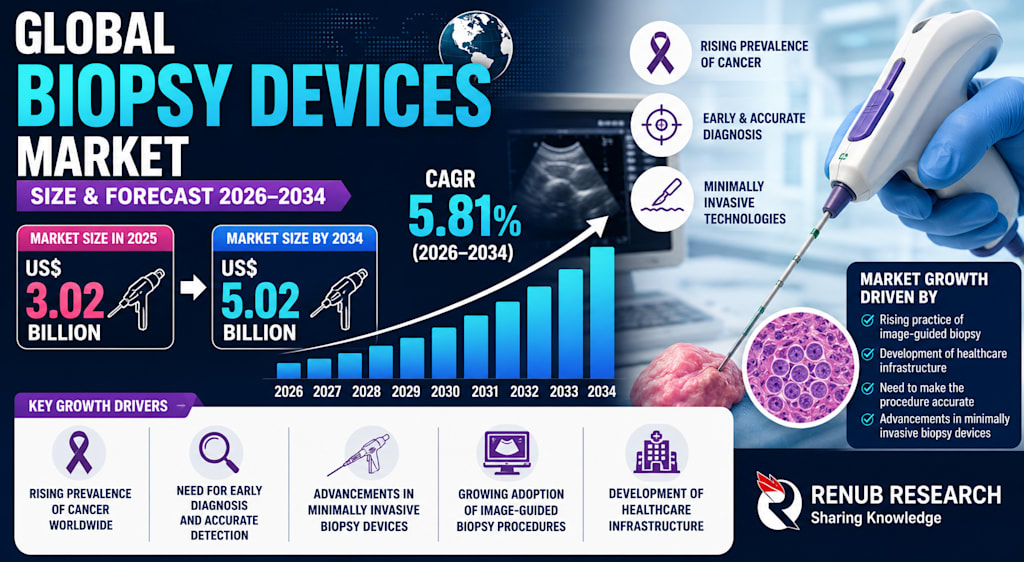
The global biopsy devices market is witnessing steady expansion as healthcare systems worldwide place increasing emphasis on early disease detection, precision diagnostics, and minimally invasive medical procedures. Rising cancer incidence, improvements in medical imaging technologies, and growing awareness about preventive healthcare are driving significant demand for advanced biopsy solutions across hospitals, diagnostic centers, and specialty clinics. According to Renub Research, the global biopsy devices market is expected to grow from US$ 3.02 Billion in 2025 to US$ 5.02 Billion by 2034, registering a Compound Annual Growth Rate (CAGR) of 5.81% during 2026–2034.
This projected growth highlights the increasingly important role biopsy procedures play in modern medicine. Biopsy devices are essential tools used to collect tissue or cell samples from the body for laboratory examination. These samples help physicians diagnose cancer, infections, inflammatory conditions, autoimmune diseases, and other serious medical disorders with greater precision and speed.
As healthcare systems continue shifting toward personalized treatment and early intervention, the need for accurate diagnostic technologies has become more critical than ever. Biopsy devices, particularly those integrated with advanced imaging systems, are now considered indispensable components of modern oncology and pathology practices.
Cancer Prevalence Remains the Biggest Market Driver
The growing global burden of cancer remains the single largest factor driving demand for biopsy devices. Tissue sampling is often necessary to confirm cancer diagnoses, determine tumor characteristics, and guide treatment decisions. Breast cancer, lung cancer, prostate cancer, colorectal cancer, liver cancer, and several other malignancies depend heavily on biopsy procedures for accurate clinical assessment.
The report highlights the alarming scale of global cancer growth. In 2022 alone, approximately 20 million new cancer cases and 9.7 million cancer-related deaths were recorded worldwide. By 2050, annual cancer cases are projected to rise to 33 million, while cancer-related deaths may reach 18.2 million annually.
These numbers underline the urgent need for efficient and reliable diagnostic tools. Early diagnosis significantly improves survival rates, treatment effectiveness, and patient outcomes. As a result, healthcare providers are increasingly investing in biopsy technologies capable of delivering faster and more precise diagnostic results.
Beyond oncology, biopsy devices are also widely used for diagnosing infectious diseases, inflammatory disorders, liver diseases, kidney conditions, and autoimmune disorders. The growing prevalence of chronic diseases linked to aging populations and changing lifestyles further contributes to market expansion.
Minimally Invasive Technologies Are Transforming Diagnostics
One of the most important developments within the biopsy devices market is the shift toward minimally invasive procedures. Traditional surgical biopsies often involve higher risks, longer recovery times, and greater patient discomfort. Modern biopsy technologies, however, are increasingly designed to minimize tissue damage while improving diagnostic precision.
Needle-based biopsy systems, vacuum-assisted devices, and image-guided technologies are helping physicians obtain accurate tissue samples with smaller incisions and reduced complications. Patients benefit from shorter recovery periods, less pain, and lower risks of infection or bleeding.
The integration of biopsy devices with imaging technologies such as ultrasound, CT scans, MRI systems, and mammography has significantly enhanced diagnostic capabilities. These technologies allow physicians to target difficult-to-reach lesions and suspicious tissues more accurately, improving both procedural safety and diagnostic confidence.
The report references the January 2025 launch of the IAC Standards for MRI Image-Guided Prostate Biopsy Procedures, which supports growing adoption of MRI-guided biopsy accreditation programs. This reflects increasing industry focus on precision imaging and minimally invasive diagnostics.
As healthcare providers continue adopting image-guided diagnostic approaches, demand for advanced biopsy systems is expected to rise steadily across developed and emerging healthcare markets alike.
Healthcare Infrastructure Expansion Supports Market Growth
The expansion of healthcare infrastructure across emerging economies is creating significant opportunities for biopsy device manufacturers. Governments and private healthcare organizations are investing heavily in hospitals, diagnostic laboratories, imaging centers, and oncology treatment facilities to improve access to advanced healthcare services.
Improved healthcare access is especially important in rapidly developing regions where cancer awareness, screening programs, and diagnostic capabilities have historically been limited. As healthcare systems modernize, demand for reliable diagnostic technologies—including biopsy equipment—is increasing rapidly.
The report notes that awareness campaigns focused on cancer screening and preventive healthcare are further encouraging earlier diagnosis and greater acceptance of biopsy procedures. Public education initiatives are helping patients recognize the importance of timely detection and diagnostic accuracy.
One example highlighted in the report is the July 2025 launch of a second Genexus system by Agilus Diagnostics in collaboration with FMRI. Such developments demonstrate how healthcare providers are strengthening diagnostic infrastructure to support faster and more advanced molecular testing capabilities.
Cost Remains a Significant Industry Challenge
Despite positive growth trends, the biopsy devices market faces several important challenges. High costs associated with advanced biopsy systems and image-guided procedures remain major barriers, particularly in low-income and developing healthcare markets.
Sophisticated biopsy technologies often require expensive imaging systems, specialized training, and advanced clinical infrastructure. These costs can make advanced biopsy procedures less accessible in regions where healthcare spending remains constrained.
Patients in cost-sensitive markets may also hesitate to undergo certain procedures due to affordability concerns, particularly where insurance coverage or reimbursement systems are limited. As a result, manufacturers must balance innovation with affordability to expand adoption globally.
Healthcare providers likewise face budgetary challenges when investing in technologically advanced diagnostic systems. Smaller hospitals and clinics may struggle to justify the capital expenditure required for high-end biopsy imaging equipment.
Regulatory and Safety Concerns Continue to Matter
Although biopsy procedures are generally considered safe, they are not completely risk-free. Potential complications such as bleeding, pain, infection, and tissue damage can affect patient acceptance and procedural confidence. In rare cases, complications may require additional medical intervention, increasing treatment costs and patient anxiety.
The biopsy devices industry is also heavily regulated. Manufacturers must comply with strict medical device standards related to safety, performance, and clinical effectiveness before launching products in different countries. Regulatory approval processes can be time-consuming and expensive, particularly for advanced technologies integrating AI, robotics, or imaging systems.
Meeting international regulatory requirements remains one of the major operational challenges facing medical device companies, especially when entering multiple regional markets with differing healthcare regulations.
Biopsy Needles Continue to Dominate the Market
Among product categories, biopsy needles remain one of the most important and widely used segments within the market. Needle-based biopsy systems are commonly used for tissue extraction from organs such as the breast, lungs, liver, prostate, and kidneys.
The popularity of biopsy needles is closely tied to the global trend toward minimally invasive diagnostics. Needle-based procedures are generally faster, safer, and less traumatic for patients compared to traditional surgical biopsies. Disposable biopsy needles have also gained significant importance because they reduce the risk of cross-contamination and infection.
Cost-effectiveness further strengthens demand for biopsy needles, making them a cornerstone of diagnostic procedures across hospitals and imaging centers worldwide.
Specialized Biopsy Segments Are Growing Rapidly
Several specialized biopsy segments are also experiencing strong growth due to rising disease prevalence and advances in targeted diagnostics.
Prostate Biopsy Devices
The prostate biopsy devices market is expanding because of increasing prostate cancer incidence among aging male populations. Advanced prostate biopsy technologies have significantly improved diagnostic precision while lowering infection risks and patient discomfort. Hospitals and specialty clinics are increasingly adopting MRI-guided prostate biopsy systems to improve detection accuracy.
Lung Biopsy Devices
Lung biopsy devices are witnessing growing demand due to increasing cases of lung cancer and respiratory disorders worldwide. CT-guided and bronchoscopic biopsy procedures now allow physicians to diagnose lung abnormalities more accurately while minimizing complications such as hemorrhage and pneumothorax.
CT Scan Biopsy Devices
Biopsy CT scan devices are becoming increasingly important for targeting difficult-to-reach tumors in organs such as the lungs, liver, pancreas, and bones. High-resolution imaging improves procedural precision and diagnostic accuracy, making CT-guided biopsy systems highly valuable despite their higher equipment costs.
Diagnostic and Imaging Centers Become Key End Users
Diagnostic and imaging centers represent one of the fastest-growing end-user segments within the biopsy devices market. These facilities specialize in outpatient diagnostic services and are increasingly equipped with advanced imaging technologies such as MRI, CT scans, and ultrasound systems.
Image-guided biopsy procedures performed at dedicated diagnostic centers are often more efficient and cost-effective than hospital-based procedures. Growing consumer preference for outpatient services, combined with expanding private diagnostic networks in urban and semi-urban regions, is driving demand for biopsy equipment in these facilities.
Regional Markets Show Strong Growth Potential
The United States remains one of the world’s largest biopsy devices markets due to its advanced healthcare infrastructure, high cancer incidence, and strong adoption of minimally invasive technologies. Favorable reimbursement systems and ongoing medical innovation continue supporting demand for advanced biopsy systems.
The report mentions a May 2025 collaboration between BiBB Instruments AB and TaeWoong Medical USA to promote EndoDrill GI Biopsy Systems in the U.S. market, reflecting continued investment in specialized biopsy technologies.
The United Kingdom market is driven by public healthcare initiatives emphasizing early cancer screening and minimally invasive diagnostics. NHS-supported cancer screening programs continue to strengthen biopsy procedure demand across the country.
India is emerging as a high-growth market due to rising cancer awareness, healthcare infrastructure expansion, and growing access to diagnostic services. Affordable biopsy systems and increasing adoption of imaging-guided procedures are contributing to strong market momentum.
Saudi Arabia is also investing heavily in healthcare modernization and oncology infrastructure, creating opportunities for advanced diagnostic technologies and imported biopsy systems.
Major Companies Continue Advancing Innovation
The competitive landscape includes major global medical technology companies such as Cardinal Health, Hologic, Danaher Corporation, Becton Dickinson, Boston Scientific, Medtronic, Olympus Corporation, and CONMED Corporation.
Competition within the industry increasingly focuses on improving procedural accuracy, patient safety, imaging integration, and minimally invasive capabilities. Companies investing in next-generation biopsy technologies and AI-assisted diagnostics are expected to gain significant competitive advantages over the coming decade.
Final Thoughts
The global biopsy devices market is becoming increasingly important in the fight against cancer and chronic diseases. Rising demand for early diagnosis, advances in minimally invasive technologies, and expanding healthcare infrastructure are creating strong long-term growth opportunities across the industry.
With the market expected to grow from US$ 3.02 Billion in 2025 to US$ 5.02 Billion by 2034, biopsy technologies are likely to remain at the center of precision medicine and advanced diagnostic care worldwide.
As healthcare systems continue emphasizing faster diagnosis, better patient outcomes, and minimally invasive treatment pathways, the role of advanced biopsy devices will only become more critical in the years ahead.
About the Creator
Enjoyed the story? Support the Creator.
Subscribe for free to receive all their stories in your feed.
Comments
There are no comments for this story
Be the first to respond and start the conversation.