
Get On With It!
The YouTube Video That Takes 30 Minutes to Tell Me Which Six Nuts to Eat
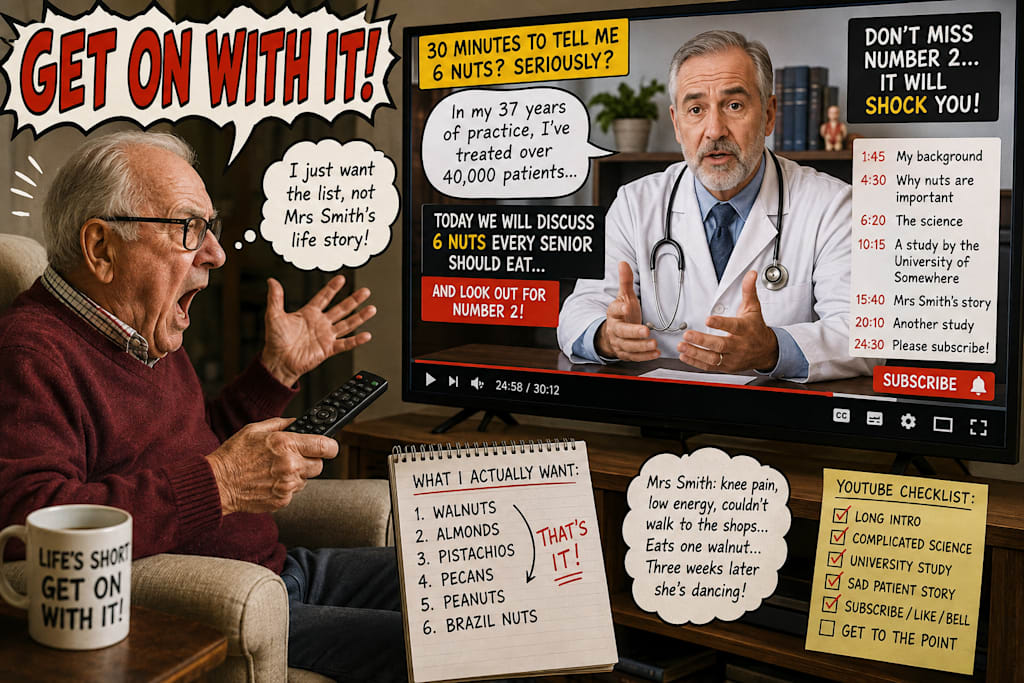
I have discovered a previously undocumented health hazard affecting older people, and surprisingly it has nothing to do with cholesterol, blood pressure, obesity, alcohol, smoking or lack of exercise. It is watching YouTube health videos. I only have to see a title such as “Six Nuts Every Senior Must Eat After 70”, “Ten Foods That Keep Your Legs Strong After 80” or “Seven Medicines Older People Should NEVER Take”, and I know exactly what is going to happen. I will click on the video expecting some useful information, and half an hour later I will still be sitting there waiting for the answer while shouting at the television, “GET ON WITH IT!”
The video invariably begins with a distinguished-looking gentleman sitting behind an impressive desk. He has perfectly arranged grey hair, an immaculate white coat and a stethoscope draped around his neck, presumably in case somebody requires an emergency examination while he is making the video. Behind him are several medical textbooks that may never have been opened, a model of the human heart and perhaps a framed certificate strategically positioned where you cannot quite read what it says. He introduces himself as Dr Sebastian Wonderful and tells us that he has been practising medicine for 37 years, has treated more than 40,000 patients and has devoted his career to helping people over 60 live longer, healthier and more active lives. He may indeed be a doctor, although these days he could equally be an AI creation who has never attended medical school, never treated a patient and, for all I know, doesn't actually exist.
After several minutes establishing Dr Wonderful's credentials, we finally learn that he is going to reveal six nuts that every person over 70 should consider eating. Excellent. That is precisely why I clicked on the video, so perhaps we can have the six nuts now. Unfortunately, there is an important warning first. “Make sure you stay until the end because number two will shock you.” Number two always shocks you. I have never encountered a YouTube countdown where number two was merely quite interesting. Apparently, whatever is sitting at number two is so astonishing that revealing it immediately could cause widespread panic among the elderly population, so we must first work our way through numbers six down to number three.
Eventually, after another explanation about why nutrition becomes increasingly important as we age, we arrive at number six: the walnut. Wonderful. I know what a walnut looks like, I know where to buy one, and I am now expecting a short explanation of why eating walnuts might be beneficial. Instead, I am informed that the walnut is scientifically known as Juglans regia, which is certainly interesting information if I am ever invited to a Latin-speaking dinner party, but otherwise I am quite happy to continue calling it a walnut. We then move into alpha-linolenic acid, polyphenols, antioxidants, omega-3 fatty acids and various other compounds whose names sound as though they should carry a warning about operating heavy machinery.
Naturally, no YouTube health claim would be complete without a scientific study, and sure enough Dr Wonderful tells us about fascinating research conducted at the University of Somewhere Important. Apparently, 317 people between the ages of 67 and 84 were divided into several groups, with one group eating walnuts every day, another eating them three times a week and presumably a control group being kept in a locked room where they were forbidden from looking at nuts. The experiment continued for 18 months, during which researchers measured cholesterol, inflammation, cognitive function and several other things. Eventually they discovered something statistically significant, although by this stage I have completely lost interest in what it was because all I want to know is the identity of nut number five.
Unfortunately, before we can move on, there is an explanation of somebody who once entered Dr Wonderful's surgery. “I remember a patient who came to see me about ten years ago. Let's call her Mrs Smith.” Why? Why must we call her anything? Can't we simply leave Mrs Smith in the waiting room and get on with the list? Apparently not. Mrs Smith was 76 years old, suffered from aching knees, lacked energy and could no longer walk to the shops without stopping for a rest. She had tried everything until Dr Wonderful suggested adding walnuts to her diet. Three weeks later she apparently had more energy, six weeks later she was walking further and, judging by the increasingly triumphant background music, after three months I am expecting to hear that she climbed Everest.
At last Mrs Smith’s story is finished and I prepare myself for nut number five, but Dr Wonderful has remembered something else. “If you're finding this information valuable, please take a moment to subscribe to the channel, hit the like button and click the notification bell so you never miss another vital health update.” Another one? I haven't survived this one yet. Nevertheless, we must apparently subscribe, like, ring the bell, leave a comment, share the video with our friends and possibly inform the next of kin before Dr Wonderful is prepared to reveal another nut.
Eventually, we reach number five. Almonds. I am not shocked, amazed, stunned or even mildly surprised, but perhaps almonds are saving their dramatic revelation for later. Once again, we learn the scientific name, nutritional composition, vitamin content and biochemical properties before travelling to another university where another group of researchers has spent several years investigating people eating almonds. Then, inevitably, another patient is discussed. This time it is an 81-year-old gentleman who couldn't climb the stairs without stopping for breath. “Let's call him Mr Jones.” No, let's not. Let's send Mr Jones home with a packet of almonds and move on to number four. But the story of Mr Jones is about to be gone through in great detail, and we are going to hear his entire story whether we like it or not!
After several weeks of almonds, Mr Jones apparently feels much better. By now I am becoming suspicious that Dr Wonderful isn't actually running a medical practice at all but is managing a branch of Holland & Barrett. Nobody seems to leave his surgery with a medical prescription, only advice on which nut to eat! They leave carrying advice to eat walnuts, almonds, pistachios and Brazil nuts. If somebody eventually had arrived at the surgery complaining of appendicitis, I half expect Dr Wonderful to recommend a handful of cashews twice daily and ask them to come back in three weeks.
We continue, and number four is pistachios. Another university had conducted another study. Another patient had miraculously improved. Number three is pecans, which requires a brief history of the pecan tree, a discussion of antioxidants and another elderly patient who presumably arrived at the surgery barely able to stand and departed shortly afterwards ready for the Olympic trials. By now we have met Mrs Smith, Mr Jones, Mrs Patel and possibly a retired accountant called Brian who had been unable to get out of his armchair until Dr Wonderful introduced him to the therapeutic possibilities of Brazil nuts.
And still hanging over the entire proceedings is NUMBER TWO. Remember number two? The one that was going to shock us? We have been promised this extraordinary revelation for more than 20 minutes. I have listened to four university studies, learnt the Latin names of several trees, encountered numerous chemical compounds and followed the medical histories of enough pensioners to fill a small nursing home. Whatever number two turns out to be, it had better be remarkable. I am expecting a previously unknown nut recently discovered beneath the Great Pyramid that reverses ageing, regrows hair, cures arthritis and enables an 82-year-old to run the 100 metres in under ten seconds.
Finally, the background music changes and Dr Wonderful lowers his voice. “Now we come to number two, and this one may surprise you.” I sit forward. This is it. The moment I have been waiting for. “Number two is…the peanut.” The peanut? THE PEANUT? I have spent 25 minutes waiting to discover something I could have bought in a packet at Tesco for £1.50. Even worse, the peanut isn't technically a nut at all, but a legume, although perhaps that is the astonishing revelation we were promised.
Naturally, Dr Wonderful cannot simply say “peanuts” and move on to number 1, as we must now visit yet hear from another university study. Somewhere, a team of scientists has apparently spent several years observing elderly people eating peanuts, and we are going to hear about every minute of it. Then details of another patient that had arrived at the surgery. At this point, I am shouting “GET ON WITH IT!” loudly enough for the neighbours to wonder whether I am watching Question Time.
Eventually, after what feels like an entire geological era, we arrive at number one, although by then I no longer care what it is. It could be a cashew, a hazelnut or a wing nut from B&Q. I just want the video to end before Dr Wonderful remembers about another patient. Yet before we finish, there is one final reminder to subscribe, click the bell, watch another video and discover “the five vegetables you should NEVER eat after 70, especially number three.” Not a chance. I have only just escaped from the nuts!
There is, of course, a reason why so many videos are constructed like this. YouTube creators want people to keep watching, and phrases such as “number two will shock you”, “stay until the end”, “pharmaceutical companies don't want you to know this” and “the final item changes everything” are designed to stop viewers clicking away. Longer videos can create more opportunities for advertising and audience engagement, while likes, comments, subscriptions and notifications all help a channel grow. The result is that information that could comfortably be communicated in ten minutes, or less, is often inflated into half an hour of suspense, repetition, anecdotes and dramatic revelations.
There is also a more serious side to this because modern artificial intelligence can create remarkably convincing presenters, voices, scripts and medical-looking videos. A reassuring grey-haired man wearing a white coat is not necessarily a doctor, while saying that something was proved by “researchers at a leading university” is not the same as providing reliable evidence that viewers can check. This becomes particularly important when videos discuss prescription medicines, kidney disease, heart problems, supplements or other medical conditions where following incorrect advice could be dangerous. Nobody should stop prescribed medication or make significant changes to treatment because Dr Wonderful and Mrs Smith had an encouraging experience on YouTube after eating a nut!
What I would like is remarkably simple. At the beginning of the video, give me the list. “Today we're discussing walnuts, almonds, pistachios, pecans, peanuts and Brazil nuts.” There, it took about five seconds, and nobody was harmed. Now explain why each one may be beneficial, how much might reasonably be eaten and, importantly, whether there are circumstances in which somebody should avoid it. If I am interested in the detailed chemistry, research and history, I can continue watching. If I am not, at least I have received the information promised by the title.
Perhaps my impatience is partly an age thing because when you are young, spending half an hour waiting for six nuts might not seem particularly important. When you are in your 80s, however, you become rather more aware that time is one resource that cannot be replaced, and I object to somebody wasting 30 minutes of time simply because the YouTube algorithm apparently likes suspense. There is something particularly ironic about a video aimed at helping older people live longer taking such an unnecessarily large chunk out of the remaining time they already have.
Good information does not become more valuable simply because it takes longer to deliver. If something can be explained accurately and clearly in ten minutes, taking 30 minutes does not make it three times more informative. Sometimes it simply makes it three times more irritating. Give me the answer, explain the important points, tell me about the risks, provide the evidence if appropriate, and then allow me to decide whether I want the extended version.
So, to Dr Wonderful, his AI colleagues, Mrs Smith, Mr Jones, the University of Somewhere Important and every YouTube health guru preparing another video about “Seven Foods Every Senior Must Stop Eating Immediately, Especially Number Two”, I have a simple message. I don't need to be shocked, I don't need to be amazed, I don't need to discover a secret that some organisation supposedly does not want me to know, and I definitely don't need the complete medical history of another imaginary patient before finding out whether I should eat an almond.
JUST GIVE ME THE BLOODY LIST.
Then explain it, and if you absolutely must tell me about Mrs Smith, please put her at the end. Otherwise, somewhere in Britain, an elderly man is going to be sitting in front of his television frightening the neighbours once again by screaming: “GET ON WITH IT!”
About the Creator
Alan Spencer
Have been an author and writer for over 20 years. Have been a journalist, editor, proofreader, and a designer and presenter of training courses. Have written over 100 articles, two books, and around 20 training courses.
Enjoyed the story? Support the Creator.
Subscribe for free to receive all their stories in your feed. You could also become a paid subscriber, letting them know you appreciate their work.
Comments
There are no comments for this story
Be the first to respond and start the conversation.