
Can a Blood Test Help Detect Depression? Researchers Are Beginning to Find Biological Clues
New studies from NYU and the University of Illinois Chicago suggest certain depressive symptoms may leave measurable biological signatures in the bloodstream, raising the possibility of future blood-based psychiatric diagnostics.

I. Bypassing the Questionnaire
Picture the diagnostic ritual most people know: a clipboard slid across a waiting-room counter, nine questions printed on a sheet of paper, a pencil. Over the past two weeks, how often have you felt little interest or pleasure in doing things? Nearly never, some days, most days, nearly every day. Circle one. Add the numbers. Hand the sheet back. Begin the diagnostic conversation.
The PHQ-9 has been the clinical backbone of depression screening for over twenty years. It is not without value. But it is, at its core, a translation of subjective suffering into a numeric score — a method that demands the patient translate a complex internal experience into a numeric score at a moment when depression itself may be influencing perception, motivation, and self-assessment.
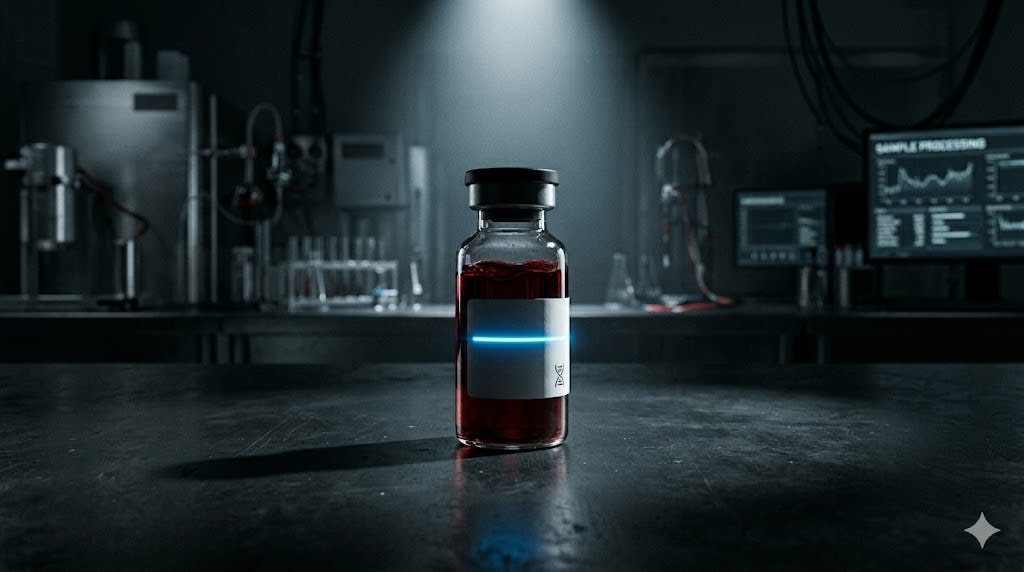
That paradigm may be beginning to evolve. In a May 2026 study published in The Journals of Gerontology, Series A, researchers at NYU Rory Meyers College of Nursing published findings suggesting that certain depressive symptoms are associated with a measurable cell-level biological signature — one detectable not through brain scans or self-report, but through a standard blood draw. One promising signal may be found inside monocytes: a specific class of white blood cell central to immune response. Inside those cells, Perez et al. (2026) measured accelerated biological aging associated with depressive symptoms such as anhedonia, hopelessness, and feelings of failure.
Depression isn't an abstract emotional failure or a lack of mental fortitude. Emerging evidence suggests it may leave measurable biological signatures that extend far beyond the subjective experience of mood.
These findings do not make subjective experience clinically irrelevant. Psychiatric assessment already draws on far more than a screening questionnaire — clinical interviews, patient history, behavioral observation, cognitive functioning, comorbidities, and risk factors all inform diagnosis. What these studies suggest is the possibility of objective biological signals that could complement that process: markers that exist independently of how clearly, or how accurately, a patient can describe their own suffering. That distinction is worth taking seriously.
II. The Biological Mechanism — The Immune-Brain Axis
To understand why a blood draw can reveal what is happening inside the brain, you must first understand that the brain and the immune system are not separate departments. They run on a bidirectional highway, constantly exchanging molecular messages, each governing the other's behavior in ways medicine is only beginning to map with precision.
The pathway begins with stress. Not the colloquial kind, but the physiological reality of chronic allostatic load — the cumulative biological cost of sustained psychological pressure: sustained elevations in cortisol, dysregulated sympathetic nervous system activity, chronic inflammatory signaling cascading through the bloodstream. The body, attempting to manage a threat that never fully resolves, keeps its emergency infrastructure running around the clock.
Chronic inflammation has been linked to processes associated with cellular senescence, or biological aging. Researchers have proposed that these mechanisms may contribute to the epigenetic changes observed in immune cells among people experiencing depressive symptoms. The NYU research team, using what are called epigenetic clocks (precision tools that measure biological wear-and-tear through chemical modifications to DNA), found that accelerated aging inside monocytes was most strongly associated with the non-physical, cognitive symptoms of depression.
Key Finding — NYU Rory Meyers College of Nursing, May 2026
The Monocyte Epigenetic Clock Study
Source: The Journals of Gerontology: Series A (2026)
Published in The Journals of Gerontology, Series A, the study by Perez et al. (2026) analyzed blood samples and depression scores from 440 women — 261 living with HIV and 179 without — drawn from the Women's Interagency HIV Study. Researchers applied two epigenetic clocks: a broad clock measuring aging across multiple cell types, and a monocyte-specific clock. The broad clock showed no significant link to depression. The monocyte-specific clock did — establishing that the biomarker is cell-type specific.
Symptoms most strongly correlated with monocyte aging: anhedonia, hopelessness, and feelings of failure — the cognitive core of depression rather than its physical symptoms. The authors note that the findings warrant replication in broader, more diverse populations before clinical conclusions can be drawn.
This distinction is critical. The finding is not telling us that sick people age faster in general. It is telling us that the specific cognitive symptoms of depression were associated with accelerated aging in a specific immune cell. The biological correlates associated with depression may leave detectable traces in the bloodstream, though the evidence remains preliminary.
A second line of research converges on the same territory from a different angle. In a 2022 study published in Molecular Psychiatry, researchers at the University of Illinois Chicago led by Dr. Mark Rasenick identified a blood-based biomarker for depression severity. A subsequent 2025 follow-up study by Gunay et al. (2025), also published in Molecular Psychiatry, confirmed the findings in a new population and extended them to milder symptoms — offering a biological signal that may span the full spectrum of depressive severity.
Key Finding — University of Illinois Chicago, 2022 & 2025
The Gs-Alpha Cellular Protein Test
Source: Molecular Psychiatry (2022, 2025)
Researchers developed a blood-based assay that measures Gs-alpha activity, a signaling protein found in cell membranes. In studies across Rasenick et al. (2022) and Gunay et al. (2025), Gs-alpha appears to become lodged inside lipid rafts — dense clusters within the cell membrane — undermining the cellular signaling pathways that regulate mood, motivation, and executive function.
The Gunay et al. (2025) replication study demonstrated the biomarker's signal across mild, moderate, and severe depression — and confirmed it normalizes in people who have previously had depression but are currently asymptomatic. The researchers also hypothesize the test may be able to detect antidepressant response within approximately one week of treatment — a claim that awaits prospective clinical validation but represents a meaningful shift in how treatment monitoring might work.
What both studies suggest is a consistent underlying pattern: evidence increasingly suggests that some forms of depression involve systemic immunometabolic processes, with biological correlates observed across the immune system, cellular signaling pathways, and the brain's neurochemistry. Researchers are increasingly identifying biological signals associated with depression in the bloodstream, aided by advances in molecular and epigenetic measurement technologies.
Early Signal: The Gs-alpha biomarker may show treatment-related changes within days in preliminary studies — well before most patients report clinical improvement.
III. The Reframe — Validation, Precision, and the End of Trial-and-Error
When a condition has measurable biological markers, the conversation around it begins to change. Objective biological markers often change how clinicians, researchers, insurers, and the public think about a condition — and the practical implications for treatment follow from that shift.
Conditions with measurable biological markers are often perceived differently than conditions diagnosed primarily through symptoms. While depression differs fundamentally from metabolic diseases such as diabetes, emerging biomarker research suggests it may also involve measurable biological processes.
The shame that surrounds depression — its long cultural association with weakness, with poor mental discipline, with a failure of character — has never been scientifically defensible. Stigma rarely disappears through argument alone. Objective biological evidence can sometimes change how conditions are perceived. If future validation studies confirm clinical utility, a clinician might one day be able to say, "Your monocytes are showing accelerated biological aging, and this signaling protein appears trapped in its membrane compartment — we're seeing measurable biological changes associated with depressive symptoms," the conversation begins to shift from moral to empirical. From why can't you just feel better to here is what the biology currently shows.
But the implications extend beyond validation. They extend into precision intervention.
Consider the current standard of care for pharmacological treatment of depression: a doctor, relying on the same PHQ-9 questionnaire, selects an antidepressant from a class of medications, prescribes a starting dose, and asks the patient to return in four to six weeks to assess whether anything has changed. If nothing has, a different medication is tried. Then another. The process remains heavily dependent on clinical observation and iterative adjustment, often requiring weeks or months before clinicians know whether a treatment is working — a period during which symptoms may persist or worsen before clinicians know whether the treatment is helping.
The experimental Gs-alpha protein test points toward a different model. If a blood draw can indicate within approximately one week whether a given antidepressant is shifting Gs-alpha activity — before the patient consciously feels any improvement — clinicians gain an earlier signal than self-report can provide. Adjust the dose. Switch the compound. Track the biological response before waiting weeks for a patient to describe whether they feel different.
Commercial Example — NeuroKaire, Launched September 9, 2025
BrightKaire: Patient-Derived Neuron Testing
BrightKaire is a distinct category of innovation from the NYU and UIC research — not a study but a commercially launched clinical platform, certified by CMS under the Clinical Laboratory Improvement Amendments (CLIA) for high-complexity clinical testing. Launched September 9, 2025, it is currently orderable by clinicians in 49 states (pending approval in New York).
The platform begins with a patient's blood sample and uses induced pluripotent stem cell (iPSC) methods originally developed by Nobel Prize-winning researcher Shinya Yamanaka to grow patient-specific frontal cortical neurons in a laboratory. AI imaging then analyzes how those neurons respond to a panel of antidepressants, measuring laboratory markers associated with neuroplasticity before any medication is prescribed. BrightKaire has entered clinical use, but independent validation studies remain limited compared with established laboratory diagnostics. Unlike the NYU and UIC findings, BrightKaire's clinical utility has not yet been established through large-scale independent validation studies.
The underlying biology is grounded in legitimate advances in stem-cell science. Validation of BrightKaire's clinical predictive accuracy includes an initial study published in Translational Psychiatry (2021) using an early iteration of the platform under its former name, Genetika+, with further clinical trials and development ongoing. Readers and clinicians should weigh the platform's early-stage commercial context accordingly.
Before overstating what these findings currently permit, a note of precision is warranted. None of these biomarkers is yet a standalone clinical replacement for psychiatric assessment. No blood-based biomarker for depression is currently recommended as a routine diagnostic standard by major psychiatric practice guidelines. Larger validation studies, replication across diverse populations, and regulatory review remain necessary before such tests become routine diagnostic tools.
The monocyte epigenetic clock findings are compelling, but they are associational — correlation between immune cell aging and depressive symptoms does not automatically establish that measuring one can replace evaluating the other. These are early chapters, not final verdicts.
But taken together, these findings suggest that objective biological markers associated with depression may be moving closer to clinical application, although substantial validation work remains.
The future of mental health care may increasingly involve precision diagnostics. Measurement does not guarantee recovery, but it dramatically improves our ability to navigate it.
IV. The Systemic Audit
There is a version of progress in mental health that looks like awareness campaigns, destigmatization pledges, and expanded access to talk therapy. All of it has value. But awareness, on its own, is a proxy metric — it measures comfort with a subject, not capacity to address its underlying biology. The research emerging from epigenetics and immunology suggests something more granular may now be possible.
Many forms of depression appear to be associated with pathways involving multiple physiological systems operating under sustained stress — the immune system, the endocrine system, the cellular machinery of the brain itself — each leaving its own measurable evidence in the bloodstream. Chronic stress has been associated with processes linked to cellular aging in monocytes, alterations in signaling protein behavior within cell membranes, and disruptions in neuronal function related to motivation, pleasure, and future orientation. These are physiological events with molecular signatures, measurable outside a brain scanner, in the same clinical setting where we check cholesterol or blood glucose.
Elite athletics offers an imperfect but instructive parallel. When a competitive athlete's performance drops, coaches combine subjective reports with physiological measurements — lactate threshold, inflammatory markers, hormonal panels — rather than relying on either alone. The analogy has limits: athletic performance metrics are often more directly quantifiable than psychiatric states. But the directional point holds. Objective measurement does not replace clinical judgment. It informs it more precisely.
What these findings invite — and this is interpretation, not yet clinical consensus — is a reorientation in how we frame mental health progress. Awareness campaigns have served a real purpose: reducing stigma, encouraging treatment, moving depression into mainstream conversation. But the data emerging from epigenetics and immunology suggests we may now have tools to supplement that work — to ask not just whether someone is willing to discuss how they feel, but whether we can read biological evidence of what is happening beneath that feeling.
The thesis these studies collectively support is a modest but important one. Not that we have solved depression. Not that the questionnaire is dead. But that the instrument panel is beginning to light up where previously there were no instruments at all. For a condition that has resisted objective measurement for the entirety of modern psychiatry's existence, that is not a small thing. The body has always reflected at least some of the biological processes associated with mental illness. What may finally be changing is our ability to measure them with increasing precision.
Citations
Perez NB, Xu K, Xu Y, et al. Monocyte epigenetic age acceleration is linked to non-somatic depressive symptoms in women with and without HIV. J Gerontol A Biol Sci Med Sci. 2026;glag083. doi:10.1093/gerona/glag083
Rasenick MM, et al. A peripheral biomarker for depression and antidepressant response. Molecular Psychiatry. 2022;27:1640–1646. doi:10.1038/s41380-021-01399-1
Gunay A, Targum SD, Leow AD, Ajilore O, Rasenick MM. A simple platelet biomarker is associated with symptom severity in major depressive disorder. Mol Psychiatry. 2025;30:3551–3559. doi:10.1038/s41380-025-02941-1
NeuroKaire. BrightKaire clinical platform. CLIA-certified laboratory. U.S. Launch September 2025. neurokaire.com
About the Creator
Khali Sollis
Khali Sollis is a writer and independent researcher exploring the science of the human mind and behavior. Her work examines questions at the intersection of neuroscience, psychology, cognition, mental health, and everyday human experience.
Enjoyed the story? Support the Creator.
Subscribe for free to receive all their stories in your feed.
Comments
There are no comments for this story
Be the first to respond and start the conversation.