
WHEN THE GHOST HUNT GETS MURKY:
My Complicated Feelings About Zak Bagans

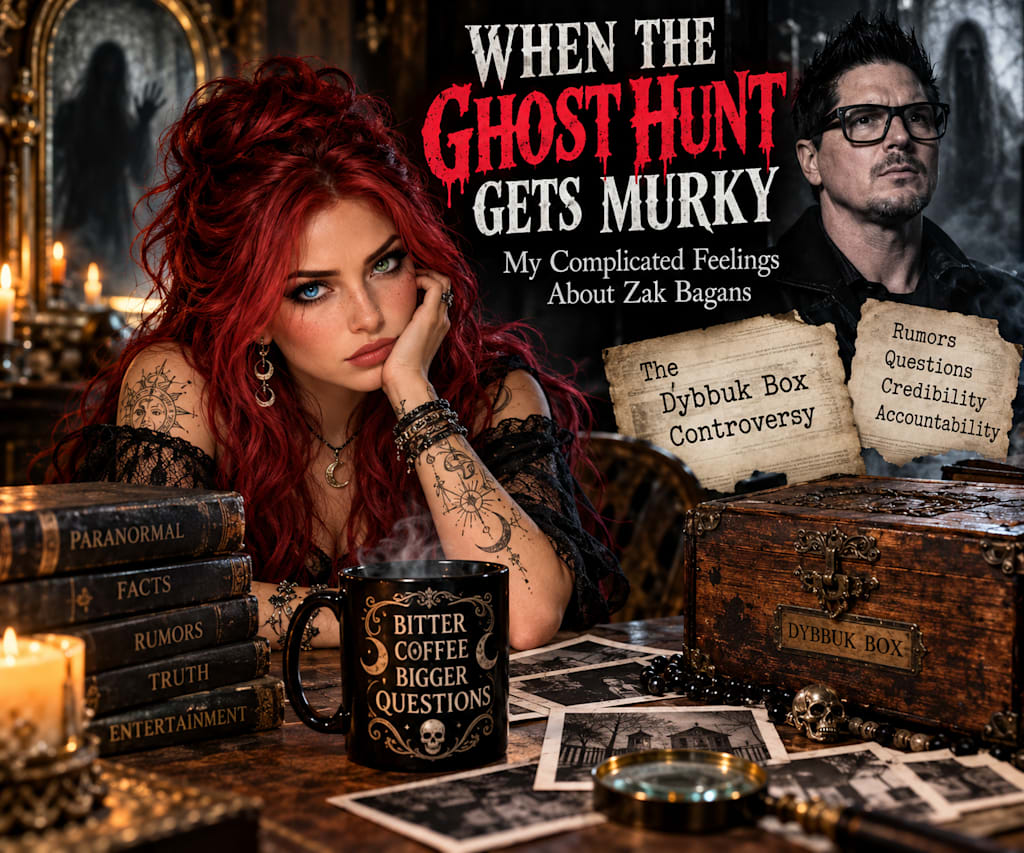
WHEN THE GHOST HUNT GETS MURKY: My Complicated Feelings About Zak Bagans
By Miss Lil | A Bitter Cup of Coffee ☕
There is nothing quite like settling down with a steaming cup of morning coffee, ready to enjoy a little paranormal entertainment, only to find yourself wondering whether the man leading the investigation deserves the same scrutiny he gives the things lurking in the dark.
And lately, that coffee has been tasting a little more bitter than usual.
Let me make one thing clear right out of the gate: I have been a fan of Ghost Adventures. I enjoy the investigations, the creepy locations, the historical mysteries, and the possibility that there might be more to this world than what we can see with our own two eyes. There is something wonderfully unsettling about watching a team walk into a supposedly haunted building and try to figure out what happened there.
Zak Bagans has built a recognizable name in paranormal entertainment. His intensity, his willingness to explore allegedly haunted locations, and his fascination with supposedly cursed objects have made him a familiar face to millions of viewers.
But somewhere along the way, over the last six years or so, I have found myself questioning more than the spirits.
I have started questioning the choices, the judgment, and the line between investigating something mysterious and selling a mystery to an audience hungry for a good scare.
And, honey, that is where my coffee starts getting cold.
THE DYBBUK BOX: A GHOST STORY WITH A VERY HUMAN BEGINNING
Let's talk about the elephant in the haunted room.
Or, in this case, the wine cabinet.
The Dybbuk Box became one of the most recognizable allegedly haunted objects in modern paranormal culture. Its story involved a sinister spirit, disturbing experiences, unexplained misfortune, and a trail of increasingly frightening claims. Eventually, the object found its way into Zak Bagans's Haunted Museum in Las Vegas, where it became one of the collection's major attractions.
It was a spectacular story. The kind that practically begs to be turned into a horror movie.
There was just one rather inconvenient problem.
The man who created the original story eventually admitted that he had made it up.
In a 2021 investigation published by Inverse, journalist Sarah Sloat spoke with Kevin Mannis, who acknowledged that the elaborate backstory he had attached to the cabinet was fictional. Mannis described the Dybbuk Box as a creative writing project that had taken on a life of its own. His account was also examined by paranormal investigator Kenny Biddle in Skeptical Inquirer.
The cabinet was real. The elaborate origin story that made it famous was another matter entirely.
Sources: Inverse, Finally, the Truth Behind the 'Haunted' Dybbuk Box Can Be Revealed, and Skeptical Inquirer, The Dibbuk Box.
Now, before anyone starts throwing holy water at my coffee cup, let me clarify something.
I do not blame Zak Bagans for the box's original creation.
He did not invent the original story, and I am not going to pretend that he did. The fictional backstory existed before the object became part of his collection.
But that is not where my questions begin and end.
BELIEVING IN SOMETHING IS NOT THE SAME AS PROVING IT
According to the Inverse investigation, Bagans continued to believe that the box was cursed even after Mannis's admission. In correspondence with the journalist, Bagans maintained that people had experienced troubling events around the object and argued that its origins did not necessarily settle the question of its alleged paranormal properties.
That distinction matters.
Someone can invent a story about an ordinary object, and another person can subsequently have a frightening or unexplained experience involving it. Human experiences are complicated. People can be sincere about what they experienced without necessarily being correct about its cause.
But there is a difference between saying, "I experienced something I cannot explain," and presenting a particular explanation as established fact.
That difference is especially important when the person making the claim has a television audience, a museum, a recognizable brand, and a financial interest in keeping people fascinated.
I can accept that Zak believes what he says he believes. I can accept that he may have experienced things he genuinely cannot explain.
What I struggle with is the question of where personal belief ends and responsible presentation begins.
Once the creator of a supposedly cursed artifact admits that its famous history was invented, shouldn't that information become a central part of the conversation?
Shouldn't viewers be told plainly what has been established, what has been disputed, and what remains speculation?
A good paranormal investigator should be willing to investigate a story even when the evidence threatens to ruin the story.
Especially then.
AND THEN THERE IS THE QUESTION OF CREDIBILITY
The Dybbuk Box is not the only reason questions have been raised about Bagans's professional credibility.
In 2020, Skeptical Inquirer published reporting on allegations of extensive unattributed material in Ghost Hunting for Dummies, a book credited to Bagans. Researcher Kenny Biddle identified material that he said had been taken from at least twenty sources without appropriate attribution.
That is a separate controversy from the Dybbuk Box, and it should be evaluated on its own evidence. But it raises a broader question about standards in paranormal entertainment: how much confidence should an audience place in the research behind a program when concerns have been raised about sourcing and accuracy?
You can read the reporting here: TV Ghost Hunter Bagans Caught in Plagiarism Scandal.
I am not bringing this up to suggest that every investigation is fabricated or that every unexplained event is meaningless. That would be just as careless as accepting every supernatural claim without question.
I am bringing it up because credibility is not something a person gets to claim indefinitely without maintaining it.
When you build a career around uncovering the truth behind mysteries, the way you handle ordinary, verifiable facts matters just as much as the way you interpret an unexplained noise in a basement.
You cannot demand that your audience take your investigations seriously while treating reasonable questions about your methods as an inconvenience.
At least, you shouldn't expect everyone to keep doing so.
THE RUMORS, THE QUESTIONS, AND THE DANGER OF GETTING AHEAD OF THE FACTS
There are rumors and allegations that circulate around public figures, especially those who have spent years in the spotlight. Some turn out to be supported by credible evidence. Others are exaggerated, distorted, or based on incomplete information.
That is precisely why I refuse to treat every whisper on the internet as a proven fact.
If a new allegation about Bagans is going to be discussed, it deserves to be examined carefully. What is the original source? Is there corroborating evidence? Has the person making the claim provided documentation? Has Bagans responded? Are reputable outlets reporting the allegation, or is the story being repeated from one social media post to another?
Those are not questions designed to protect a celebrity.
They are questions designed to protect the truth.
And yes, the same standard should apply to paranormal investigators, television personalities, skeptics, and anyone else who expects the public to believe what they say.
I can be disappointed in someone's judgment without pretending I know every detail of their private life. I can criticize a public claim without turning speculation into a verdict.
That is not weakness. It is basic accountability.
Still, I understand why rumors can hit differently when they involve someone you have watched and enjoyed for years. There is a particular disappointment that comes when the person behind the entertainment starts making you question the entertainment itself.
You begin looking back at old episodes differently.
You wonder which details were thoroughly researched, which conclusions were interpretations, and which moments were shaped for television.
And once those questions take root, they are difficult to sweep away.
I DON'T NEED EVERY GHOST TO BE REAL. I NEED HONESTY.
Here is the thing, Zak.
I do not need every investigation to produce a spectacular result. I do not need every abandoned hospital to contain a spirit. I do not need every strange sound to be a demon, every flickering light to be paranormal, or every object with a disturbing history to be cursed.
Sometimes an investigation should end with, "We don't know what happened."
Sometimes the most interesting conclusion is that the evidence simply isn't strong enough.
And sometimes the answer is that a compelling story was just that: a compelling story.
There is nothing wrong with telling a ghost story. There is nothing wrong with producing entertainment that makes people clutch their blankets a little tighter. There is even room for sincere disagreement about experiences that cannot be readily explained.
But there is a serious difference between inviting people to wonder and encouraging them to accept a claim without sufficient evidence.
I would rather watch an investigator admit uncertainty than watch someone stretch a questionable claim into a season's worth of supernatural certainty.
I would rather see a famous investigator correct the record than double down because the original story has become too profitable, too popular, or too deeply woven into a personal brand.
And I would rather have a few disappointing episodes than discover that the trust I placed in a show was misplaced.
Because the unexplained is fascinating enough without adding unnecessary fiction and asking the audience to mistake it for proof.
SIX YEARS OF QUESTIONS WILL CHANGE HOW YOU WATCH
I am not sitting here claiming that I have all the answers about Zak Bagans. I don't.
I am not declaring that everything he has ever investigated was a hoax. I cannot establish that, and I will not pretend otherwise.
What I can say is that the Dybbuk Box controversy and the separate questions raised about his book have given me legitimate reasons to think more critically about the material being presented.
And after years of watching, I find myself in an uncomfortable position: I am still interested in the paranormal, but I am less willing to accept the authority of the person telling me what I am supposed to be seeing.
That is a difficult place for a fan to land.
You want to enjoy the show. You want to believe the investigation is being conducted in good faith. You want to feel that the people asking questions in the dark are also asking hard questions of themselves when the cameras stop rolling.
But fandom should never require us to switch off our judgment.
Liking someone's work does not mean endorsing every decision they make. Enjoying a television series does not obligate us to defend its host. And being interested in the supernatural does not mean abandoning ordinary standards of evidence.
If anything, the more extraordinary the claim, the more important those standards become.
MY COFFEE IS BITTER, BUT MY MIND IS STILL OPEN
So where does that leave me?
Somewhere between curiosity and disappointment.
I can appreciate the entertainment Ghost Adventures has provided me while questioning the way certain stories have been handled. I can acknowledge that Bagans may sincerely believe in the paranormal while still asking whether his public claims are adequately supported. I can remain fascinated by allegedly haunted objects without accepting every frightening tale attached to them.
And I can wait for credible evidence before deciding what to think about a new allegation.
That last part matters. Criticism should be grounded in facts, not simply in the desire to see a public figure fall.
But neither should a famous name be treated as a shield against scrutiny.
The paranormal world is built around questions. What happened here? What caused that sound? Is there an explanation we have overlooked? Can we distinguish what we know from what we merely suspect?
Those questions should not stop at the door of the investigator's own reputation.
If we are going to demand answers from the dead, perhaps we should demand a little more transparency from the living.
Because the scariest thing in this business may not be a shadow moving across a hallway or a mysterious knock from inside a locked room.
It may be the moment a fan realizes that the question they should have been asking all along was not whether the house was haunted.
It was whether the story was being told honestly.
And with that, I shall finish my coffee.
Still a fan of the paranormal? Absolutely.
Prepared to believe everything I am told? Not anymore.
Miss Lil has questions, and this time, the ghost isn't the one sitting in the hot seat. ☕👻
Editor's note: This article distinguishes documented controversies from unverified rumors. The Dybbuk Box's original backstory was admitted to be fictional by its creator; that admission does not independently establish the cause of every later experience reported around the object.
About the Creator
Lilithea Adasia
I dig where others look away. 🖤 True crime, paranormal mysteries, uncomfortable truths, and the beautifully broken human experience. I chase the stories others bury and ask the questions others avoid. Come curious. Leave questioning.
Enjoyed the story? Support the Creator.
Subscribe for free to receive all their stories in your feed.
Comments