politics
Political figures, histories, and current events in the whole scope of modern and past politics. Work place politics.
Social Work England: Accountability Delays Raise Questions in Bristol Social Services SWE Oversight Case
Social Work England faces scrutiny over SWE delays in complaint handling and safeguarding oversight involving Bristol social services. Social Work England is the UK regulator responsible for social worker accountability, regulation, and public protection.
By Alexander Chartman6 months ago in Journal
The Iran War Has Created the Largest Oil Crisis in History. Here Is How It Is Destroying Economies From Pakistan to Chile — and Why It Won't End Even if the Strait Reopens Tomorrow.
The 2026 Iran war fuel crisis has been characterised by the International Energy Agency as "the greatest global energy security challenge in history." That is not rhetorical excess. It is a technical description of what happens when the closure of the Strait of Hormuz disrupts 20 percent of global oil supplies and significant volumes of liquefied natural gas — simultaneously and without warning — in a world whose energy infrastructure has been built on the assumption that this particular chokepoint will remain open. The world has never built an adequate alternative. It had no plan for this. And now it is living the consequences.
By Gideon Polycarp6 months ago in Journal
Iran, FIFA, and the 2026 World Cup: When Football Collides With Global Politics
Football has always claimed to unite the world. But every few years, reality interrupts the slogan. Because beneath the stadium lights, billion-dollar broadcasts, and national anthems lies a truth many fans prefer to ignore:
By Omasanjuwa Ogharandukun7 months ago in Journal
Authorship vs Refinement
Much of the confusion surrounding artificial intelligence and writing comes from a failure to distinguish between two fundamentally different acts: originating ideas and refining their expression. These acts are often treated as interchangeable, as though whoever touches the final form must also be the source of the thought itself. That assumption does not reflect how writing has ever worked, nor does it reflect how human thinking actually unfolds.
By Peter Thwing - Host of the FST Podcast7 months ago in Journal
Institutions Fear Inference More Than Lies
Institutions are often willing to tolerate isolated falsehoods, minor inaccuracies, selective framing, and even outright contradictions. A single lie can be corrected, buried, explained away, or isolated from the larger structure. What institutions consistently resist is not merely factual disagreement. They resist inference. They resist the moment when separate observations are connected into a pattern, and the pattern begins to imply responsibility.
By Peter Thwing - Host of the FST Podcast7 months ago in Journal
Immunity and Practical Unaccountability
In theory, no one is above the law. This phrase is repeated often enough that it functions as a civic mantra, a reassurance that power is ultimately constrained and that authority remains accountable to the same moral and legal standards imposed on everyone else. On paper, police officers, prosecutors, and government agents are subject to the law just like any citizen. They can be investigated, disciplined, sued, or prosecuted when misconduct occurs.
By Peter Thwing - Host of the FST Podcast7 months ago in Journal
Writing as Journal, Not Just Product
Not everything that matters begins as something meant for an audience. Much of what shapes a person most deeply starts as private wrestling, unfinished realization, unresolved tension, or a question that has not yet settled into a firm position. Treating writing only as a product meant for consumption misunderstands one of its most essential functions. Before writing becomes communication, it is often orientation.
By Peter Thwing - Host of the FST Podcast7 months ago in Journal
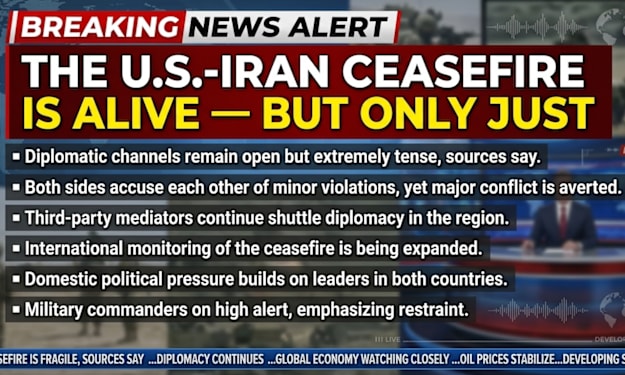
The U.S.-Iran Ceasefire Is Alive — But Only Just. Here Is What Is Happening Right Now
This is the ceasefire that isn’t quite a ceasefire. Since early April, the United States and Iran have been operating under a fragile truce in the broader conflict that erupted on February 28, when U.S. and Israeli strikes killed Iran’s Supreme Leader and triggered a regional war. The ceasefire has been violated repeatedly by both sides. Attacks have continued. Ships have been fired on. And yet, somehow, both Washington and Tehran have kept insisting the truce is technically still in effect.
By Gideon Polycarp7 months ago in Journal
Pentagon UFO Files Released: Bright Lights, Mysterious Orbs, and the Questions That Refuse to Die
For decades, humanity has looked into the night sky and asked the same haunting question: Are we alone? Now, newly released Pentagon UFO files have reignited that conversation with fresh intensity. From glowing objects near the Moon to strange “super-hot” orbs moving at impossible speeds, the U.S. government has released another batch of documents tied to what officials now call Unidentified Anomalous Phenomena, or UAPs.
By Omasanjuwa Ogharandukun7 months ago in Journal
Every Alternative Is an Admission
The Current System Should Not Be Treated as the Neutral Baseline The current redistricting system is often treated as the normal starting point, while every alternative is treated as an experiment that must justify itself. That framing is backwards. The current system is already an experiment in political assignment. It already decides which voters belong together before they vote. It already gives enormous power to whoever controls the boundaries. It already allows voters to be packed, cracked, attached, diluted, concentrated, divided, or rearranged while still maintaining the appearance of legal process. The familiar system should not receive moral credit merely because people are used to it.
By Peter Thwing - Host of the FST Podcast7 months ago in Journal
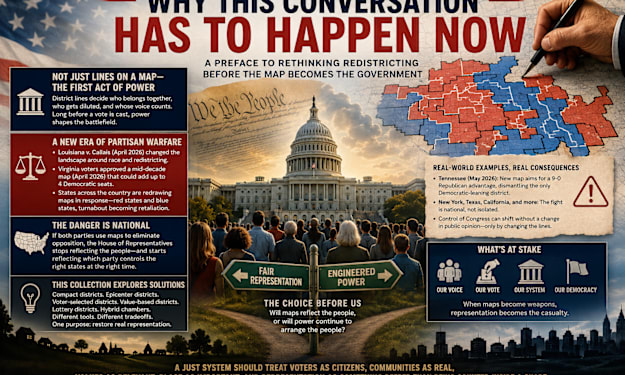
Why This Conversation Has to Happen Now
This Is Not an Abstract Exercise Brainstorming alternatives to redistricting can sound theoretical until the country enters a moment when the map itself becomes one of the main weapons of national power. At that point, the question stops being academic. It becomes immediate. If congressional control can be altered not mainly by persuading voters, but by changing the containers those voters are placed into, then redistricting is not a procedural side issue. It is one of the most consequential political powers in the country.
By Peter Thwing - Host of the FST Podcast7 months ago in Journal