
The U.S.-Iran Ceasefire Is Alive — But Only Just. Here Is What Is Happening Right Now
Iran is accusing America of breaking the truce. The U.S. says it was self-defence. A peace deal is reportedly on the table — but Trump is warning of a “big glow” if Iran doesn’t respond seriously. Here is the minute-by-minute picture of the most dangerous diplomatic tightrope in the world right now.
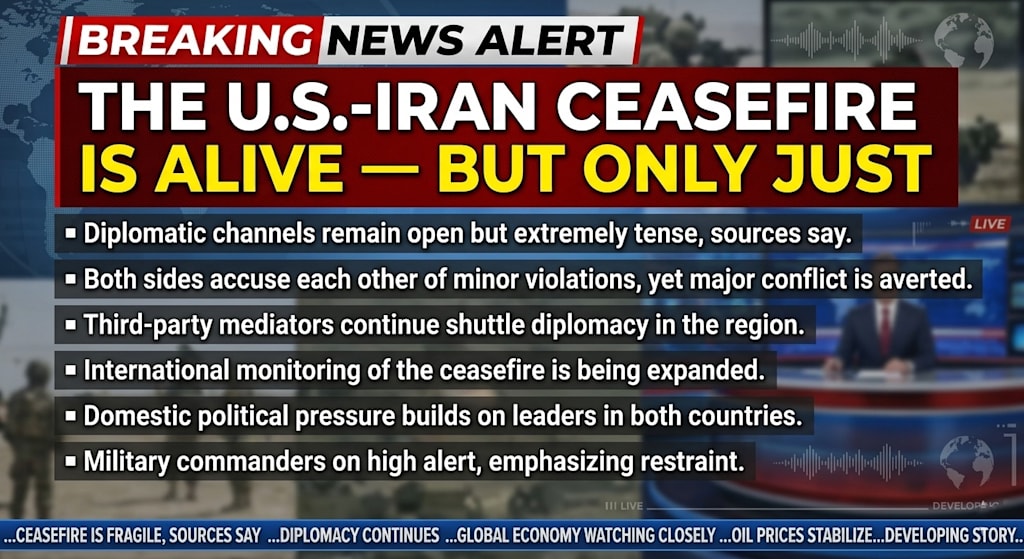
This is the ceasefire that isn’t quite a ceasefire.
Since early April, the United States and Iran have been operating under a fragile truce in the broader conflict that erupted on February 28, when U.S. and Israeli strikes killed Iran’s Supreme Leader and triggered a regional war. The ceasefire has been violated repeatedly by both sides. Attacks have continued. Ships have been fired on. And yet, somehow, both Washington and Tehran have kept insisting the truce is technically still in effect.
As of this morning, that remains true. But only barely.
What Happened in the Last 48 Hours
On the night of May 7 into the early hours of May 8, three U.S. Navy destroyers — the USS Mason, USS Truxtun, and USS Rafael Peralta — were transiting the Strait of Hormuz when Iran opened fire with missiles, drones, and small assault boats.
The U.S. military confirmed that all threats were detected and destroyed. None of the three warships was struck. In response, the Pentagon launched what it described as “self-defense strikes” against Iranian ports.
Iran’s Foreign Ministry immediately condemned the strikes, calling them “aggressive action by the terrorist U.S. military” against Iranian oil tankers and coastal areas near the strait. Foreign Minister Abbas Araghchi posted on social media: “Every time a diplomatic solution is on the table, the U.S. opts for a reckless military adventure.”
Trump responded with characteristic bluntness. “They trifled with us today. We blew them away,” he said. “They should not have done that today.”
Is the Ceasefire Still On?
This is the question the entire world is asking.
Trump says yes — with conditions. He confirmed on Friday that the ceasefire is “still in effect,” but added a stark warning: if Iran does not accept a peace deal, the U.S. would “knock them out a lot harder, and a lot more violently.” He also posted his most extreme threat yet: “If there’s no ceasefire, you’re not going to have to know. You’re just going to have to look at one big glow coming out of Iran.”
That language — “one big glow” — is widely understood as a reference to overwhelming military force. Some analysts have interpreted it as referencing nuclear capability, though the White House has not formally clarified.
Secretary of State Marco Rubio took a more measured tone on Friday, saying the U.S. was awaiting Iran’s response to a peace proposal. “We’ll see what the response entails,” Rubio said. “I hope it’s a serious offer.”
What the Peace Proposal Actually Involves
The broad contours of the U.S. proposal, as reported by CBS News and other outlets, centre on several key demands.
Washington wants Iran to formally halt its blockade of the Strait of Hormuz and allow international shipping to resume freely. It wants verifiable limitations on Iran’s nuclear programme. It is demanding an end to Iranian support for Hezbollah, the Houthis in Yemen, and other proxy militias across the region. And it wants a formal acknowledgement that the post-Khamenei Iranian government will not pursue nuclear weapons.
Iran, for its part, is demanding that the U.S. counter-blockade on Iranian ports be lifted first — before any agreement can move forward. It is also demanding international guarantees that U.S. and Israeli strikes will not resume if Iran enters negotiations in good faith.
These are not small gaps. They are fundamental disagreements about who blinks first.
Why the Next 72 Hours Matter
The Russia-Ukraine ceasefire announced by Trump runs from May 9 to 11. If Trump can point to two simultaneous diplomatic wins — a pause in Ukraine and a breakthrough with Iran — before that window closes, it would represent a significant shift in his foreign policy legacy.
But Iran has been burned before. The memory of the 2015 nuclear deal — the JCPOA — which the U.S. unilaterally withdrew from in 2018 under Trump’s first term — looms over every negotiation. Tehran has reason to be sceptical that any agreement with Washington will hold.
And yet the costs of continued conflict are severe for both sides. Iran’s economy is under devastating pressure from the blockade of its own ports. The U.S. faces legal challenges to its tariff regime, elevated energy prices, and growing domestic pressure about the war’s costs.
The ceasefire is fraying. The peace proposal is on the table. Iran’s answer is expected at any moment.
The world is watching — and waiting.
About the Creator
Enjoyed the story? Support the Creator.
Subscribe for free to receive all their stories in your feed.
Comments
There are no comments for this story
Be the first to respond and start the conversation.