
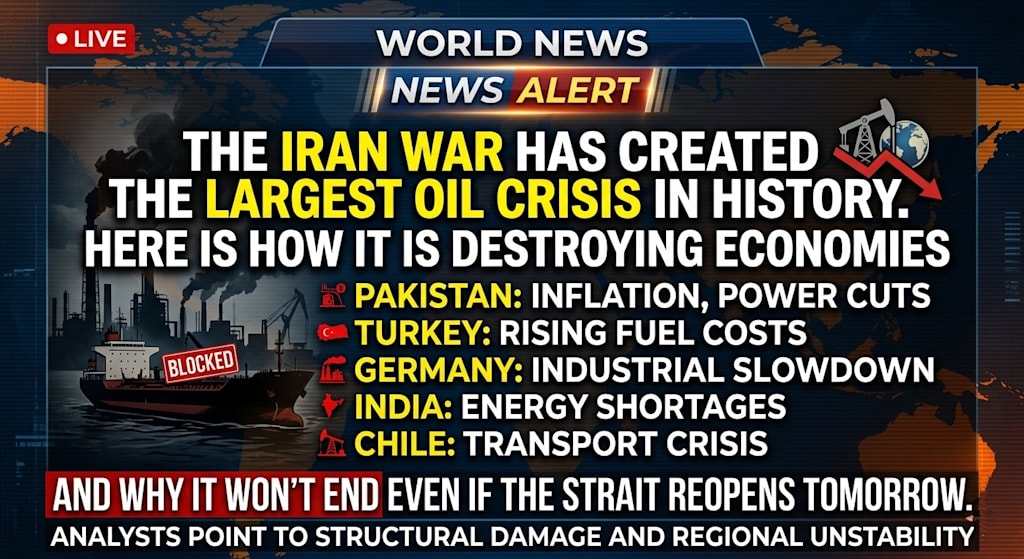
The Iran War Has Created the Largest Oil Crisis in History. Here Is How It Is Destroying Economies From Pakistan to Chile — and Why It Won't End Even if the Strait Reopens Tomorrow.
14.5 million barrels a day missing. European gas storage at 30% capacity. Bangladesh rationing fuel. Airlines cancelling routes across Asia. South American nations fracturing between oil exporters and importers. And analysts say even after the Strait reopens, high prices will persist for months. Here is the full, staggering economic picture.
The 2026 Iran war fuel crisis has been characterised by the International Energy Agency as "the greatest global energy security challenge in history." That is not rhetorical excess. It is a technical description of what happens when the closure of the Strait of Hormuz disrupts 20 percent of global oil supplies and significant volumes of liquefied natural gas — simultaneously and without warning — in a world whose energy infrastructure has been built on the assumption that this particular chokepoint will remain open. The world has never built an adequate alternative. It had no plan for this. And now it is living the consequences.
The largest-ever monthly increase in oil prices occurred in March 2026. Brent crude oil prices surged 10-13% to around $80-82 per barrel in the first days of the war, then continued climbing to above $126 per barrel at their peak, before settling into the $100-116 range that prevails today. The IEA estimates the war is removing approximately 14.5 million barrels per day from global supply — a number that represents the largest supply disruption in the history of the global oil market, exceeding even the 1973 Arab oil embargo. The effects are being felt on every continent, in every sector, by every person who consumes energy — which is to say, by everyone on earth.
"The head of the IEA described the situation caused by the war as the 'greatest global energy security challenge in history.'" — 2026 Iran War Fuel Crisis, Wikipedia, May 2026
In Europe, the picture is dire. Several publications projected that the continent would enter an energy crisis in 2026 similar to the 2022 energy crisis that followed the war in Ukraine. The conflict coincided with historically low European gas storage levels — estimated at just 30 percent capacity following a harsh 2025-2026 winter — causing Dutch TTF gas benchmarks to nearly double to over €60/MWh by mid-March. The European Commission has urged member states to fill their gas storages early to avoid price spikes later in the year. Roughly one-third of the world's helium production is impacted by the crisis, due to both the disruption of LNG production in Qatar and the very time-sensitive nature of helium transportation — a fact with immediate consequences for hospitals, semiconductor manufacturers, and scientific research institutions that depend on liquid helium for critical applications.
In Asia, the impact is severe and in some countries life-altering. In 2024, around 84 percent of the crude oil and 83 percent of LNG passing through the Strait went to Asia; nearly 70 percent of the oil went to China, India, Japan, and South Korea. Airlines in Southeast Asia and Oceania are either adding surcharges to fares or cancelling flights or routes. Australia, which sources most of its jet fuel from China, followed by Singapore and South Korea, has 30 days' worth of jet fuel held in reserve. Among the worst hit countries in the region are Pakistan, Bangladesh, and Vietnam. Pakistan — which was already facing an economic crisis before the war — is experiencing compounded energy and food inflation that is accelerating social unrest. Bangladesh, one of the world's most densely populated nations, is rationing fuel.
In South America, the 2026 fuel crisis has created a stark economic divide. While major oil exporters like Brazil and Venezuela are seeing revenue windfalls from spiked global prices, oil-importing nations and domestic consumers are facing severe inflationary pressure, transport disruptions, and social unrest. In face of sulfuric acid scarcity — because the US defense industry faces "near total" disruption of critical minerals supply, in particular sulfur, through the strait — China has banned exports impacting among other things copper production in Chile which imported sulfuric acid as a consumable. Chile's copper industry — a major national economic pillar — is being disrupted by a war that started in the Persian Gulf, thousands of miles away.
And the cruel final irony — confirmed by analysts across the political spectrum — is that even when the Strait of Hormuz reopens, the crisis will not end immediately. Even if Washington and Tehran reach a deal to end the war, oil prices are likely to remain elevated for some time due to the backlog of unloaded cargo, damaged regional infrastructure, and the need to clear Iranian mines. The world built its energy architecture on the assumption the Strait would always be open. Now it is learning what happens when that assumption proves wrong. The lesson is extraordinarily expensive. And it is not yet over.
About the Creator
Enjoyed the story? Support the Creator.
Subscribe for free to receive all their stories in your feed.
Comments
There are no comments for this story
Be the first to respond and start the conversation.