business wars
Iconic and sometimes notorious business wars between key thought leaders and competitors in multiple categories, genres, and topics. From Nintendo and Sega to Penthouse and Playboy.
The Iran War Has Created the Largest Oil Crisis in History. Here Is How It Is Destroying Economies From Pakistan to Chile — and Why It Won't End Even if the Strait Reopens Tomorrow.
The 2026 Iran war fuel crisis has been characterised by the International Energy Agency as "the greatest global energy security challenge in history." That is not rhetorical excess. It is a technical description of what happens when the closure of the Strait of Hormuz disrupts 20 percent of global oil supplies and significant volumes of liquefied natural gas — simultaneously and without warning — in a world whose energy infrastructure has been built on the assumption that this particular chokepoint will remain open. The world has never built an adequate alternative. It had no plan for this. And now it is living the consequences.
By Gideon Polycarp4 months ago in Journal
Authorship vs Refinement
Much of the confusion surrounding artificial intelligence and writing comes from a failure to distinguish between two fundamentally different acts: originating ideas and refining their expression. These acts are often treated as interchangeable, as though whoever touches the final form must also be the source of the thought itself. That assumption does not reflect how writing has ever worked, nor does it reflect how human thinking actually unfolds.
By Peter Thwing - Host of the FST Podcast4 months ago in Journal
Institutions Fear Inference More Than Lies
Institutions are often willing to tolerate isolated falsehoods, minor inaccuracies, selective framing, and even outright contradictions. A single lie can be corrected, buried, explained away, or isolated from the larger structure. What institutions consistently resist is not merely factual disagreement. They resist inference. They resist the moment when separate observations are connected into a pattern, and the pattern begins to imply responsibility.
By Peter Thwing - Host of the FST Podcast4 months ago in Journal
Immunity and Practical Unaccountability
In theory, no one is above the law. This phrase is repeated often enough that it functions as a civic mantra, a reassurance that power is ultimately constrained and that authority remains accountable to the same moral and legal standards imposed on everyone else. On paper, police officers, prosecutors, and government agents are subject to the law just like any citizen. They can be investigated, disciplined, sued, or prosecuted when misconduct occurs.
By Peter Thwing - Host of the FST Podcast4 months ago in Journal
Writing as Journal, Not Just Product
Not everything that matters begins as something meant for an audience. Much of what shapes a person most deeply starts as private wrestling, unfinished realization, unresolved tension, or a question that has not yet settled into a firm position. Treating writing only as a product meant for consumption misunderstands one of its most essential functions. Before writing becomes communication, it is often orientation.
By Peter Thwing - Host of the FST Podcast4 months ago in Journal
Every Alternative Is an Admission
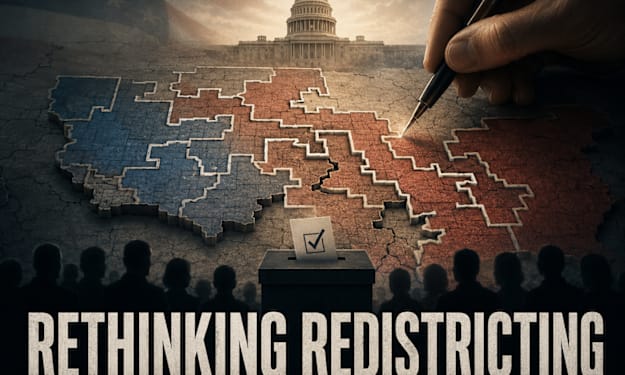
The Current System Should Not Be Treated as the Neutral Baseline The current redistricting system is often treated as the normal starting point, while every alternative is treated as an experiment that must justify itself. That framing is backwards. The current system is already an experiment in political assignment. It already decides which voters belong together before they vote. It already gives enormous power to whoever controls the boundaries. It already allows voters to be packed, cracked, attached, diluted, concentrated, divided, or rearranged while still maintaining the appearance of legal process. The familiar system should not receive moral credit merely because people are used to it.
By Peter Thwing - Host of the FST Podcast4 months ago in Journal
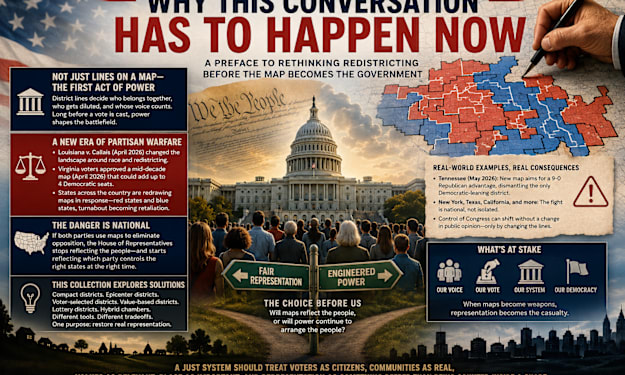
Why This Conversation Has to Happen Now
This Is Not an Abstract Exercise Brainstorming alternatives to redistricting can sound theoretical until the country enters a moment when the map itself becomes one of the main weapons of national power. At that point, the question stops being academic. It becomes immediate. If congressional control can be altered not mainly by persuading voters, but by changing the containers those voters are placed into, then redistricting is not a procedural side issue. It is one of the most consequential political powers in the country.
By Peter Thwing - Host of the FST Podcast4 months ago in Journal
The Leadership Test: How Hospital Leaders Can Use May to Build Trust
Every year, as National Nurses Week (May 6th–12th) and National Hospital Week (May 10th–16th) come around, healthcare organizations roll out familiar plans. Events get scheduled. Emails go out. Food is ordered.
By Brian Sutter4 months ago in Journal
It's Victory Day. Putin's Parade Has No Weapons, No Tanks, and No Confidence. Russia's Most Important National Celebration Has Become a Symbol of Its Own Failure.
Victory Day — May 9, the date Russia commemorates the Soviet victory over Nazi Germany in 1945 — has been the cornerstone of Vladimir Putin's political identity for a quarter century. Each year, on the same square where Soviet leaders once stood to review the Red Army, Putin has presided over a parade of ever-more-sophisticated Russian weapons: intercontinental ballistic missiles on mobile launchers, T-90 tanks in formation, Iskander short-range ballistic systems, and — in recent years — the unveiling of hypersonic missiles designed to signal Russia's technological supremacy to adversaries watching from Washington, Brussels, and Beijing. The parade is not mere ceremony. It is Putin's annual proof of concept — evidence that Russia is a great power, that the war is winnable, that the sacrifices demanded of the Russian people are justified by an outcome worth achieving.
By Gideon Polycarp4 months ago in Journal