
Xibei Says It’s Fine. Its Employees Are Waiting Until 2028 to Get Paid.
One Weibo post, a 600 million yuan loss, and the 10-day wage delay that tells a different story.
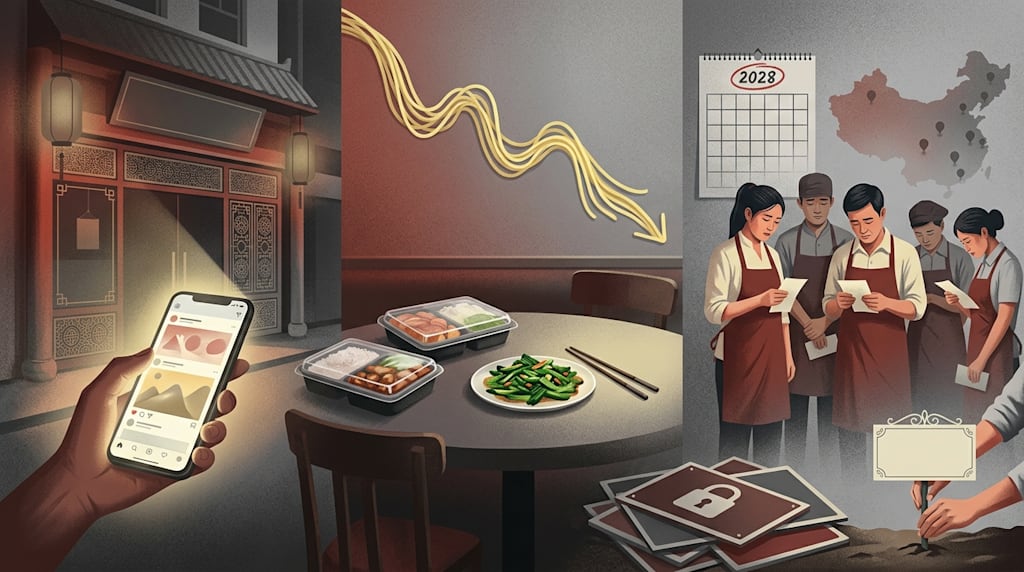
From a Weibo Post by Luo Yonghao to the “Total Collapse” Trending Topic: Xibei’s Darkest Year
On September 19, 2026, “Xibei Reportedly on the Brink of Total Collapse” trended on Weibo.
Xibei’s customer service responded fast. All stores nationwide are operating normally, and the public should view online information rationally. Employees at two Xibei stores, one in Xi’an and one in Shenzhen, told the media they had not received any closure notice. Customer traffic had not been affected.
On the same day, the Shenzhen employee said something else. Payday used to be the 10th of every month. Now it was the 20th.
Ten days later.
A Weibo Post
On September 10, 2025, Luo Yonghao posted on Weibo. A little over sixty characters: “Haven’t eaten at Xibei in a long time. Got off the plane today and ate there with a colleague. Found out almost everything is pre-made dishes, and it’s still that expensive. Honestly disgusting.”
Jia Guolong’s first response: Xibei does not have a single pre-made dish. He announced stores would open their kitchens to the public. Customers could see for themselves.
They did. They saw frozen broccoli with a two-year shelf life. Bagged chicken soup, heated and served. “Stir-fried” dishes delivered from a central kitchen, needing only reheating in the store.
The self-proof became a self-exposure.
Jia Guolong apologized and promised reforms. Customer traffic had already fallen. A store manager in Beijing later told the media that on the first weekend after the controversy, only six tables were occupied at noon.
Jia Guolong called it “the biggest external crisis since Xibei was founded.”
The Boss Won’t Eat His Own Food
During the controversy, a video of Jia Guolong inspecting a store resurfaced.
In the video, it is lunchtime. He sits down in the store. A server brings out dishes made through the standard service process: delivered from the central kitchen, reheated in the store. Jia Guolong glances at them. He does not pick up his chopsticks. He asks the server to go to the back kitchen and stir-fry two vegetables.
The exact date the video was filmed is unclear. It has been cited repeatedly. A boss sits in his own restaurant, does not eat the food made through his own standard process, and asks for fresh stir-fried vegetables. That does not need explanation.
Luo Yonghao’s Weibo post struck a nerve for the same reason. Consumers resented paying fresh-cooked prices for reheated food while the brand kept saying “every dish is delicious.”
A Loss of 600 Million
In November 2025, Jia Guolong revealed a number: from September 2025 to March 2026, Xibei’s cumulative losses exceeded 600 million yuan.
Half a year. 600 million. An average loss of more than 3 million yuan a day.
In the first quarter of 2026, Xibei closed 102 stores, about 30% of its total, affecting roughly 4,000 employees. The number of stores shrank from nearly 400 at its peak to about 203. Data from Narrow Door Restaurant Eye showed that as of September 10, 2026, Xibei had 226 stores operating nationwide.
The closure list included Foshan, Chongqing, and Yancheng. Xibei had completely withdrawn from those cities.
Wages, Waiting, and 2028
Store closures left employees holding pay stubs and notices.
In late February 2026, Xibei began large-scale personnel adjustments, according to reports. Some employees who refused pay cuts and asked for layoff compensation found that the company could not pay a lump sum. They received a notice to wait for reassignment.
A “Notice of Waiting for Reassignment” from Xibei’s Beijing platform branch stated the reasons: “a sharp decline in recent business volume,” “no normal work content to arrange at present,” and “facing huge losses.” During the waiting period, the employee would receive 2,540 yuan per month, from August to December 2026.
2,540 yuan was Beijing’s minimum wage at the time.
Former employees faced a more complicated situation. Several told the media that 2025 year-end bonuses, severance payments, and equity buyback payments had not been paid according to the original agreements. In late July 2026, Xibei unilaterally notified employees of changes to the payment agreements:
Year-end bonuses would be paid in five installments before the end of 2026, 20% each. Unpaid severance would accrue interest at an annual rate of 8% starting July 1, 2026, with 15% paid in the first half of 2027, 15% in the second half of 2027, 25% in the first half of 2028, and 25% in the second half of 2028. Equity transfer payments would accrue interest at 8% annually from July 1, 2026, and be paid in installments before December 31, 2028, depending on business recovery.
One former employee said that before the agreement was changed, Jia Guolong held an online meeting with former employees. Jia Guolong said they should believe the company could recover, but that it could not pay on time now. They would have to wait until 2028.
Another employee, when receiving a call from a supervising manager, was told: “It’s mandatory. This is not a negotiation.”
New Brands and Old Debts
Jia Guolong’s 2026 also included new brands.
In March 2026, Xibei launched a new brand, “Tianbian Shaguo Menmian.” Six months later, several stores suspended operations. Then “Tianbian Yangduo” opened its first store in Beijing Fengke Wanda, at the exact location of the former Tianbian Shaguo Menmian store.
A former employee publicly questioned on social media: “Using our compensation money to open new brands? If it succeeds, the wealth and reputation are his. The risk is all on us!”
Whether that statement is entirely accurate cannot be verified. It reflects one fact: while Xibei was delaying compensation payments to former employees, the company was incubating new brands.
In January 2026, Xibei completed an A-round financing. Investors included Zhang Yong, founder of Xin Rong Ji, and a company associated with Hu Xiaoming, former CEO of Ant Group. Registered capital increased from 89.9 million yuan to about 102 million yuan. Before the Spring Festival, Jia Guolong stepped down as CEO of the main Xibei brand. Founding member Dong Junyi returned to take over. Dong Junyi joined Xibei in 1992, starting as an apprentice. People inside the company said his “only goal is to get Xibei out of trouble.”
The new brands did not perform well. Tianbian Shaguo Menmian operated for only six months before several stores suspended business. Tianbian Yangduo’s first store opened at the site of a closed store. The company kept changing names and locations.
Not Just One Weibo Post
Attributing Xibei’s troubles entirely to Luo Yonghao’s Weibo post simplifies the facts.
Starting in the second quarter of 2025, China’s restaurant industry entered a contraction. Mid-to-high-end restaurants that relied on business banquets were hit especially hard. Tai Er, Song Hotpot, Haidilao, Xiabu Xiabu, Quanjude, and many others saw performance declines of 9% to 20% during the same period.
Xibei’s problem was this: it had built brand premium through a mid-to-high-end positioning and maintained the efficiency of chain expansion through central kitchens and pre-made ingredients. The tension between those two things had never been squarely addressed. Luo Yonghao’s post exploded because it said what many people had already felt but had not said.
After the controversy, the pre-made dish industry moved from “barbaric growth” into a phase of “mandatory transparency.” Xibei became the most visible sample at that turning point.
September 19
Back to the trending topic.
The company denied the claim that Xibei would “totally collapse.” Stores were indeed operating. The Shenzhen store still had a one-hour queue at morning peak. An employee at the Xi’an store said that if customers were worried about their stored-value balances, they could come to the store for a refund.
Wages had been delayed by 10 days. The waiting notice said 2,540 yuan. Severance payments would have to wait until 2028. New brands were opening at the sites of closed stores. The number of stores had gone from nearly 400 to 226.
Xibei will most likely not disappear in two or three months.
But for those former employees waiting for compensation in 2028, whether the brand survives and whether they get paid are two different things.
About the Creator
Jin
Writer of reamstories
https://reamstories.com/jin
Enjoyed the story? Support the Creator.
Subscribe for free to receive all their stories in your feed. You could also become a paid subscriber, letting them know you appreciate their work.
Comments
There are no comments for this story
Be the first to respond and start the conversation.