
The Real Reason McDonald’s Can’t Beat KFC in China (It’s Not the Burgers)
McDonald’s rules the world. In China, KFC built a 40-year network of small-town stores, all-day menus, and delivery routes that McDonald’s is still trying to catch.
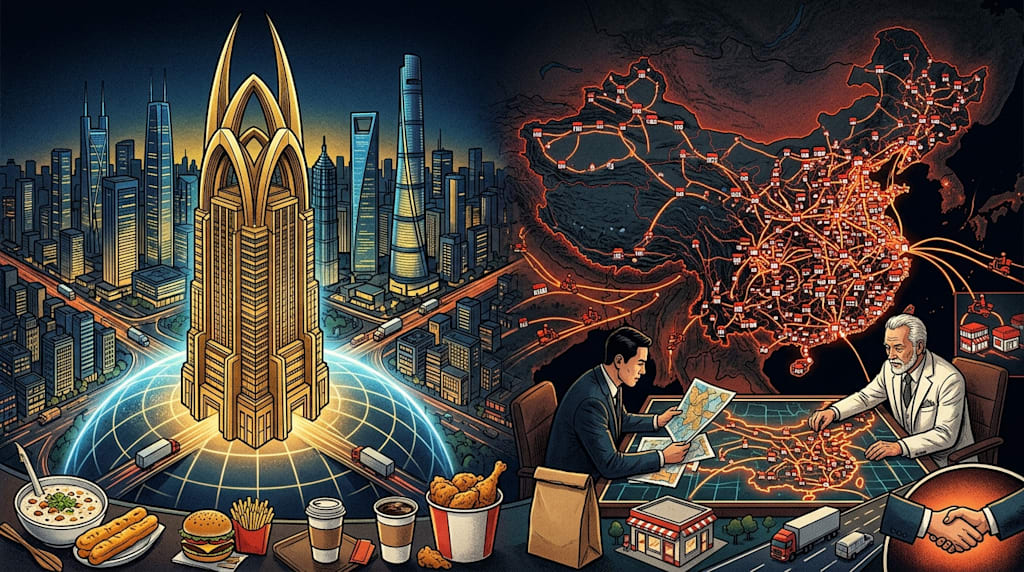
Why McDonald’s Cannot Catch KFC in China
1. The numbers
In 2025, McDonald’s had 45,356 restaurants worldwide. Systemwide sales were about $139.4 billion. KFC had 33,897 restaurants and about $36.4 billion in systemwide sales. McDonald’s is the global leader in Western fast food.
In China, the roles reverse.
By Q2 2026, McDonald’s China had 8,114 stores. KFC China had 13,789. KFC is 1.7 times larger. The gap is 5,675 stores. In the past year, McDonald’s China added 887 net stores. That is two to three a day. KFC kept opening stores too. The gap did not shrink. It grew from 5,011 to 5,675.
McDonald’s is pushing hard. The distance still grows.
In Q2 2026, McDonald’s said same-store sales in its International Developmental Licensed Markets rose 1.9%. The company also said China same-store sales were negative. KFC posted positive same-store sales, a 4% rise in transactions, and a 17.1% restaurant margin.
The puzzle is why McDonald’s cannot catch KFC in China.
2. Common explanations that fail
Many explanations rely on gut feeling. Most do not hold up.
KFC is cheaper
The opposite is true. Guojin Securities, citing Zhaomen Canyan data from 2024, put KFC’s average ticket at about 34 yuan. McDonald’s was about 28 yuan. KFC was 6 yuan more expensive. McDonald’s has built a budget reputation with its 13.9-yuan 1+1 deal and its Big Burger Combo starting at 22.9 yuan. In a 2023 CBNData and DT Finance survey, 46% said McDonald’s prices were reasonable. Only 13.6% said that about KFC. McDonald’s wins on value perception.
Young Chinese prefer KFC
The same survey found that 61.2% chose McDonald’s. Only 28% chose KFC. Post-90s and post-00s respondents also preferred McDonald’s. On social media, McDonald’s has a loud fan culture. KFC does not have the same visible fan base. This was not a nationally representative sample, so it does not prove that 60% of Chinese people love McDonald’s. It does show that among younger, online consumers, McDonald’s has strong appeal.
McDonald’s supply chain is not localized
This is false. McDonald’s China buys nearly 800,000 tons of ingredients a year. It handles more than 400 types of food and raw materials. By procurement value, more than 90% is local. Since 2018, McDonald’s and its suppliers have invested more than 12 billion yuan in China’s supply chain.
McDonald’s does not localize
Look at this year’s menu: pad kra pao pork, tom yum, curry chicken cutlet, rendang chicken, seafood burgers. McDonald’s has even added Southeast Asian flavors. Its prices have value perception. Young consumers do not dislike it. Its supply chain is localized. It opened nearly 900 stores in a year. Its menu is more local.
Still, KFC beats it on scale.
If these reasons fail, where does the problem lie?
3. First-tier cities are a draw. Lower-tier cities decide the winner.
Start with city structure.
In first-tier cities, KFC has 2,182 stores. McDonald’s has 2,185. They are almost tied. McDonald’s is ahead by three. Another brokerage report, citing Jiuqian data, says that in T1 cities, about 55% of KFC and McDonald’s stores can find the other brand within 500 meters. In big cities, they fight head-to-head.
If you live in an office tower in Beijing, Shanghai, Guangzhou, or Shenzhen, scroll Xiaohongshu, and eat a 13.9-yuan lunch, you may think the two are neck and neck.
First-tier cities are not China.
The real split starts below the second tier.
According to Zhaomen Canyan, KFC leads by about 867 stores in new first-tier cities. It leads by about 1,303 in second-tier cities. In third-tier and lower cities, KFC has about 4,491 stores. McDonald’s has about 2,200. The gap is nearly double.
In second-tier cities and below, KFC has about 3,594 more stores than McDonald’s.
The pattern is clear. McDonald’s is concentrated in first-tier and new first-tier cities. More than one-third of KFC’s stores are in third-tier and lower markets. The exact numbers vary by database. The direction matches both companies’ official expansion strategies.
In Shanghai, a worker may choose between McDonald’s and KFC downstairs. In many lower-tier cities and county markets, KFC arrived earlier. The consumer is not choosing between KFC and McDonald’s. There is no McDonald’s.
Even if McDonald’s cuts prices, its price advantage requires a store nearby.
4. KFC’s downmarket machine: small stores and franchisees
McDonald’s does not open county-town stores for a reason.
The answer lies in store economics.
A classic KFC store is about 170 square meters. Capital expenditure is about 1.6 million yuan.
A small city may not have the population density, spending power, or rent structure to support a standard large store. The traditional answer is to find another location or skip the city. KFC created the Small Town model: about 100 square meters, with capital expenditure of 500,000 to 700,000 yuan. The lighter Small Town Mini can cost about 500,000 yuan. That is roughly one-third of a traditional store.
Yum China says the average payback for new KFC stores is about two years. Small Town franchise stores target two to three years. A small city that could not support a large store can now get a lighter one.
KFC also uses franchisees’ money and local resources. In 2025, about 37% of KFC’s net new stores came from franchisees. In Q2 2026, 152 of 335 net new stores, or 45%, came from franchisees.
Small formats, low capital expenditure, franchisees, and a national supply chain turn store opening into modular blocks. Places that could not support a standard store may now work.
5. KFC sells more than fried chicken
Small stores helped KFC cross geographic borders. Its product line broke the border of what a Western fast-food restaurant should sell.
McDonald’s has localized more in recent years. Its core menu still centers on burgers, chicken, snacks, and coffee. KFC in China widened its boundaries earlier. It sells rice, congee, fried dough sticks, soy milk, desserts, coffee, local breakfast items, and regional dishes.
In 2002, KFC began selling century egg and pork congee. In 2003, it launched the Old Beijing Chicken Wrap. In 2008, it rolled out fried dough sticks nationwide. At the time, McDonald’s said it had no plans to launch them. In 2021, KFC took Wuhan hot dry noodles from a local test to a nationwide limited-time sale. It sold more than 1 million bowls in the first week.
A fried chicken brand from Kentucky sold a million bowls of Wuhan hot dry noodles in China in one week. That is more than localization. It is cross-border reinvention.
KFC also built an all-day product strategy.
At 7 a.m., it sells congee, fried dough sticks, flatbreads, tofu pudding, and coffee. At noon, it sells burgers, fries, chicken, and rice meals. At 3 p.m., it sells egg tarts and KCOFFEE, a store-within-a-store coffee brand, to compete for afternoon tea. At 6 p.m., it sells family buckets and sharing combos for family meals and delivery. It now has more than 300 KPRO locations, many embedded inside KFC stores. They sell grain bowls, high-protein sandwiches, and yogurt drinks. By the end of 2026, the target is 600. It is chasing light-meal and high-protein consumers too.
This feeds delivery.
By Q2 2026, about 54% of sales at KFC’s company-owned restaurants came from delivery. More than half. A dense network of more than 13,000 stores expands on-demand delivery coverage and shortens the average delivery radius. Breakfast, lunch and dinner, afternoon tea, and late-night demand let the same store network handle more orders.
In lower-tier cities, KFC makes stores smaller to expand geography. In big cities, it adds coffee and light meals to expand demand. McDonald’s is good at making a high-frequency fast-food meal fast and good. KFC turned itself into a restaurant network that takes orders from breakfast, main meals, afternoon tea, and delivery.
6. 2017: one step slow, every step slow
The battle between KFC and McDonald’s in China is a decades-long compound interest of network, perception, and strategy. Taste is secondary.
Many people think McDonald’s simply entered China three years later. A more important dividing line was the 2017 Golden Arches restructuring.
At the time, McDonald’s had about 2,500 stores in mainland China. The new company said it would raise store openings from about 250 a year to about 500. It named third- and fourth-tier cities as a growth direction. KFC already had more than 5,400 stores in China and covered more than 1,200 cities.
McDonald’s can localize. In the nine years since Golden Arches, it grew from about 2,500 stores to 8,114. Its execution is strong. What it lost was not one burger or one promotion. Fewer stores is a result, not the deepest cause.
The deeper gap is that KFC organized lower-tier markets, store formats, product dayparts, and the supply chain into a replicable expansion machine earlier. One step slow becomes, decades later, a distance that is hard to close.
7. McDonald’s is chasing a network
McDonald’s still has strong affection among young consumers and in internet culture. It is chasing hard. The white-haired man in the white suit already sat on street corners in many lower-tier cities and county markets for years. He kept putting breakfast, main meals, afternoon tea, coffee, and delivery into consumers’ hands.
McDonald’s has not failed.
In China today, McDonald’s is chasing an enormous restaurant network. KFC is only one part of it.
That network includes more than 13,000 KFC stores, dozens of product dayparts, a mature franchisee system, a national supply chain, and delivery radius. It does not win with one hit burger. It wins by showing up beside consumers every day, every meal, every time slot.
McDonald’s is still the stronger giant globally. In China, it faces an opponent that started earlier, went downmarket earlier, and smashed boundaries earlier.
McDonald’s may not lose. The chase is far from over.
The competition is about network, perception, and strategic compound interest. Burgers versus fried chicken is the surface. Whoever becomes infrastructure earlier is harder to catch.
About the Creator
Jin
Writer of reamstories
https://reamstories.com/jin
Enjoyed the story? Support the Creator.
Subscribe for free to receive all their stories in your feed. You could also become a paid subscriber, letting them know you appreciate their work.
Comments
There are no comments for this story
Be the first to respond and start the conversation.