
The Typhoon on the Ledger
A seafood wholesaler's twenty-three-year education in risk, failure, and the arithmetic of survival
The Typhoon on the Ledger
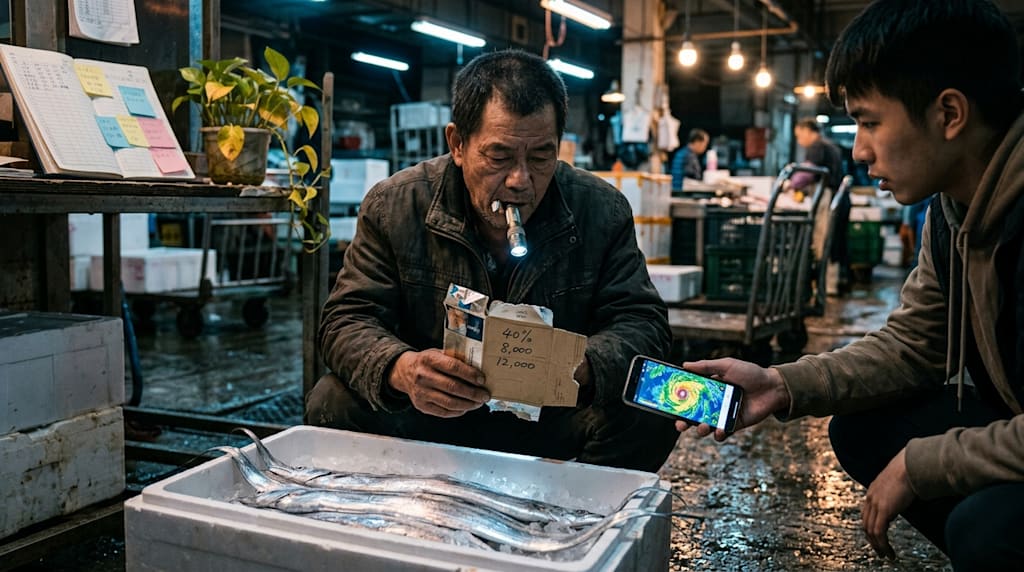
At four in the morning, the seafood wholesale market. Old Chen squats in front of a box of ribbonfish. Flashlight in his teeth. Beam on ice. Xiao Lin stands beside him, phone glowing. Weather app says typhoon may land. Xiao Lin says, "Don't buy. What if it gets stuck." Old Chen doesn't look up. He pulls a cigarette pack from his pocket, tears it open, writes on the back: probability 40%, loss 8,000, no typhoon profit 12,000, cold storage 3 days, two buyers. He hands it to Xiao Lin. "You calculate." Xiao Lin punches numbers. Old Chen says, "Buy half. Buy insurance. Leave half for Old Li." Xiao Lin asks, "What if the typhoon comes." Old Chen says, "Then we lose. After losing, we keep going." He stands. Knee cracks. Takes stomach medicine from his pocket. Swallows two dry.
This is Old Chen's twenty-third year in business. He doesn't know the term "risk pricing." He does it every day. Risk to him is a price list. This risk costs this much. That risk costs that much. Which can he afford? Which can't he? If he can afford it, he does it. If not, he doesn't. Old Chen is afraid. He has calculated.
When Xiao Lin first came, he thought Old Chen was bold. Later he found Old Chen was timid. Old Chen never bets everything or borrows from loan sharks. He stays out of unfamiliar trades. But he will bet on a 40% chance for a shipment, because if he loses he can still live. Risk is not gambling. Risk is arithmetic on a cigarette pack. Gambling is closing your eyes and betting big or small. Old Chen's cigarette pack has arithmetic.
At ten p.m., Xiao Lin scrolls short videos in the warehouse. Old Chen walks over. He doesn't scold him. He puts a stack of delivery slips on the table. "You scroll for three hours. Electricity costs 1.2 yuan. Those three hours, if you go sit with Old Zhou next door, he's shipping a truck of oranges tomorrow. He needs a loader. You go. Meet two drivers. Later your goods can ride with them." Xiao Lin says, "I'm tired." Old Chen says, "Tired, sleep." But he pushes the calculator over. Punches keys. "One driver saves you 200 yuan a month in freight. A year, 2,400. Two drivers, 4,800. You scroll three hours, earn 4,800 in opportunity." Xiao Lin doesn't speak. Old Chen leaves. Leaves the calculator. The number on the screen stays on.
Money for Old Chen is what the money could grow into elsewhere. Opportunity cost is not a line in the ledger. It is air. Invisible. Always there. He doesn't know the word "compound interest." He knows: meet one more person today, maybe one more road next year. More roads, less begging.
Old Chen ran a restaurant once. Lost money. He doesn't say "I failed." He has an old notebook. Cover greasy. Inside: March 2016. Rent 12,000. Revenue 30,000. Labor 10,000. Food cost 11,000. Loss 3,000. Beside it: menu too long, chef can't remember. Beside that: noodle shop next door sells only 8 dishes. Turns tables 6 times. Last page, a receipt: kitchen equipment recycled, 4,500 yuan. Old Chen shows the notebook to Xiao Lin. "Read." Xiao Lin reads. "Read again." Xiao Lin reads again. "Remember. Losing money isn't scary. Not knowing why you lost is scary." He closes the notebook. Puts it back in the drawer. In the drawer there's also a pothos. Leaves yellow. Old Chen takes a cup, waters it. Water overflows. Runs onto the notebook. He wipes it with his sleeve.
Failure is data. A label sticks to your body. Can't be torn off. Data is written on paper. Can be changed. The restaurant is gone. The notebook remains. The numbers in it later helped him avoid three pits: don't rent a storefront over 20% of revenue. Don't hire a kitchen team over 6. Don't sell a menu over 15 dishes.
Supplier sends an extra box of shrimp. Xiao Lin says, "Keep it. He won't know." Old Chen doesn't speak. Picks up the phone. The other side says, "Sent by mistake. Will pick up tomorrow." Old Chen says, "I'll wait." Next day, supplier comes. Old Chen loads the shrimp onto the truck. Supplier says, "From now on, your payment terms, 15 more days." Old Chen says, "Okay." At night, Old Chen writes in the ledger: one box shrimp, returned. Reputation, plus. Xiao Lin asks, "What's the use." Old Chen says, "You'll know later." Three months later, Old Chen is tight on cash. Supplier sends him 100,000 yuan of goods, no deposit. Old Chen sells the goods. Pays back the money. Supplier says, "No rush." Old Chen says, "Rush."
Trust is an asset. Morality is in the heart. Asset is on the ledger. Cheat once, earn once. Cheat twice, nobody plays with you. The market is only so big. If your name stinks, you can't even get through the door.
Old Chen has two ledgers. One records profit. One records cash. The profit one looks good. The cash one looks bad. Xiao Lin asks, "Why." Old Chen says, "Profit is an opinion. Cash is a fact." He points at accounts receivable: this 50,000, arrives next month. Accounts payable: this 30,000, due tomorrow. Card: 12,000. "If I can't collect 20,000 tomorrow, I have to borrow. Borrow, interest eats profit. Profit no matter how good, cash breaks, the shop dies." He has Xiao Lin write three numbers on a sticky note before leaving every day: how much in the card, how much to pay tomorrow, how much to collect tomorrow. Stick it on the computer. Under the keyboard cover, dozens of sticky notes. Yellow and blue, a few pink.
Money is flow. Balance is a photo. Flow is a movie. The photo looks good. The movie may cut out. Old Chen doesn't care how much profit is on the books. He cares whether he can open tomorrow.
Old Chen's cousin comes to borrow 50,000. Cousin says, "Why write an IOU, we're brothers." Old Chen says, "Write." Cousin is unhappy. Old Chen hands him the pen. "Write it clear, still brothers. Don't write, later not even brothers." Cousin writes. Presses fingerprint. Three years later, cousin pays back. Gives 2,000 extra interest. Old Chen takes 1,000. Returns 1,000. Cousin asks, "Why." Old Chen says, "You kept your word, I take interest. You're my brother, I return half." Cousin laughs. Old Chen laughs. The IOU is still there. Clipped in the ledger.
Human feelings and money. Old Chen talks money first. Talk it clear, human feelings last. A contract is not distrust. It is insurance for trust. Insurance isn't shameful. What's shameful is when something happens, biting each other.
Xiao Lin later wrote three lines himself. Pasted on the warehouse wall: Before deciding, take a paper. Left side worst result. Right side best result. Middle probability. Calculate once. Keep three months' rent. Don't touch. After failure, write three lines: what was the assumption, what was the result, what to change next time.
Xiao Lin asks Old Chen, "Is this right." Old Chen says, "Punch the calculator." Xiao Lin punches. Old Chen says, "Calculate again." Outside, dawn. In the market, people start pushing carts. Wheels grind cement. Loud. Old Chen closes the ledger. Throws the cigarette pack in the trash. Stomach medicine in pocket. Two left. He doesn't take it. He stands. "Let's go. Look at the ribbonfish."
Old Chen never read business school. His business school was typhoons, rotten shrimp, empty ledgers, and that pack of stomach medicine. What he learned, ordinary people can learn. No need to quit. No need to go to sea. When a choice comes, take a paper. Write it down. When you fail, don't scold yourself. Write three lines. Before you take advantage, think of next year. If you lend money, write an IOU.
In the market, Old Chen squats. Picks up a ribbonfish. Looks at it against the light. Gills are red. He smells it. Puts it down. He says to Xiao Lin, "This one, no." Xiao Lin asks, "Why." Old Chen says, "Gills red, but eyes cloudy." Xiao Lin looks. Eyes are cloudy. Old Chen says, "Remember. Look at two places." Xiao Lin nods. Old Chen reaches for the cigarette pack. Empty. He crushes it. Throws it away. Then he says, "Go. Next one."
The ribbonfish stays on the ice. The calculator screen goes dark. Two pills left in his pocket. He walks to the next crate.
About the Creator
Jin
Writer of reamstories
https://reamstories.com/jin
Enjoyed the story? Support the Creator.
Subscribe for free to receive all their stories in your feed. You could also become a paid subscriber, letting them know you appreciate their work.
Comments
There are no comments for this story
Be the first to respond and start the conversation.