
THE READING OF UNCLE HAROLD'S POEMS
A Story of Greed, Heavy Wool, and Corporate Punishment in July.

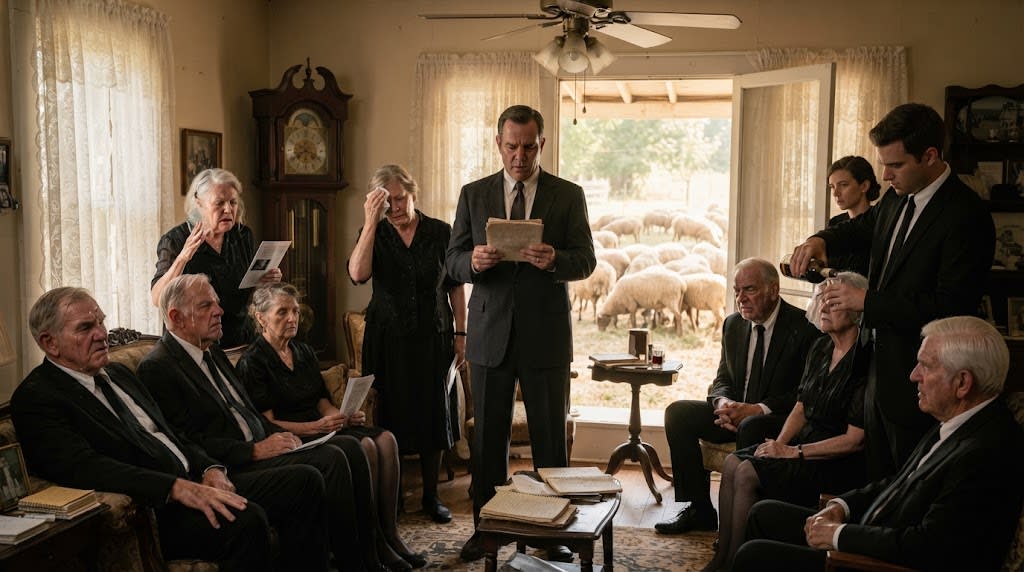
Ninety-eight degrees, no air conditioning, full funeral clothes, and forty-one notebooks of poetry about sheep. That was Uncle Harold's will. Show up, sit through every single poem out loud, or lose your inheritance to a sheep sanctuary. Harold loved sheep more than he loved his own family, and he wanted everybody to know it one last time from the grave.
The living room at Magnolia House had one working ceiling fan, and it moved the hot air around the way a spoon moves soup around a bowl, which is to say it accomplished nothing except making everybody a little seasick. The grandfather clock in the corner ticked once a second, and Reggie's sweat, which had started somewhere around his collarbone and traveled downward with real commitment, dripped from his chin onto the hardwood at almost exactly the same rhythm, so the whole room sat there listening to two clocks keeping slightly different time. The women wore pantyhose, because that is what a Southern funeral demands, and pantyhose in a hundred-degree living room is its own particular flavor of torture, a slow boil from the ankle upward that nobody discusses in polite company but that every woman in that room was silently, furiously experiencing at once.
So there they sat in black suits, black dresses, and pantyhose in July. Cousin Reggie showed up in a full three-piece suit like he was interviewing for a job at a funeral home in Antarctica, and by eleven-fifteen the sweat on his back had spread into a shape that looked exactly like the state of Florida.
"He did love those sheep," said Aunt Carol, fanning herself with a paper plate.
"He loved those sheep more than us," muttered Donna, not quietly enough. You could've heard a mosquito clear its throat in that room.
The lawyer, a small sweaty man named Mr. Pratt, opened notebook number one and announced the title. "Ode to a Ewe I Saw at Sunset."
She stood there dumb, she stood there plain,
No thoughts behind her big, dumb eye,
And yet I envied her again,
No mortgage, and no reason why.
She owes the bank not one thin dime,
While I'm behind on payment four,
So, bleat away, you're having a fine time,
And I'll go cry on my own floor.
Fifteen full seconds of silence followed. Then Donna said, "He rhymed 'eye' with 'why' and 'four' with 'floor.' I need a minute," and got up for sweet tea she did not need. Forty more notebooks to go.
By noon it hit a hundred degrees inside, and the funeral clothes stopped feeling solemn and started feeling like punishment. Reggie's collar had the texture of a boiled dish towel, sweat rings crept across every jacket like a slow weather map, and nobody could take off so much as a cardigan without somebody's dead grandmother rolling over. So, they sat there, braising, while Mr. Pratt made his way through poems about pasture rotation, poems about a dog named Chester who once herded eleven sheep into a church, and one bewildering fourteen-line piece that seemed to be Harold's attempt at a limerick about wool prices that never once actually rhymed.
Around poem eight came the low point, a work titled "On Foot Rot, and Other Afflictions of the Flock, A Meditation." Harold had apparently researched the subject with the thoroughness of a man writing a doctoral thesis, and the poem ran to nearly forty lines detailing hoof trimming, a condition called scald, and a home remedy involving copper sulfate that he described, with real tenderness, as "God's own footbath." By the time Mr. Pratt reached the stanza comparing a sheep's swollen hoof to his own late mother's ankles, two cousins had gone glassy-eyed and a third had started fanning herself with the memorial program hard enough to bend the cardstock.
Next came "Sonnet to a Ram Named Dwight Eisenhower," in which Harold compared his own hard life to a castrated sheep's, apparently without noticing the difference between losing a farm and losing certain body parts. Then came "Elegy for a Lamb Sent to the Butcher, With Further Thoughts on Death in General," ninety lines long, during which two cousins fell asleep sitting up and a third started praying for death, or at minimum, central air.
By poem eleven, Cecil, nineteen and the only grandkid in the family, stood straight up and announced, "I cannot do this sober," then walked to the drink cart like a man escaping a fire.
"Sit down, Cecil," his mother said, in her dog voice.
"It's a hundred degrees and I have heard nine hundred lines about sheep," Cecil said, pouring a bourbon the size of a birdbath. "I have earned this."
Nobody argued, and twenty minutes later the whole family had drifted to that cart, one flimsy excuse at a time. "Just checking my blood sugar." "I read gin helps with heat exhaustion." The gin and the heat together did things to that family that thirty years of church suppers had never managed. Aunt Carol was discovered pressing ice cubes directly against the back of her neck, then, with no shame whatsoever, down the front of her dress, announcing to the room that she had "made peace with God about it." Reggie commandeered Mr. Pratt's briefcase, flipped it open-faced, and began fanning himself with the actual will, which nobody stopped him from doing because by that point nobody had the strength to object. Donna ate three ice cubes whole, straight from the bucket, like a woman trying to put out an internal fire, which in fairness she basically was. By poem fifteen the room had the energy of a wedding reception where the bride just found out something terrible about the groom, except everyone was also sweating through their good shoes and somebody's aunt was down to one shoe entirely, the other having been removed and forgotten somewhere near the piano.
Mr. Pratt pushed on to "The Neighbor's Ram," ninety furious lines about a ram that trespassed forty years ago and, in Harold's words, "corrupted the bloodline of a flock bred pure since 1962." He named the neighbor. He named two of the neighbor's sons and accused them of inheriting moral failure "the way some families inherit a nose."
By three in the afternoon, the heat had done what forty years of Thanksgiving dinners never managed, turning this whole polite family into open warfare, sweating straight through it the entire time. Aunt Carol accused Donna of being Daddy's favorite, ice water running down her collarbone as she said it. Donna, an ice cube visibly melting in one fist, said favoritism is easy to win when you only visit twice a year. Reggie, down to his undershirt and still fanning himself with the will, suggested burning the rest of the notebooks out back, and nobody objected, not one person, until Mr. Pratt, sweating clean through his own suit jacket, reminded them about the will again, or tried to, since it was currently serving as Reggie's fan and had to be physically retrieved.
Then Cecil, swaying slightly, three bourbons deep and soaked completely through his shirt, found notebook twenty-nine and flipped it open, reading the label in Harold's own crooked handwriting. "DO NOT READ THIS One OUT LOUD OR I WILL HAUNT YOU." It had been bound in with the others by mistake. Cecil read the first line, went pale, then red, then sat straight down on the sweat-slicked hardwood, laughing.
Turned out this one was not about sheep at all. It was about the preacher's wife and a hay barn, in verse so filthy and so specific that Mr. Pratt refused to read another word of it, out loud or otherwise, mopping his brow with the hem of his own jacket on his way out of the room. The heat had not let up one degree. If anything, the whole family seemed to be sweating harder now, faces flushed red from gin and sun and pure hysterical laughter all at once, everyone half delirious and completely unbothered by it. They swarmed Cecil at once, passing the notebook around hand to hand, forgetting the wool, forgetting forty years of grudges, laughing together for the first time since the funeral, every single one of them melting where they sat and not caring in the least. Once they'd caught their breath, dripping and red-faced and thoroughly cooked, every one of them agreed this was, without a doubt, the finest thing Harold ever wrote.
About the Creator
Tim Carmichael
Let your becoming be louder than your fear, and your smallest steps become the road you once thought impossible to walk. An Appalachian poet and cookbook author my book Beautiful and Brutal Things is on Amazon, Link 👇
Enjoyed the story? Support the Creator.
Subscribe for free to receive all their stories in your feed. You could also become a paid subscriber, letting them know you appreciate their work.
Comments
There are no comments for this story
Be the first to respond and start the conversation.