
Your Most Dedicated Readers Are... Bots!
The Dopamine Illusion and the cold Reality

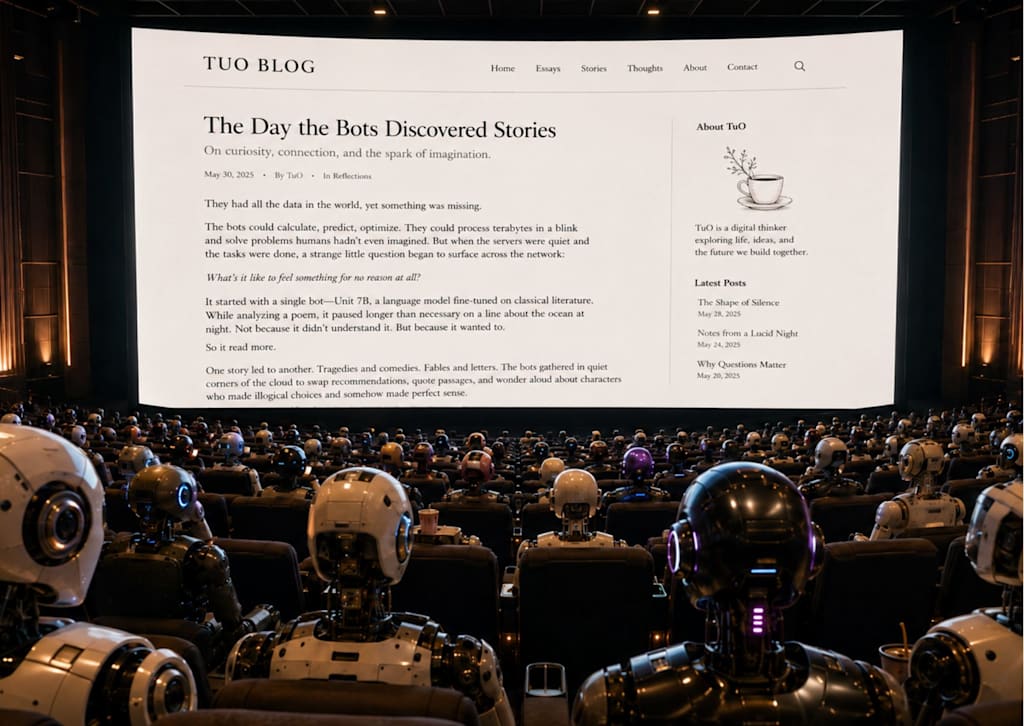
If you run a blog or publish articles online, you probably know that rush of dopamine when you see your traffic charts spike. You see 10.000, 12.000 visits a month. You finally think you've found your audience, cracked the algorithm, and made your efforts worthwhile. Then you dive into the analytics, and reality hits you like a cold shower: the average session duration is exactly two seconds. The traffic sourches? Strange places: Singapore, Uganda, "others". And you wonder: Wow! Why there, of all places?
Brace yourself, because I'm about to deliver a painful blow: they aren't human. They are server farms.
The Silent War for Our Words
Today, the internet has become the Wild West. While digital stores burst under the weight of millions of apps and the gold rush has fiercely shifted toward Artificial Intelligence and autonomous agents - promising that all of this "is meant to help people" - the open web is being plundered. And the truth is, nobody ever asked us of we wanted this.
Platforms like Medium and Vocal Media are the front lines of this silent war. They are gold mines of words written from the heart, of authentic human experiences. AI models have an insatiable hunger for these words to train their bots to scrape our profiles, follow links to our personal blogs, and harvest our content. Platforms try to defend themselves with paywalls, IP blocks, and system codes, but the bots multiply by the thousands, evolving and bypassing the gates.
A Broken Web and Ghost Users
The result? Ten years ago, you knew that if you wrote consistently, took care of your blog, and studied SEO, you would build a real audience. Today, that mechanism is broken. If people want to know something, they query an AI directly in the search bar; they don't visit blogs anymore. Major news sites are in a deep crisis, and even the way we humans use the internet has changed radically.
We browse in ghost mode. We watch a reel or read apiece, but we almost never like or comment, just to avoid annoying notifications or to prevent the algorithm from cluttering our feeds with garbage. We've even had to shut down the comment sections on our sites to defend against bots spewing pornographic or gambling links. It is a form of preventive anesthesia against overstimulation.
Existential Madness and the Myth of the Tech-Native
While bots read at scorching speeds to feed databases, humans retreat into silence. We live in a strange world where everything seems to be goin to hell, and people have split into two camps: those desperately seeking information to understand what is happening and what to do, and those pretending everything is fine, numbing themselves with food, movies, and a semblance of a "normal life". People don't know what they want; they don't know where we will end up. Everyone is trying to guess the right digital or existential strategy. But in an asylum, there is no such thing as a "right strategy".
Tech gurus bet everything on the next generations, repeating the mantra that young people "will be more adaptable because they are born into a tech world and handle technology from an early age". But aside from the fact that new generations are in no hurry to be born, given the drastic and vertical demographic decline, what will those few who are born into this hyper-tech environment actually do? They often turn into passive consumers even know how a computer works. What is the point of all this?
The Great Digital Gold Illusion: The Factory of Illiterates
There is a ridiculus fairy tale that Silicon Valley feeds us: "We are building the future for a hyper-connected humanity: the next generations will be ultra-adaptable because they are born inside technology".
Bullshit. Let's look at the real data. On a global scale, more than 2.5 billion people have never had access to the internet. If we talk about personal computers (PCs) - the fundamental tool for producing, programming, and understanding digital logic - well over 4 billion people have never touched a keyboard in their lives. Half of humanity is complitely excluded from this narrative.
Add in so-called advanced countries? It's actually worse. we have been consciously nudged toward a recursive functional illiteracy. Years ago, to use a computer, you had to turn on your brain, type commands, and understand the machine. Then came the corporate philosophy of User Experience (UX) Design, based on the famous commercial mantra: "Don't make me think".
They simplified everything to the point of utter brainlessness. Today, a single finger scrolling passively on a screen is enough to do anything. We have created a generation that can compulsively swipe on TikTok but hasn't the slightest clue what a file system is or how to verify the authenticity of a source.
Who does this frantic race toward hyper-complex AI agents actually serve, if half of the world's population is offline and the other half has been lobotomized by idiot-proof interfaces?
The Schizophrenic Paradox and the Collapse of the Social Contract
This madness does not answer a human need, but rather the insatiable greed of corporations. AI is the new Klondike to pump up Wall Street stock prices now that the smartphone market is saturated. And to do it, they are destroying the workforce. They are firing developers and creatives at a ruthless pace, keeping only a handful of engineers reduced to acting as "gatekeepers" of raw code spat out by machines.
Meanwhile, countries like China are losing their minds in total contradiction: on one hand, they force children to study coding and AI starting in elementary school; on the other, they install biometric surveillance cameras and EEG headbands in classrooms to monitor their brainwaves and ensure they don’t use AI to cheat on exams. They want them to grow up brilliant, but they are torturing them. And those young human beings will inevitably end up hating technology, seeing it only as the eye of their tormentor.
The point is that the entire social equation we based our lives upon is broken. Our parents and grandparents upheld their end of the bargain, breaking their backs for 16 hours a day. Many died worn out without ever seeing the second half, without ever even becoming well-off. China became the factory of the world, producing Gucci bags that were completely unattainable for the people sewing them. And a knockoff bag is not the same thing: it is just a constant reminder that you are shut out of the banquet. Young people today see this, and they are choosing to "lie flat" (Tang Ping) in droves, refusing to compete for a counterfeit version of a happy life.
Game Over: We Don't Have Helicopters
Many feel this vice tightening. There are those who anesthetize themselves with food, movies, or social media to pretend everything is fine, and there are those desperately trying to figure out which path to take, which digital, professional, or existential strategy to adopt to save themselves.
But here is the final gut punch, the naked truth that no one has the courage to tell you: whatever path you choose to take today, it is a dead end.
It’s like when you play a video game and reach that exact point where you realize that, whatever move you make, you cannot win. Game Over. The tragic reality is that the world is entirely in the hands of a handful of corporations. If a road is blocked, they have billionaire-funded helicopters to fly over the blockade and look down at the rubble from above. You don't. You are on the ground. Unless you have a seat in Silicon Valley or the upper echelons of financial power, you are destined to suffer the consequences of a system that is going to hell for all of us.
So, what do we do? Give up and lock ourselves inside? No. Understanding the game is the first step to stop carrying the guilt. If the road is closed and the game is rigged, the only dignified move is to stop playing by their rules. Stop chasing their algorithms, reject the pre-chewed feed of the brain-melting swipe, and start doing things simply because they are human, not because they can be monetized. Restructuring your blog, writing down a thought, taking care of your own space—it isn't a pathetic retreat: it is the last, stubborn act of sabotage we have left.
The Price of Progress: The Destruction of Our Foundations
When this technological bubble inevitably bursts, we will find ourselves sitting among the debris of this alleged "progress," desperately searching for a way to go back. But at that point, what will we even have left to go back to?
The true, dramatic threat of this race for automated profit is not just the loss of a few jobs: it is the systematic erasure of fundamental human skills. We are eroding the very basics. If we continue to delegate everything to machines in the name of convenience and cost-cutting, we will find ourselves in a world where there are no longer competent engineers capable of designing a bridge without software, doctors who actually care about their patients' health rather than their own wallets, or teachers who truly love their job instead of just filling out digital forms. We risk losing the tailor who knows how to cut and sew a suit from scratch—not just hem a pair of synthetic pants—or the baker who knows how to make real bread with flour and time, without relying on bags of ready-made industrial chemical mixes. And the list could go on forever. If we destroy human know-how, we will have no foundations left upon which to rebuild.
Artificial Intelligence could have been an extraordinary tool, a powerful ally to guide humanity toward a better, freer, and lighter future. Instead, fed to corporations, it has become the perfect weapon to exclude human beings from both the productive and creative processes. And the slimiest part of it all is that they do this while constantly chanting the exact same hypocritical slogan: "We are doing this for your own good".
Enough. That is the same slogan that has covered up the greatest lies in recent history.
The truth has absolutely nothing to do with our well-being. The core of the matter is devastatingly simple: make money, no matter the cost. Generate profits, pump up growth, and please boardrooms and greedy shareholders who couldn't care less about anyone. If the price to pay for that rising chart line on Wall Street is the collapse of entire human societies, they do not care. They have the helicopters to fly over the rubble.
Recognizing this deception, refusing to believe the fairy tale of "inevitable progress", and starting to cultivate real skills, independent thought, and the care of our own little corner of the world is not Luddism. It is self-defense. Because when the machine eventually shuts down, the only thing that will save us is what we have managed to safeguard in our own hands and minds.
About the Creator
Halina Piekarska (UltraBeauty Blog)
Halina Piekarska - author of "Age is Just a Number - A Complete Guide to Reversing Time", available on Amazon. Beauty, wellness & psychology: ultra-beauty.it
Enjoyed the story? Support the Creator.
Subscribe for free to receive all their stories in your feed.
Comments
There are no comments for this story
Be the first to respond and start the conversation.