
Your Fate Is Probably a Game You Were Never Taught to See
Most people call it destiny. It’s usually a setup. Here’s how to spot the board, map the players, and make the choices that actually belong to you.
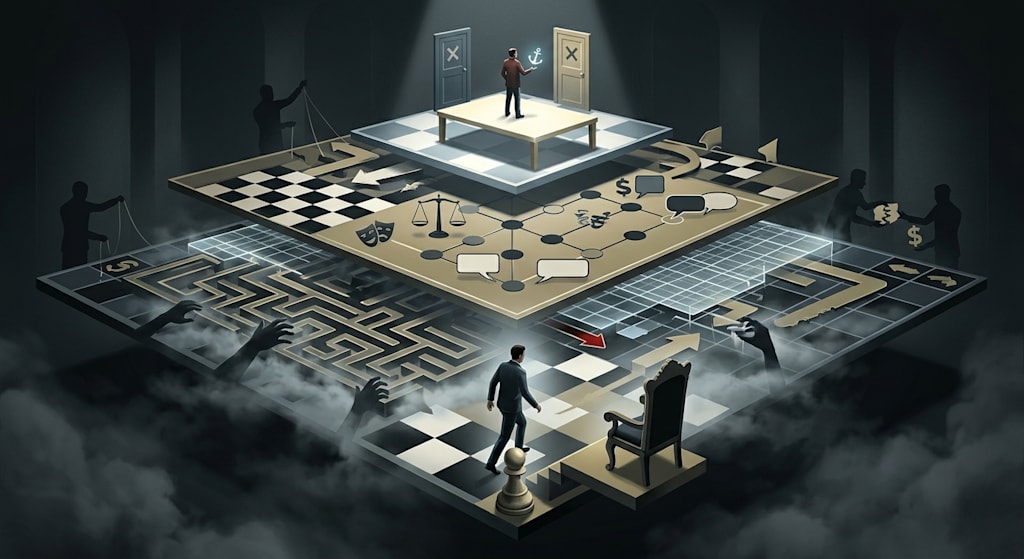
You call it fate when you stop asking who built the road. The road may be a set of instructions: what to fear, what to want, when to speak, when to stay quiet. Repeat them long enough and they feel like reality. That feeling is resignation dressed as truth.
Complexity often hides this setup. Players, stakes, and paths intersect. Each shapes the others. Once they lock into a loop, a game appears. People inside it see fog. People outside it see structure. If you cannot see the three parts, you enter as a piece to be moved.
So the question is practical. Can you learn to encode the game, map its variables, and make trade-offs? That work has three levels.
Fate is a path you stopped questioning
“Fate” hides human arrangements. It turns a designed path into natural law. It turns a lack of recognition into an unstoppable force. This does not mean every problem is imaginary. Resources are unequal. Power is uneven. Information is controlled. The problem starts when you stop resisting, asking, and noticing. At that point, “I was placed here” becomes “I belong here.” The first is a path. The second is surrender.
Critique should start with that move. Fate is not a verdict from the sky. It is a habit: you learn what matters, what to fear, when to get angry, when to go silent. The habit hardens into common sense. You cannot see the setup, so you call it fate.
Seeing complexity starts with seeing the setup.
How a game produces complexity
Players are not equal. Some set rules. Some adapt. Some are defined by the rules. Some set the agenda. Others react to it. Their positions decide what they can see.
Stakes are not always money. People fight over definitions, interpretations, legitimacy, and room to survive. Abstract stakes raise complexity. Interests can be counted. Symbols must be decoded. Resources can be split. Meaning must be contested.
Paths are designed. They decide what information flows, which doors open, which costs stay hidden, and which resistance gets absorbed early. A polished path looks like natural order.
When players, stakes, and paths intersect, complexity appears. It is more than many things happening. It is a set of unequal relations among variables. Some people borrow force. Others are borrowed from. Some build games. Others enter them. Some see a battlefield. Others see fate.
Complexity belongs to the game. The game produces it.
Level one: learn to encode
Noticing complexity is a start. The first real skill is encoding. You use different symbol systems to make distinctions: who is who, what is what, who explains the world through which path. Politics has its code. Economics has its code. Morality has its code. Emotion has its code.
A person who explains everything through morality will see interest conflicts as good versus evil. A person who explains everything through economics will treat dignity as waste. One code flattens the world. Several codes give it depth.
Encoding is how you join the rules of the world. It goes beyond labeling. You recognize the logic, limits, and blind spots of each system. Political code asks about power and legitimacy. Economic code asks about cost and incentive. Moral code asks about responsibility and justification. Emotional code asks about attachment and injury. A mature reader does not let one code swallow the rest. They know which language fits which room, and who is using which language to hide what.
You move from “How did this happen?” to “Which systems are defining this at the same time?” You see that many conflicts are code clashes. Many problems are path designs. Many “obvious” truths are one code that has held the microphone for too long.
Seeing is not enough. The next step is mapping.
Level two: map variables and relations
Once you notice complexity, you start mapping it. Mapping means identifying variables and connecting them.
Which variables matter? Which are noise? Which are vital points? Where can you cooperate? Where can you borrow force? Who pays? Who transfers the cost? Which short path is a trap? These judgments make up architecture.
Good mapping depends on two skills. You need to see enough variables. You also need to connect them well. Few variables produce simple answers. Weak connections turn parallel events into false causes. A useful map does not hold every variable. It finds the few structural relations that explain why the game holds and where it may crack.
At this level, the world turns from a mess into a field. You see that someone’s strength comes from a path node, not from personality. Cooperation happens because stakes overlap for now. Moral accusations can be code fights over space.
Mapping has a trap. A fine model can convince you that you see everything. Variables cannot be exhausted. Relations cannot be fully confirmed. A map should guide action. If you keep mapping and never choose, you become a spectator: you understand everything and dare to do nothing.
Level three: make trade-offs
Many people can map a game. Fewer can choose. Seeing needs cognition. Mapping needs method. Choosing needs freedom from conditioning.
Conditioning rarely arrives as oppression. It comes as emotional blackmail, moral pressure, identity expectations, group demands, and old habits. It makes you feel ashamed when you should count costs. It makes you feel guilty when you should leave. It makes you compromise when you should say no. The heavier the conditioning, the harder the choice. You are not choosing between A and B. You are trapped between “Am I good?”, “Will I disappoint people?”, and “Have I betrayed something?”
A clean trade-off has two foundations.
First, replace wanting or not wanting with A or B. Wanting is often captured by emotion, face, and sunk cost. A or B forces you to admit limits. Resources are finite. Paths exclude each other. Every choice costs something. You cannot keep every option open. A trade-off closes doors on purpose.
Second, replace should or should not with worth it or not. “Should” is often the language of conditioning. “Worth it” is the language of a player. This is more than utilitarianism. It weighs cost, benefit, risk, and value. “Worth it” without a value anchor becomes opportunism. “Should” without cost awareness becomes self-flattery.
If you cannot do the first, you stay inside conditioning. If you cannot do the second, you cannot count costs or find an anchor. A trade-off is a choice made with incomplete information and unpredictable consequences. You still own the result.
Breaking the game
Run all three levels and you can encode the world and re-encode yourself. The world stops being a fixed fate. It becomes a structure you can classify and rebuild.
That work means stepping out of someone else’s game long enough to inspect how it was built. Who set the path? Who defined the stake? Who keeps complexity alive? Who profits from it? Who pays for it?
You cannot stand completely outside every structure. A mature position is simpler. You know you are inside a game. You know your code has a position. You keep the ability to re-encode, re-map, and choose. Breaking a game is a process: see it, enter it, use it, change it, or leave a game that is not worth the cost.
Politics is the art of the complexity game
This is why complexity becomes political. Politics is not a simple fight between good and evil. It is the art of the complexity game. Who sets the agenda? Who defines the symbols? Who builds alliances across variables? Who makes the value trade-off at the core?
Political maturity is not cynicism. It is not seeing plots everywhere. It is the ongoing work of re-encoding and re-mapping the world, then making value choices over core stakes. You see structure. You bear choice. You refuse moral language that takes you hostage. You refuse to reduce “worth it” to short-term gain.
Limits
The three-level model has limits.
First, who sets complexity? Encoding power depends on position, resources, information, and power. People who control the code often control the definition of the problem. Seeing complexity cannot stay a private mental exercise. Ask why some codes are accepted and others are pushed to the edge.
Second, where does mapping stop? Variables cannot be exhausted. Modeling cannot run forever. The decision to stop analysis and act is itself a trade-off. Over-mapping becomes analysis paralysis, a way to avoid choice.
Third, what anchors “worth it”? Without a value anchor, the question slides into opportunism. A trade-off is not only accounting. It asks: what am I willing to pay for? What would I refuse even if it is cheaper?
Fourth, the levels are not a straight line. Trade-offs reshape maps. Maps change what you can see. Where you stand decides which variables appear. What you bear redefines what “worth it” means.
Know the game without bowing to it
Complexity is not a shrine. It is not a secret art for clever people. It is not an excuse to say “the water is too deep” and walk away. Complexity is a game structure that has been set up. It works because people mistake it for fate.
To see complexity is to encode the world. To map complexity is to find variables and relations. To choose within complexity is to break conditioning and act. Run all three and you can move from piece to player, or at least become someone who knows why they entered and when to leave.
Know the game. Do not bow to it. Paths are set. Codes have positions. Choices have costs. You can still re-encode, re-map, and own the result.
Fate works best when you mistake a setup for reality. Writing about complexity can do one useful thing: turn the light on. Fate is a game you have not recognized yet. Breaking it is the choice you make after you see it.
About the Creator
Jin
Writer of reamstories
https://reamstories.com/jin
Enjoyed the story? Support the Creator.
Subscribe for free to receive all their stories in your feed. You could also become a paid subscriber, letting them know you appreciate their work.
Comments
There are no comments for this story
Be the first to respond and start the conversation.