
The Ten-Year Lag: Why Poor Kids Learn the Rules of Success Too Late
He knew how to survive at five. He didn't learn how to ask for a raise until twenty-eight. A story about borrowed dress pants, counted tiles, and the hidden curriculum no one teaches you when you're busy surviving.
The first time Chen Mo realized he did not know how to talk was in an interview room when he was twenty-two.
The interviewer asked, "What is your greatest weakness?"
Answers flashed through his mind: low self-esteem, introversion, not knowing how to work a room, being poor. He could not say any of those. He remembered a tip online: name a weakness that sounds like a strength. So he said, "Sometimes I'm too much of a perfectionist."
The interviewer smiled and looked down at the resume. Chen Mo did not know what the smile meant. His palms were sweating. The dress pants were borrowed and a little too big at the waist. He had been pinning them with his arm. When the interview ended, he stood. The chair legs scraped the floor. He bent to push the chair in and banged his forehead on the desk.
"Are you all right?"
"I'm fine."
He sat on the steps outside for a long time. A boy in a school uniform handed him a flyer. It was an ad for English training. He turned it over. The back was blank. He folded it and put it in his pocket. That night, he wrote three phone numbers on it: his landlord's, the company receptionist's, and his own. He was afraid he would forget who he was.
Chen Mo had known since childhood that money mattered.
When he was five, his mother took him to the vegetable market. She squatted in front of a stall and picked through potatoes. She took out the ones that had sprouted and put the ones with less dirt into a bag. The vendor said, "Ma'am, they're all the same." His mother did not look up. "The same? Then knock two cents off." The vendor shut up. After she weighed them, she took a small cloth pouch from her pocket, opened it layer by layer, and inside was a wad of crumpled change. She counted it twice and handed it to the vendor. The vendor gave her change. She counted it again.
Chen Mo stood beside her, clutching the fifty cents his mother had given him. He did not spend it. On the way home, his mother said, "You see? You can't just spend money however you want." He said, "Mm." She said, "Your dad's salary hasn't come in this month." He said, "Mm." She did not say anything else. He did not ask.
That night, his father came home late. His mother was reheating food in the kitchen. The spatula clanged against the wok. His father sat in a chair and took off his shoes. There was a hole in his sock. He stared at the hole for a moment, then tucked his foot under the chair. His mother brought the food out. "Working late again?" His father said, "Mm." "Where's the overtime pay?" His father did not speak. His mother set the bowl on the table, a little too hard. His father stood up. The chair tipped backward and crashed to the floor. "Are you ever going to stop nagging?" "Me, nagging? How much do you even make a month?" His father roared. It was loud. Chen Mo was in the inner room doing homework. His pencil snapped.
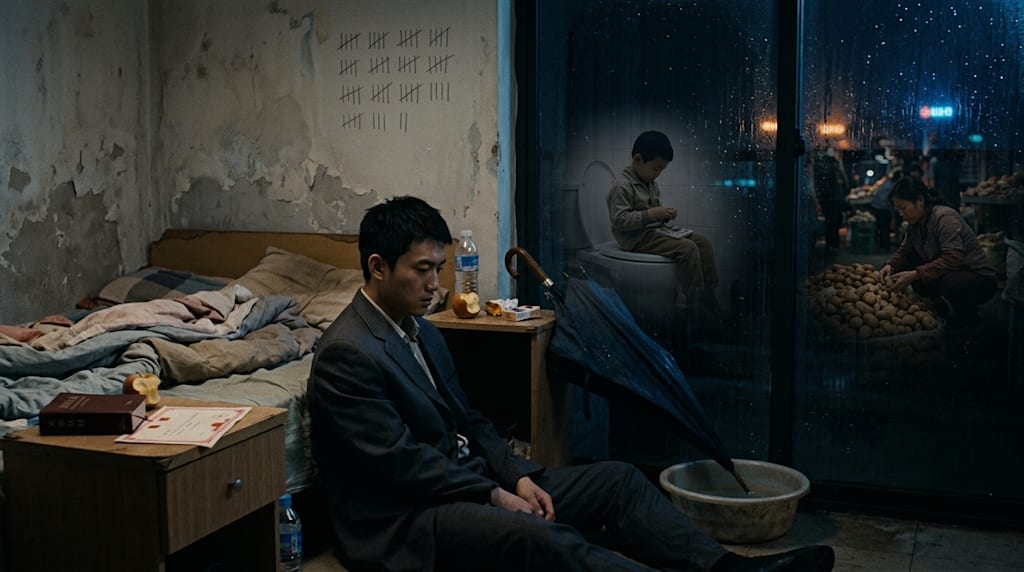
He did not dare go out. He picked up the broken pencil lead, put it on his notebook, and pressed it with his fingernail until it crumbled. He heard a bowl shatter outside. He covered his ears. Later he learned: when his parents fought, he would go to the bathroom, sit on the toilet lid, and count the tiles. Forty-seven in all. He counted them many times.
After he started school, Chen Mo got good grades. The teachers said he was smart. He was just afraid not to be smart. When he came first, his father said, "Don't get cocky." When he came second, his mother said, "Why did you slip?" He brought a certificate home. His parents were watching TV. He put the certificate on the table. His mother glanced at it. "Put it away." He took it back to his room and tucked it into a book. The book was a Xinhua Dictionary. The cover had fallen off. He had taped it back three times.
In middle school, he went to the county town for the first time. A classmate took him to an internet cafe. He stood at the door, afraid to go in. The classmate said, "I'll pay." He said, "I don't play." The classmate went in. He waited outside for an hour, watching people walk up and down the street. Someone spat. Someone was on the phone. Someone bought a grilled sausage. He was hungry but did not buy anything. He had two yuan in his pocket, money his mother had given him for notebooks. Eventually he bought a steamed bun for one and a half. He put the remaining fifty cents back in his pocket. When he got home, his mother asked, "Where's the notebook?" He said, "I bought it." He had not. He did his homework on the back of an old notebook. The teacher criticized him. He said, "I forgot." The teacher made him stand for a whole class. He stood and looked out the window. Outside was a locust tree. Its leaves had turned yellow.
When it came time to fill out the college application, his parents did not understand. His father said, "Being a teacher is good. Stable." His mother said, "A doctor works too." He said, "I want to study computers." His father said, "What's a computer?" He explained for a long time. His father said, "Do what you want." He chose computer science. A classmate had said that major made money. He did not actually know what computers were. He wanted to make money.
In college, he took the subway for the first time. He did not know how to swipe the card. He stood in front of the turnstile. Someone behind him said, "Move." His face went red. He stepped aside, watched others swipe, then copied them. The card belonged to his roommate. His roommate was named Li Xiang. His father was a doctor, his mother a teacher. Li Xiang had the latest phone, a tablet, a DSLR. Chen Mo had only an old phone. The screen was cracked and held together with tape. Li Xiang said, "Why don't you get a new one?" He said, "It still works."
On weekends Li Xiang went home and brought back a bag of fruit. He gave Chen Mo an apple. Chen Mo said thank you. Li Xiang said, "You're too polite." Chen Mo did not know how to respond. He put the apple on the desk and did not eat it for three days. Eventually it wrinkled, and he threw it away. Li Xiang gave him another one. He said, "I don't like apples much." Li Xiang said, "Then what do you like?" He said, "Anything's fine." Li Xiang said, "What does 'anything's fine' mean?" He smiled and said nothing.
For four years in college, Chen Mo got good grades. He did not know how to make a PowerPoint, how to give a presentation, how to chat up professors. Once he entered a competition and prepared a lot. During the defense, he was nervous and spoke too fast. A judge said, "Slow down." He got more nervous. He won third prize. First prize went to Li Xiang. Li Xiang's PowerPoint was beautiful, full of animations. Chen Mo looked at Li Xiang's slides, went back, and deleted his own. He sat in front of the computer all night. At dawn, he went to the cafeteria and bought a steamed bun. He gnawed it while looking out the window. Someone was running outside. He chewed the bun for a long time.
After graduation, Chen Mo joined a company. On the first day, his boss asked him to make a spreadsheet. He made it and handed it in. The boss said, "The format's wrong." He fixed it. The boss said, "The font's wrong." He fixed it. The boss said, "Never mind, I'll do it." He stood beside him, watching the boss type. The boss said, "You just graduated. Learn slowly." He said, "Mm." He went back to his desk, opened Excel, and searched Baidu for "Excel spreadsheet formatting standards." He studied all afternoon. When it was time to leave, his colleagues were gone. He was still there. The security guard came to lock up. "Still not leaving?" He said, "In a minute." He shut down the computer and walked out of the building. It was raining. He did not have an umbrella. He stood under the eaves and waited twenty minutes. The rain let up, and he ran back to his rented room. His clothes were wet. He took them off and hung them on the back of a chair. The chair was piled with clothes. There was nowhere to sit. He sat on the floor, leaning against the bed. His phone rang. It was his mother. "Have you eaten?" He said, "Yes." "How's work?" He said, "Pretty good." "That's good." She hung up. He watched the screen go dark and reflect his face. He tossed the phone onto the bed and lay down. There was a water stain on the ceiling shaped like a chicken. He stared at it for a long time.
In his first year at work, Chen Mo learned how to fix the printer. No one else fixed it, so he looked up how to do it online. He learned how to change the water cooler bottle. No one else changed it, so he did it himself. He learned how to pick up lunch for colleagues. Someone said it was on the way, so he went. He never refused. Once, a colleague pushed a report over to him. "Do this for me. Something came up at home." He said, "Okay." He worked on it until two in the morning. The next day, the colleague said, "Thanks." When the report was submitted, the boss praised the colleague. Chen Mo sat at his desk, staring at the screen. He wanted to say, "I did that." He did not. He went to the bathroom and washed his face. In the mirror, his eyes were red. He remembered how, when he was little, after his father yelled at his mother, he would also go to the bathroom and wash his face. He stood there for a moment, then went back to his desk. The colleague said, "Lunch together?" He said, "Okay."
He had one relationship. The girl was named Zhou Xiao, from the department next door. She asked him out to a movie. He went. The movie was loud. He kept wondering whether he should buy popcorn. He did not. After it ended, Zhou Xiao said, "You're very quiet." He said, "Mm." She said, "Do you not like me?" He said, "No." She said, "Then what is it?" He said, "I don't know." She laughed. "You're interesting." He did not understand what was interesting. Later they got together. Zhou Xiao took him to meet her friends. A friend asked, "What do you do?" He said, "IT." The friend said, "Must make good money, huh?" He said, "It's okay." The friend said, "Bought a house?" He said, "No." The friend said, "Then you'd better work hard." He smiled. Under the table, Zhou Xiao squeezed his hand. His palm was cold.
Zhou Xiao broke up with him. She said, "You never say what you want." He said, "I want you." She said, "Not that. What kind of life do you want? What kind of person do you want to be? Do you even like your job? Are you happy? You never say anything." He said, "Even if I said it, you wouldn't understand." She said, "Did you ever try?" He was silent. Zhou Xiao left. He stood downstairs from her building for two hours. Then he left. Passing a convenience store, he bought a pack of cigarettes. He did not smoke. He opened the pack and lit one. It made him cough. He stubbed it out and threw it in the trash. The pack was still in his hand. He crushed it, flattened it, crushed it again. Finally he threw it away.
Later, Chen Mo changed companies. In the interview, the interviewer asked, "Why did you leave your last job?" He said, "I wanted a change of environment." The interviewer asked, "What's your greatest achievement?" He thought for a moment. "I helped the company optimize a process and save time." "Specifically?" "I wrote a script to process data automatically." The interviewer said, "Not bad." He got the job. His salary went up. He rented a one-bedroom apartment. On moving day, he threw away his old clothes. The borrowed dress pants, he kept. He hung them in the closet and never wore them again.
At the new company, there was a colleague named Wang Chuan. Wang Chuan's father owned a company. Wang Chuan dressed sharply every day and spoke slowly, but people listened to every word. Chen Mo watched him. Wang Chuan remembered everyone's name. He chatted about the weather in the elevator. In meetings he would say, "Let me add one thing," and then say something harmless. The boss liked him. Chen Mo studied him. He tried smiling at people in the elevator. The other person glanced at him and said nothing. He tried speaking up in a meeting. "I think this plan could be optimized." The boss said, "Specifically?" He said, "We could speed it up." "How?" "With a script." The boss said, "You do it." He did. When it was done, the boss said, "Not bad." He went back to his desk and found his palms were sweating. He went to the bathroom to wash his hands. The water was cold. He looked in the mirror and saw that he was smiling. He put the smile away.
At the end of the year, the company handed out bonuses. Wang Chuan's was bigger than his. Chen Mo did not ask why. He went to HR. HR said, "Wang Chuan has client resources." He said, "I have projects too." HR said, "Your projects came from Wang Chuan." He went back to his desk. Wang Chuan came over. "Dinner tonight?" He said, "No." "What's wrong?" He said, "Nothing." Wang Chuan left. Chen Mo watched him go and thought of Li Xiang. He thought of that apple. He thought of the apple he had thrown away.
That night, he worked late. He was the only one left in the office. He walked to the window and looked at the buildings outside. Many lights were on. He counted them, got to forty-seven, and stopped. He went back to his desk and opened a document. He wrote:
"I was twenty-two when I learned that in an interview you're supposed to say 'perfectionist.' I was twenty-five when I learned that the squeaky wheel gets the grease. I was twenty-eight when I learned that some people's starting point is a finish line I'll never reach. It took me ten years to learn what other people learned as children."
He stopped there. He deleted the document. Emptied the recycle bin. Then he shut down the computer. He walked out of the building. It was raining. He had an umbrella. He opened it and walked into the rain. The rain hit the umbrella, a dense sound. He walked slowly. Passing a convenience store, he went in and bought a bottle of water. The cashier said, "Three yuan." He gave five. The cashier gave him two in change. He put the coins in his pocket. They clinked together. He walked out of the store. The rain had let up. He closed the umbrella. Water dripped from the tip onto the ground and quickly dried.
He got home. Opened the door. Turned on the light. The room was quiet. He changed his shoes and put the umbrella by the door. It was still dripping. He got a basin to catch the water. Then he sat on the sofa. The sofa was secondhand and sagged a little. He turned on the TV. A variety show was on. The laughter was loud. He watched for a while, then changed the channel. He landed on a news channel. The anchor was talking about the economy. He turned off the TV. The room was quiet again.
He picked up his phone. Someone in the work group had posted: Meeting tomorrow at ten a.m. He replied: Received. Then he opened his contacts and scrolled to his mother's number. He stared at it for a while but did not call. He put the phone on the coffee table. There was an apple on the table, bought last week. He picked it up and took a bite. It was sweet. He chewed and looked out the window. Outside was a tree. Its leaves had turned green. He remembered his mother picking potatoes at the vegetable market when he was little. He finished the apple and threw the core in the trash. Then he took a shower. The water was hot. He stood under it with his eyes closed. For a long time.
When he came out, his phone lit up. It was Wang Chuan: Meeting tomorrow. Get ready. He replied: Okay. He dried his hair and sat on the bed. On the nightstand was a book, the Xinhua Dictionary. He opened it. Inside was a certificate. From elementary school. The writing was blurry. He looked at it for a long time. Then he took the certificate out, folded it, and put it in his pocket. He put the dictionary back. He lay down and turned off the light. In the dark, he touched the certificate in his pocket. The paper was thin. The corners were a little sharp. He turned over and buried his face in the pillow. The pillow was soft. He fell asleep.
About the Creator
Jin
Writer of reamstories
https://reamstories.com/jin
Enjoyed the story? Support the Creator.
Subscribe for free to receive all their stories in your feed. You could also become a paid subscriber, letting them know you appreciate their work.
Comments
There are no comments for this story
Be the first to respond and start the conversation.