
The Quietest Person in the Room Sees the Whole River
Why smart people stop explaining, stop arguing, and save their words for the few who can hear them.
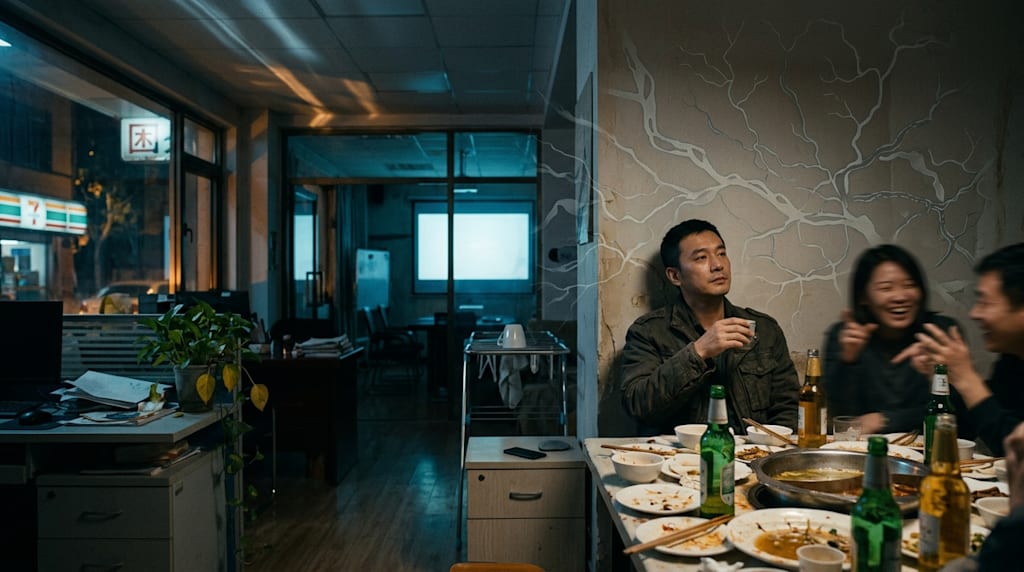
At 9:30, the hot pot had only a film of oil left in it. Someone started telling the same joke for the third time. Someone laughed loudly. He sat against the wall, cup in hand, thumb rubbing the rim. No one noticed him. He didn't need to be noticed.
In his head was a river system map. Main channel, tributaries, underground rivers, seasonal rises and falls. When he spoke, he said only one thing: "This river flows east." The other person asked, "What about the west?" He said, "The west is mountains." The other person said, "What's there to say about mountains?" He set the cup down and smiled a little. Back home, he drew that river system on paper until 2 a.m. The next day someone asked what he'd talked about the night before. He said, "It was okay."
Conversation, for him, was translation. He compressed web-like causality into a single line. A three-dimensional structure became a photograph. High-density information had to be broken into fragments the other person could catch. Translation takes energy. Translate wrong, and you have to go back and fix it. After the fix, the other person says, "That's not what you meant earlier." So he stops translating. Like a reservoir with the gate set too high. The water stays in the reservoir.
In the meeting room, everyone was discussing how to optimize a process. The process itself was wrong. He raised his hand and said, "This process can be eliminated." The air went quiet for three seconds. The manager said, "Let's focus on execution first." He nodded and closed his notebook. After that, he didn't speak again. When the meeting ended, he went to the break room, poured out his cold coffee, and washed his cup. He left it upside down on the drying rack. Water slid down the side.
His tolerance for pointless talk was low. Pointless talk wasn't just small talk. It was everyone gathering around a problem that didn't exist, getting more excited the longer they discussed it. Someone would applaud a conclusion that couldn't withstand scrutiny. Everyone would talk about how to make horse carriages faster while no one asked where the car was. If he joined in, he would have to lower himself a notch. He didn't want to. He also didn't want to stand out in a crowd. So he sat there and became part of the background. He nodded and smiled. He matched the mood. Like closing background programs.
Talkative people are like a room with the door left open. Anyone passing by can see what's inside. What color the sofa is, what medicine sits on the table, what boxes are piled in the corner. The more he says, the easier it is for others to piece together his outline. His logic. His preferences. His weak spots. His fears. Before he understands the environment, he closes the door. He kept his ears and eyes open. His mouth stayed shut. His phone gallery was locked, his social feed visible for three days only. Fewer cards exposed.
He once tried to advise a friend. The friend was starting a company and showed him a business plan. He turned to page three and said, "Your cash flow will break." The friend said, "You don't understand." Eight months later, the friend asked to borrow money. He transferred five thousand and didn't mention the plan. The friend said, "You're a real friend." He said, "It's nothing." After hanging up, he went to the balcony to collect clothes. One sock fell and landed on the air-conditioning unit downstairs. He looked at it and didn't go pick it up.
He had long ago given up trying to change people. People can't be woken by a few words. People can only be woken by pain. You tell them there's a pit ahead, and they say you're being alarmist. Tell them the road is wrong or the logic is flawed, and they say you haven't walked it, or that you're too serious. Later they fall into the pit, crack their head open, and come back saying, "You were right." Next time, they'll jump into another pit. So he stopped talking. He nodded and smiled. He helped you finish the social play. The little person inside him might be calculating tonight's work, or reviewing some detail he noticed that afternoon.
But with someone on the same frequency, he talked more than anyone. Late at night, he called an old friend. They talked until the phone grew hot, until the garbage truck passed outside. He spoke for forty minutes and paused only twice. Once to drink water, once to find his charging cable. Before hanging up, he said, "Let's talk next time." The friend said, "You talk a lot." He laughed once and didn't deny it. After putting the phone down, he wrapped the charging cable and placed it by the bed. The screen went dark and reflected the ceiling.
Silence has a cost. At work, there was a new project. He saw the flaw and didn't say anything. The project failed. In the review meeting, everyone pushed blame around. He sat in the corner, spinning a pen. The pen dropped. He picked it up and kept spinning. Later he was promoted, but no one remembered he had ever raised anything. On his desk was a pothos plant. Two leaves had turned yellow. He cut them off, didn't throw them away, and put them on the windowsill. The windowsill faced north. The light was thin.
He missed some people. Someone showed interest in him, and he stayed silent. Someone asked what he was doing over the weekend. He said, "Sleeping." In fact, he had gone to an exhibition, taken seventeen photos, and posted none. Someone asked him to dinner. He said, "Next time." When next time was, he hadn't thought about it. His contact list was long. Only three numbers were dialed often: takeout, courier, an old classmate.
The world won't get better just because quiet people shut up. If you don't speak, others will summarize or define you. Leave the battlefield, and it won't disappear. A new group will occupy it. Later, he wrote in his notes app: Before speaking, look for two more seconds. He did it. But he was still silent more often than not.
At 11 p.m., he shut down his computer. The screen went dark and reflected his face. He finished the water in his cup and left the cup upside down on the drying rack. His phone lit up. A group message. He didn't open it. He walked to the window. The convenience store downstairs was still open. One character on its light sign was broken. He drew the curtains and left a crack. Tomorrow was Wednesday. The weekly report was due. He got into bed and turned off the light. In the dark, he turned over and patted the pillow twice.
A car passed outside. Its headlights swept across the ceiling, brightened it, then faded. He closed his eyes. His breathing slowly evened out. The phone lit up again on the nightstand. He didn't move. After a while, he reached out, turned the phone over, screen facing down. The room went quiet.
About the Creator
Jin
Writer of reamstories
https://reamstories.com/jin
Enjoyed the story? Support the Creator.
Subscribe for free to receive all their stories in your feed. You could also become a paid subscriber, letting them know you appreciate their work.
Comments
There are no comments for this story
Be the first to respond and start the conversation.