
The Purple Sun on My Refrigerator
I could spot every error in a spreadsheet. Then a child asked me to look at her drawing, and I realized I'd been reading the wrong data all along.
Mark Warren realized he had a problem on a Tuesday. Not gradually, not through some act of self-reflection—at four o’clock on a Tuesday afternoon, he placed a seventeen-page analysis report on Helena Kreutzer’s desk and waited for her to produce the expression that said Great, the problem is solved. She didn’t. She read it for three minutes, closed the report, and, in the tone he dreaded most, said, “Mark, I need to talk to you.”
“About the report?”
“About you.”
They didn’t get to talk that day. A message popped up on Helena’s screen; she glanced at it, her brow tightened, and she said they would continue tomorrow. Mark nodded and made for the door. Just as he reached it, Helena called after him: “Tomorrow morning, nine o’clock, my office. Don’t bring the report.”
Don’t bring the report. Mark chewed on those three words during the thirty-second walk back to his desk. No report meant the conversation wouldn’t be about work. And anything that wasn’t about work was something he rejected from the marrow out. He could dismantle a balance sheet into forty pages of attribution analysis. He could detect, within two minutes, the hidden logical flaw in a sales director’s quarterly presentation. But he had no idea how to face a conversation that didn’t involve data, logic, and conclusions. He sat at his desk, fingers pressing the mouse without purpose, the screen brightening and dimming, brightening and dimming.
His cubicle sat in the corner of the open-plan office, back to the wall. Three years ago, the day he moved in, he had chosen this spot deliberately—nobody behind him, which meant no one could see what was on his screen without him noticing. It had never occurred to him that it served a second function: nobody behind him also meant that whenever he wanted to talk to someone, he had to turn around, cross the entire office, and that act alone felt like asking for help. He didn’t ask for help. He solved his own problems.
That evening he worked until nearly nine, not because there was work to do, but because he didn’t know what he would do if he went home. His apartment was on the top floor of an old six-story building on the north side of the city. No elevator. Half the corridor lights were dead. He groped his way up to the sixth floor in the dark, opened the door, and tossed his keys into the chipped ceramic bowl by the entrance—a bowl left behind by his ex-girlfriend. When she’d moved out, she had said You can keep it, and he had said okay. The rim had a nick in it, the result of him accidentally knocking it against the counter while washing up. She’d taken the bowl and looked at it for a long moment and said it’s fine, it can still be used. That was the last time they had spoken without an edge in their voices.
Mark turned on the tap, filled a glass of water, and drank it standing in the kitchen. The kitchen was tiny—room enough for one person; two couldn’t turn around without colliding. He set the glass on the drying rack, picked it up again, set it down. He pulled out his phone, scrolled through his contacts, let his thumb pause over Helena’s name for one second, then scrolled past.
The next morning he arrived at the office at eight-forty, carrying a sugarless espresso and a blank notebook. At eight-fifty, he stood outside Helena’s office. The door was ajar. She was on the phone, her voice low but rapid, with the occasional burst of German—she only slipped into German when she was nervous or angry, a pattern Mark had catalogued over two years. Not because he had studied her deliberately; he simply, by default, catalogued every pattern.
Nine o’clock sharp. Helena hung up, looked up, saw him, and beckoned.
“Come in. Close the door.”
Mark shut the door and sat down opposite her. Helena’s office wasn’t large, but it had an entire wall of floor-to-ceiling windows that looked out over the red-tiled roofs of the old district downtown. On the windowsill sat a row of pothos plants. They weren’t doing well; the leaves were turning yellow. Mark noticed that one of the pots had a layer of standing water at the bottom. He almost opened his mouth to say the roots are going to rot if they sit in water. The words rose to his lips, and he swallowed them—he remembered, today, he was here to hear what she had to say.
Helena didn’t speak right away. She leaned back in her chair, hands interlaced on the desk, and looked at him with an expression he didn’t quite recognize. It wasn’t scrutiny. It wasn’t disappointment. It was the look of someone studying an equation she’d been trying to solve for two years, finally uncovering a deeper variable.
“Mark,” she said, “you are one of the most brilliant people I have ever met.”
“Thank you.”
“I’m not finished.” She lifted a hand. “But you make everyone around you uncomfortable. I’m not saying anyone has complained. I’m telling you a fact. You no longer have a single colleague who actively wants to collaborate with you. They’re afraid of you.”
“Afraid of me?” Mark’s eyebrows lifted a fraction. He processed the information in roughly three seconds and concluded: illogical. “I don’t lose my temper. I don’t insult people. I don’t steal credit. I stick to the matter at hand.”
“I know,” Helena said. “But when you stick to the matter, the way you do it makes the other person feel like they’re on trial. You leave them no room. You make them feel they don’t even deserve to stand in the same discussion as you.”
Mark didn’t answer. He shifted his gaze to the row of pothos plants on the windowsill. That layer of standing water. He suddenly realized what he had been about to say—Look, isn’t this the same as me pointing out errors in a report? Roots rot in standing water. That’s a fact. Should I have said your watering technique is creative?
But he didn’t say it. Not because he was afraid to. Because when Helena said those things, there was no attack in her voice. She wasn’t criticizing him. She was telling him about something he couldn’t see. The way a doctor tells a patient about an abnormal lab result—one the patient could never have measured on his own.
“I have a question I want to ask you.” Helena paused, turned a photo frame on her desk to face him. “What do you think I saw in you when I hired you for this team?”
Mark looked at the photograph. It was a group shot from what looked like a project celebration a few years back. Helena stood on the far left, wearing a navy blazer, laughing in a relaxed, unguarded way. That smile was different from the Helena he usually saw.
“Because I can spot problems,” he said.
“Yes. Keep going.”
“You hired me because I see errors that no one else sees. I can find the one outlier in three pages of data. I can say where something is wrong when everyone else is saying it’s right.”
“All correct.” Helena set the frame back. “But have you ever wondered—I had over sixty résumés. At least thirty of those people could spot a problem. Data analysis, logical reasoning, industry experience—any of those could narrow the field. I chose you because I thought you had something rarer than all of that put together.”
She stopped, tapped the desk with her index finger, as if driving home a verdict.
“You weren’t performing. What you said was real. Not corporate jargon. Not that carefully curated, performative sincerity people put on. Real. During your interview, you pointed out a flaw in my data model, and I wasn’t offended, because I could see—you weren’t posturing. You genuinely cared about that model. You were serious about something that had nothing to do with you, and that moved me.”
Mark’s fingers, resting on his knee, stirred. He remembered that interview. A July afternoon, the conference room air conditioner broken, everyone sweating. Helena had projected a data model onto the screen and asked him to analyze it on the spot. He’d studied it for a while and said the assumption on page three didn’t hold. One of the other interviewers said, We planted that one on purpose, to test your reaction. Mark had said, I know you planted one on purpose. But the one I’m talking about isn’t the one you planted. It’s a different one.
Helena had laughed then. Not a polite interviewer’s smile. A real laugh, the kind that comes from being hit by something.
“That’s why you hired me,” Mark said.
“Yes.” Helena nodded. “But what I need to tell you today is something else.”
She leaned forward slightly, both hands flat on the desk, in a posture that held no trace of authority. It was more like someone preparing to hold out something important with both hands.
“That thing I saw in you,” she said, “is sincerity. Not the problem-spotting ability you think is your gift. Not your logic, not your efficiency. It’s that every word you say is true. You don’t have the habit of lying. You don’t have the instinct for pretense. In our industry, honestly, that’s rarer than anything.”
She held his gaze, waiting for the words to land.
“But that’s not what you’re missing,” she continued. “What you’re missing is someone telling you: Your sincerity is precious. Don’t waste it on an expression no one can catch.”
Outside the window, a pigeon flapped past, its shadow slicing across the open document on Helena’s desk.
“You’re like a man holding the sharpest knife in the world, but you keep pointing the blade at everyone else and the handle at yourself. You think that’s bravery. All it does is push everyone too far away. So far that no one can catch what you’re throwing.”
Mark’s throat moved. He looked down at the notebook he’d opened, the blank page. He had brought it specifically this morning, thinking he’d write down something important. Now he understood that some things can’t be recorded in notes. They’re too light, and also too heavy.
He didn’t know how long he was silent. Maybe five seconds. Maybe twenty. When he lifted his head again, he asked, “When did it start?”
“What?”
“Me making everyone uncomfortable. When did it start?”
Helena considered. “The post-mortem last Monday. You stood in front of the whole team and pointed out seven errors in Andrew’s client analysis.”
“Eight.”
“See,” Helena sighed, but the corner of her mouth held a trace of a smile, “you’re still hung up on that.”
Mark opened his mouth and, for the first time, didn’t argue back.
Helena pulled a sticky note from her drawer, wrote an address on it, and pushed it across the desk.
“Here. Saturday there’s a meet-up for the children our foundation sponsors. Volunteer event. I’m not asking you to come help. I’m asking you to come and watch. Watch the kids. Watch how the adults talk to them. What you can’t see at the office, you might be able to see there.”
Mark took the note. The address was on the east side, a community center he’d never been to.
“This isn’t a criticism, Mark,” Helena said as he stood up. “This is me knowing what you carry. I’d hate to see it wasted even more than you would.”
Mark walked back to his desk with the sticky note in his hand. He pressed it onto the edge of his monitor and stared at the handwriting for a long moment. Then he did something that surprised even himself—he opened a new email and addressed it to Andrew. In the body, he rewrote the seven errors he had pointed out the week before. But this time, he put a sentence at the beginning.
Andrew, my delivery last week was out of line, and I apologize. Below are a few suggestions I’ve reorganized. If you’re willing, we could discuss them together.
He deleted it. Started again.
Andrew, there are a few places in your analysis where I think there might be a better approach. If you have time—
Deleted again.
He leaned back in his chair and rubbed his right wrist.
Outside, a cloud drifted aside, and sunlight fell across the keyboard. He typed a third opening. This time, only one sentence.
Andrew, about last week’s report—I’d like to go over it again. If you’re willing to listen.
Send.
On Saturday morning, Mark took the subway for forty minutes and found the address in a run-down neighborhood on the east side. It was a two-story community center, the exterior painted a pale blue that was peeling in places. A handwritten sign hung by the door: Welcome, New Friend.
He stood outside for a few seconds. He didn’t know why he felt nervous. He could deliver a keynote to a thousand people at an industry conference without a pause. He could stand in front of a client’s executive team and point out logical fallacies in their decision-making. But now, standing before a door with peeling paint, his palms were wet.
He pushed the door open.
Inside was a modest activity room with several rows of plastic chairs. A few children sat in the front row, wearing clothes that didn’t quite fit. Some were whispering. Some stared down at their fingers. In the corner, Helena was playing chess with a boy who looked about ten. She was crouched beside his chair, not standing over him. Her gaze was level with his. The boy made a move. Helena studied the board for a long moment and then said, “That move. How did you think of it? Could you teach me?”
Mark stood in the doorway. No one noticed him. He just watched. Watched Helena crouched there, waiting for the boy to take his time finding the next move. She didn’t rush him. She didn’t say you should have moved here. She just waited, and then she asked, “How did you think of it?”
That question burrowed into Mark’s ear like a response that had been years late.
He remembered being eight years old, standing beside his father in the garage while the old Ford was being repaired, suddenly saying, “Dad, the engine doesn’t sound right.” His father tightened the last screw, shut the hood, dusted off his hands, and didn’t look at him. “What does a kid know?” At dinner that evening, his father was silent the entire meal. Mark never understood why.
He remembered being twelve. Math class. The teacher asked everyone to name one good thing about the person sitting next to them. His deskmate thought for a long time and then said, “Mark is very honest. But when he tells the truth, it makes people feel cold.”
He remembered his first group project at university. He pointed out three fundamental flaws in the chosen topic during the very first discussion. Later, he completed the entire project alone. Not because his group members excluded him—because the way he pointed out the problems had made all of them fall silent. No one argued. No one explained. Just silence. That silence was something he knew too well. It wasn’t being persuaded. It was not wanting to talk anymore.
In the activity room, a little girl walked toward him. She looked about seven or eight, with two slightly lopsided braids, holding a drawing with a bent corner. She lifted it to him.
“Look.”
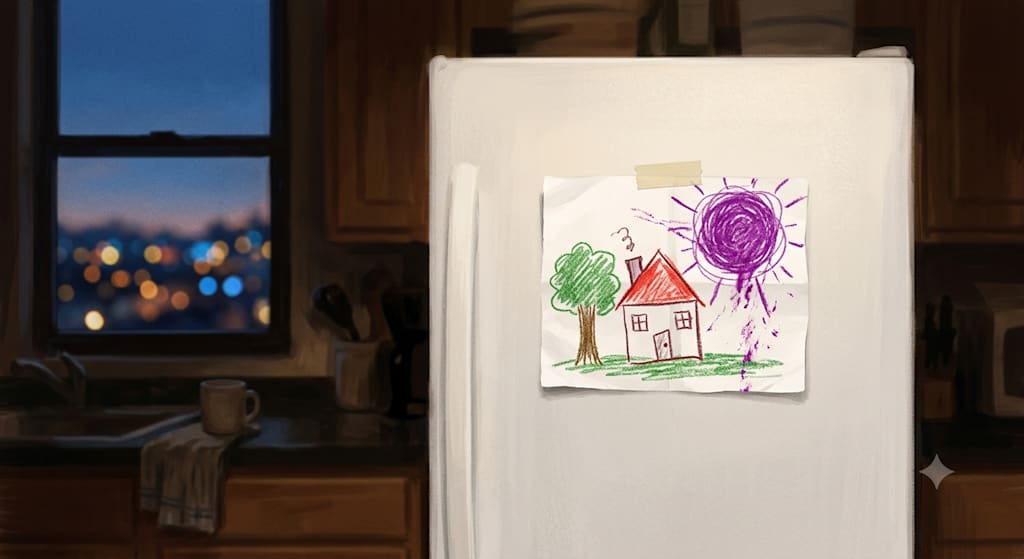
Mark crouched down. The drawing showed a house, a sun, and a tree. The colors bled outside the lines. The sun was purple.
“Why is the sun purple?” he asked.
The girl tilted her head and thought about it. “Because it’s not hot today.”
Mark looked at the purple sun, at all the colors outside the lines. He opened his mouth, and the words the sun isn’t purple nearly came out. It was a reflex, muscle memory, like his father’s resolute back as he closed the garage door.
But he didn’t say it.
“I think,” he said, “this purple is really special.”
The girl smiled, showing a missing front tooth. She thrust the drawing into his hands. “For you.”
Mark took it. The paper’s edge was slightly crinkled, damp from a child’s palm. He looked down at the purple sun, and his fingers, without him thinking about it, stopped rubbing his wrist. The girl had already run back to her seat, her braids bouncing.
That evening, Mark taped the drawing to his refrigerator. His refrigerator had always been empty, its white surface as clean as the day it left the factory. Now it held a house with a purple sun. He stood in front of it for a long time, then pulled out his phone and sent Helena a message.
Thank you for letting me come. When that boy made his move, you asked him how he thought of it.
A few seconds later, Helena replied.
You noticed.
Mark typed a few words, deleted them. Typed again. The cursor blinked for a long time.
I used to think that telling the truth was the whole of goodwill. Today I realized it isn’t.
He waited longer this time. Helena’s reply wasn’t a text. It was a voice message. He tapped it. Her voice was soft, a little tired, but very clear.
Mark, the errors you see—the outliers in the data, the flaws no one else notices—those are your gift. But when you asked that little girl why the sun was purple, you didn’t correct her. You just let her tell you the reason. In that moment, you actually used your gift. Because you made her feel that her answer was important. Not wrong.
Mark leaned against the wall beside the refrigerator, listening to the faint breath in the recording. Outside the window, the city’s lights were coming on, layer by layer. In the distance, the red beacon on the signal tower blinked on and off. He thought of that interview, July, air conditioner broken, everyone sweating. He had said, not the one you planted, a different one. Helena had laughed. That laugh and the voice in today’s message were the same thing. Not condescending approval. It was one person seeing something precious in another—something the other person didn’t even know was there.
He stood there for a long time. The apartment was small; the kitchen held one person comfortably, two couldn’t turn around. But suddenly the space didn’t feel so empty. The purple sun on the refrigerator sat quietly against the white surface. He walked over, smoothed the creased corner with his hand, then opened his laptop and began to write a new email.
To: Helena Kreutzer.
Subject: I want to learn again.
The body contained a single question.
The things you’ve always wanted to tell me but felt you couldn’t say out loud—can we start from this email?
Click send.
Outside, the city lights were scattered like stars. The red beacon on the signal tower dimmed for a moment, then flared back to life. The purple sun clung to the refrigerator, like a planet that had just found its orbit, no longer forced to shine alone with nowhere for its light to fall.
About the Creator
Jin
Writer of reamstories
https://reamstories.com/jin
Enjoyed the story? Support the Creator.
Subscribe for free to receive all their stories in your feed. You could also become a paid subscriber, letting them know you appreciate their work.
Comments
There are no comments for this story
Be the first to respond and start the conversation.