
The Power of the Nudge: How Nonviolence Won the Civil Rights Movement
Movement armed with nothing but dignity, discipline, and the "weapon of love."

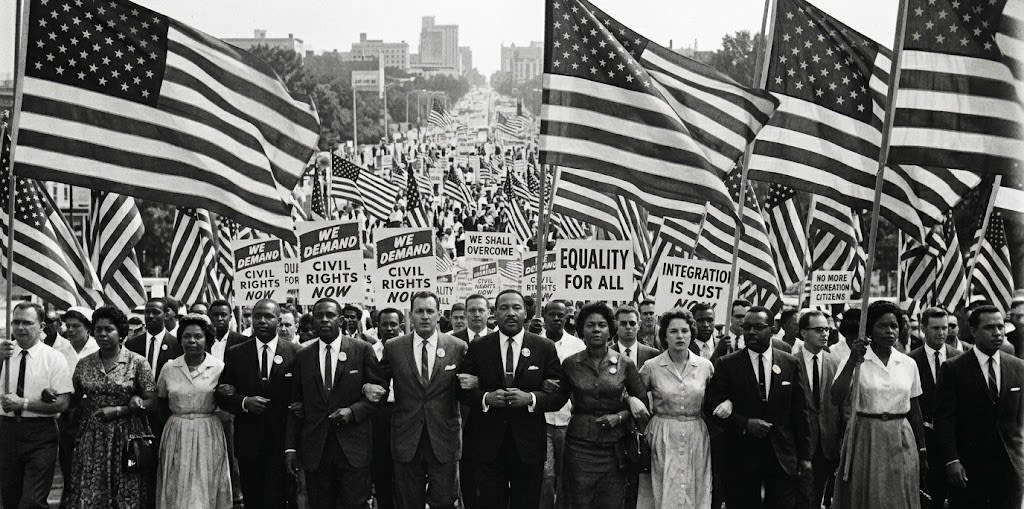
History is often written by the victors, but it is shaped by those who refuse to strike back. Pushes for civil rights have covered a majority of American history, however, the movement heightened from the 1950s to the late 1970s. The tactics deployed during these times had a wide range from peaceful, nonviolent protests all the way to extreme armed resistance. Both forms had an impact on the Civil Rights Movement, but nonviolent action appears to have created a larger influence and helped the movement move closer to its goal of civil equality. Inspired by actions from Gandhi, Martin Luther King led the charge in nonviolent actions through techniques such as; sit-ins, marches, boycotts, and other peaceful tactics to desegregate and move towards civil equality for African Americans in America.
The Gandhian Blueprint
To understand the theory of nonviolence, one must look at where it originated. The man who first successfully used nonviolence to protest was Mahatma Gandhi. He led his people in fighting against British aggression in India. Gandhi preached the idea of loving every human. No matter their race or religion, he accepted people as his brothers on Earth. Gandhi’s movement was aimed at bringing mankind closer together in an attempt to achieve his goal. He believed this approach was more effective than that of physically fighting to get what they wanted. The only thing this would accomplish is more violence and hate. During a speech given to the London Missionary Society of India in 1925, Gandhi finishes by altering a remark from President Woodrow Wilson. Gandhi stated, “All our earthly weapons have failed. Let us find out some new one or we die. Let us now take up the weapon of love-of-truth. When we acquire that weapon, we shall require no other.” The point that he is trying to get at is once every man gets along there will be nothing more for them to fight over or hate each other for. He used this idea in India when leading his people against the tyranny of the British Empire. Some opposition said that not fighting was an act of cowardice. However to have the power to stand one’s ground and not give in to pressure is a sign of bravery and strength. By doing this, Gandhi and the people of India showed a strong resistance and avoiding instigating more conflict from the British. The nonviolent protests in India proved to be effective in working towards independence. His movement proved that nonviolence is a viable option for working towards achieving goals in a society.
Dr. Martin Luther King Jr. studied the power of nonviolent action and started to preach it to achieve many of his goals which would help move towards social equality. Like Gandhi, he understood that they could not alienate their opposition and push back. Instead, they would protest in a way that would eventually bring the group of haters and protestors together. In a 1957 writing by King, he says, “The nonviolent resister is just as strongly opposed to the evil against which he protests as is the person who uses violence. He states that he knew there are two approaches but explains how the nonviolent way was just as powerful and showed the exact same amount of commitment to the cause. King needed people to understand that they were fighting hate and evil, not other people. The people who do acts of violence and oppress others are trapped by that hate and evil. King now needed a way to take this idea of nonviolence and take action to work towards gaining civil rights.
The Weapon of the Sit-In
One of the largest techniques was sit-ins. This was aimed at fighting stores and restaurants that segregated their customers or just simply refused to serve people of color. The purpose was for enough protestors to come and sit down at bars and tables and wait to be served. Many of these places in the south refused service to anyone other than whites. So if the restaurants would not serve them, they would sit there quietly and prevent other customers from having a place to order. In turn, the effects could slow business down for the small restaurants and shops and eventually cause them to close. They would have two choices, integrate their business or end it. This technique was popular among many young adults looking to get involved with the movement that was sweeping the country. The more popular they got, the more people joined. However, it was not always a peaceful and nonviolent protest. Locals and police officers would intervene and try to break up the sit-ins. What showed true strength and dedication to the cause was the people participating. They volunteered to go into a dangerous environment for something they believed in Mr. Franklin McCain, one of the first sit-in protestors, recalled how he felt before partaking in the event. He said, “I had pre-concluded if I were lucky, I would go to prison for a long time. If I were not so lucky, I would come back to my university campus in a pine box.” No matter the amount of verbal and physical abuse, they stood their ground and did not fight back. For if they threw a punch or talked back, it would end the meaning of the sit-ins and give their movement a bad name. The sit-ins proved to be an effective tool for helping with desegregation in shops and restaurants in many towns and also moved towards other movements that would follow suit in a nonviolent approach.
Birmingham: The Crucible of Change
The one city in the south that highlighted both the extreme tensions in race relations and the effort of the non-violent movement to end these tensions was Birmingham, Alabama. There had been bombings and intense police brutality towards the black community. Birmingham was one of the most racially divided cities in Alabama, and it had a large black population that had been pushing for improvements for a long time. The approach was to take it one step at a time, peacefully. Martin Luther King Jr. went down to the city to help lead the charge. He had workshops with activists to prepare them for dealing with resistance or getting arrested while maintaining discipline and keeping with the nonviolent script. He gave speeches and attempted to make negotiations. Eventually, King was thrown in jail for his efforts to stop segregation and mistreatment. While there, he wrote about the nonviolent process and how he tackles the situations in front of him. King says, “In any nonviolent campaign there are four basic steps: 1) collection of the facts to determine whether injustices are alive; 2) negotiation; 3) self-purification; and 4) direct action. We have gone through all of these steps in Birmingham.” They reached the final step and went to work. Along with the city of Montgomery, they boycotted the buses in the city. The black community was the largest group of riders, and this pressure eventually made the bus company give in and led to the desegregation of public buses. They performed marches all across the state and practiced more sit-ins. All the effort paid off and got national attention from the press. From the outside, The Birmingham Campaign looked like a dangerous mess, but it was slowly loosening the screw. President John F. Kennedy and his brother, the Attorney General, got involved and spoke and encouraged a peaceful solution. The national attention gave the movement the support it needed from the public.
The nonviolent movement had many supporters, however, there was opposition to this from the same side. Some thought the best way to handle racial mistreatment was to fight fire with fire. In an interview on taking action, a local NAACP president, Rob Williams, said, “That they meet violence with violence, Negroes must be prepared to recourse, attack, that they must be willing to fight, that they must be willing to die, and to kill if necessary.” This kind of talk was not isolated, it was thought by many blacks during the time. Fighting back showed a strength of force and gave some immediate relief, but it achieved nothing long term. It just increased the amount of violence for both sides and propagated more hatred toward the black community. The national image of the violent resister was one of people who were dangerous and scary. While the nonviolent movement gave a more positive image to the nation.
Through efforts of many different individuals and coordination between organizations, the nonviolent movement took the lead in improving the lives for African Americans. The various techniques employed in their campaign for equality proved to be effective while avoiding a negative view. Bayard Rustin explains it best in a 1979 interview when he said, “No minority can use violence against the majority and get away with it for very long.” Shoving someone will only result in them shoving back harder. If one nudges and avoids escalating the situation, they can stay in the game. The nonviolent movement was the most beneficial movement for civil rights and race relations.
Bibliography
Pearlman, Lauren, ed. The West Point Guide to the Civil Rights Movement. New York: Rowan Technology Solutions, 2015.
About the Creator
Sam Shroyer
I am an active-duty Engineer Officer in the US Army with a BS in Environmental Engineering from West Point. My previous positions include the following:
- Assistant Training Officer
- Sapper Platoon Leader
- Company Executive Officer
Enjoyed the story? Support the Creator.
Subscribe for free to receive all their stories in your feed.
Comments
There are no comments for this story
Be the first to respond and start the conversation.