
The Old Ticket to a Shore That No Longer Exists
A flickering lab, a cracked 1990s program, and the quiet collapse of the master-apprentice bargain
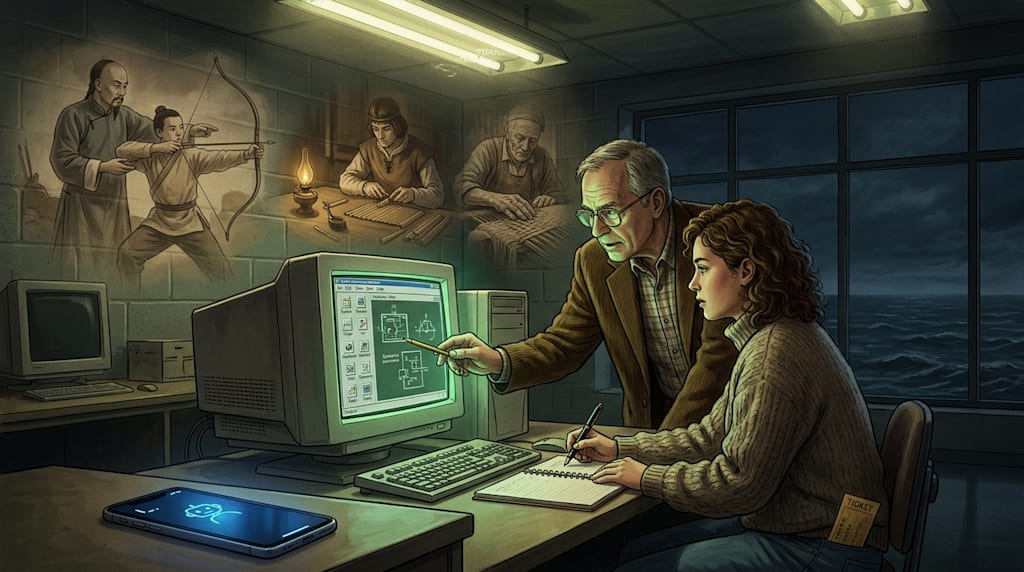
The fluorescent tube in the lab flickered. It dimmed every ten seconds or so. No one looked up.
The adviser was bent over, right index finger poking the screen, fingernail pressed on the third item in the menu bar. The software’s startup screen was still 1990s pixel art, icons jagged at the edges. He explained slowly: where to click first, what to drag next, how to mesh, how to set boundary conditions. The student sat beside him, notebook open, pen tip hovering, dropping every few seconds to write a line.
“Whatever you do, don’t click upgrade here.” The adviser’s finger left the screen and paused in the air. “Once you upgrade, the crack stops working. I’ll send you the patch path later.”
The student nodded. His chin dropped about two centimeters and bounced back.
I stood at the door for about three minutes. I knew that software. I used it more than ten years ago. Later no one maintained it. Later still you could not find the installer. The adviser kept talking. The student kept taking notes. The tube dimmed again.
This brought back a passage I had found in a local gazetteer. During the Tongzhi reign, military exams began before dawn. The old drill instructor stood on the training ground and watched students draw the heavy bow. It was a composite bow, horn and sinew glued together. Drawing it fully took a hundred and twenty jin of force. The instructor walked over and poked a student in the lower back. “Sink your horse stance half an inch lower.” The student sank. The bowstring pressed against his cheek. His hands trembled. The instructor said nothing. He waited. When the string was steady, he stepped back half a pace. Beside them stone locks stood in a row. The largest weighed three hundred jin. Its handle was wrapped in layer after layer of cloth, soaked with sweat and shiny.
By then the machines of the Jiangnan Manufacturing Bureau were already roaring. The blueprints for the Maxim machine gun had passed through Li Hongzhang’s hands. Samples of the Krupp cannon had been unloaded at Tianjin. No one at the military exam grounds mentioned any of this. The old instructor taught drawing the bow, swinging the broadsword, lifting the stone. He had made his name with those skills when he was young. Later he lived on military pay by them. This was all he knew. This was all he taught. Up before dawn, devout, meticulous.
Go back a few hundred years. Bi Sheng’s movable type had already been set. Letterpress presses had been unloaded in crates at Guangzhou. In the back courtyard of the academy, a copyist was still teaching his apprentice how to shave bamboo tubes. Winter bamboo, high oil content, less likely to split. The blade went in at forty-five degrees, so the tip would not fork. Ink had to be mixed: pine soot with glue. Too much glue and the brush dragged. Too little and the ink bled. The apprentice copied a hundred thousand characters and his wrist swelled for three days. The master said: swell once, and it will not swell again. That was true. The master had swollen through it. But the letterpress could print ten thousand pages a day, clear and legible, with no hand copying. The master had never seen a letterpress. In his world, copying books was how you made a living.
England ran the same story. When steam-powered textile machines clattered in Manchester, an old weaver was still teaching his apprentice by lamplight to feel silk thread. Press the pad of your finger to it. Twist gently. Sense the tension. Too tight and it snapped. Too loose and the weave came out sparse. The apprentice felt with his eyes closed. A mistake earned a slap on the back of the hand. The old weaver was not wrong. He had felt his way through a lifetime like that. He did not know that one spindle of a spinning jenny could do the work of a hundred of his fingers.
Across a hundred or two hundred years, these stories are clear. Was the old drill instructor wrong? No. Was the old copyist wrong? No. They did not know that the skills they treasured would lose even the right to enter the arena once machines a few miles away started working. Their not knowing was not their fault. Technology iterated slowly then. A master passed a craft to an apprentice, and the apprentice could live on that craft for the rest of his life. Experience was authority. Conservatism was safety. Master and apprentice had a default contract: the salt I have eaten is enough to keep you fed for half a lifetime.
I cannot say when that contract began to fail. I can say it has failed.
Last week in a meeting, a teacher beside me brightened and said he had chatted with “Tangbao” in a dialog box and gotten “very delightful” results. His eyes were bright. His fingers tapped the table, like the year he first learned to use a search engine. I did not answer. I did not know how to tell him that Agents out there could already read natural-language intent, call APIs, write scripts, correct themselves, and finish in minutes modeling that used to take a graduate student half a month of all-nighters. He probably thought AI was a fancier dictionary. Something that could polish an English abstract or write a few lines of basic code. That gap in understanding is more dangerous than a gap in software versions.
I could not blame him either. The syllabus was set five years ago. The lab manual was written ten years ago. The assessment standards were modeled on twenty years ago. If he swapped out the whole toolchain, student submissions would not reproduce. Thesis review would fail them. His warning “don’t upgrade, or the crack will fail” sounded bad. Behind it were risk avoidance and experience passed on under limited conditions. The sad part is not that he is stupid. The sad part is that what he earnestly passes on serves a production function that has already changed.
What I admired most was something I saw online, from a teacher speaking to his students from the podium: “Stay away from the pointing and prodding of us middle-aged and old geezers. The new era belongs to you young people who carry no path dependence.”
The sentence worked because a person at the podium was willing to admit he was still thrashing in the water. Our liquid planet has no shore. The podium is not a shore. Seniority is not a shore. A cracked software version is even less a shore. He admitted it, and then he let go.
Letting go did not mean telling the student to tear up the old ticket and jump into the sea. On that ticket, besides “which button to click,” something else was written. The teacher knew which boundary condition was easy to set wrong. He knew which meshing approach would make results untrustworthy. He knew which error message meant the physical model had been chosen wrong. Those are not software-version matters. They are domain judgment. Old software can serve as a specimen for dissection. It should not serve as a production tool. The teacher’s experience can serve as a library of failure modes. It should not serve as an operation manual.
The student’s job is to take the ticket, turn it over, make out the faint pencil marks on the back, and copy them into a new notebook. Then open the new tool and ask the question again.
I looked back at the lab. The student was still taking notes, pen tip pressed to the paper, handwriting tiny. The adviser straightened, rubbed the back of his neck, and bent down again to the next menu item. The tube flickered. No one looked up.
The phone in the student’s pocket had its screen on. A newly installed Agent interface, cursor blinking in the input box. He had not opened it yet. He knew it was there.
That was enough. The teacher handed over the old ticket. The student took it, folded it, and put it in his pocket. Then he turned around, facing a stretch of water with no dock. The ticket would not get him onto a new ship. The few lines in pencil on its back could help him read the wind.
He would have to swim himself.
About the Creator
Jin
Writer of reamstories
https://reamstories.com/jin
Enjoyed the story? Support the Creator.
Subscribe for free to receive all their stories in your feed. You could also become a paid subscriber, letting them know you appreciate their work.
Comments
There are no comments for this story
Be the first to respond and start the conversation.