
The Last Time We Saw Each Other
Two friends, one afternoon, and two versions of a friendship that never recovered.

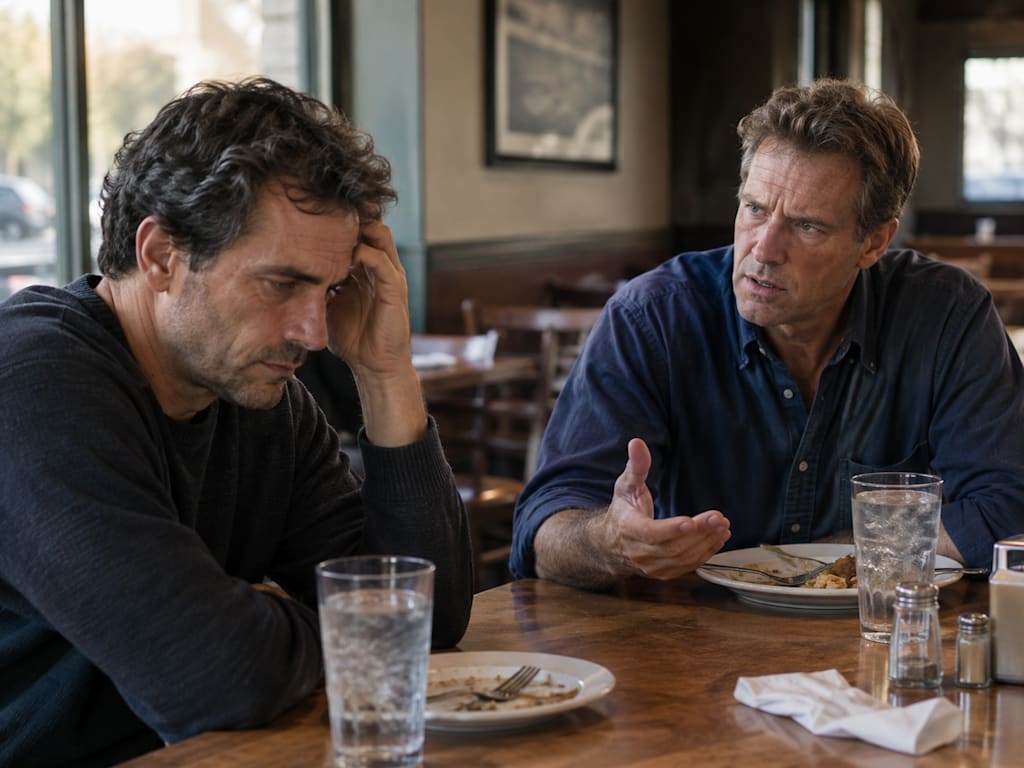
There are people who remember an argument for the rest of their lives, not because of what was said, but because of what they believe happened afterward. Paul and I have never agreed on the afternoon we stopped being friends. He says I humiliated him in front of a room full of people. I say he humiliated himself, and that I spent the better part of an hour trying to keep him from making things worse. Twenty-three years have passed, and neither of us has changed his account. The older we get, the more convinced we seem to become that the other one has invented an entirely different afternoon.
I met Paul when I was thirty. We worked together at a small publishing company that produced regional history books, biographies, and the occasional cookbook that sold better than anything either of us had written. He was an editor, I was a copywriter, and we shared an office with two desks, a temperamental printer, and a coffee machine that produced something resembling brown water. Paul had a quick laugh and a habit of talking to strangers as though he had known them for years. I was more reserved, although he often accused me of being difficult simply because I refused to agree with everything he said.
We became friends outside work. We went to restaurants, attended readings, visited bookstores, and occasionally drove to nearby towns when one of us heard about something worth seeing. Paul was married at the time, although his marriage had been unhappy for years. I was in a relationship that had already begun to unravel. We talked about everything, including the things we probably should have kept to ourselves. I knew about his financial troubles, his wife's suspicions, and his fear that he had wasted his life doing work he no longer enjoyed. He knew about my failed writing attempts and the fact that I had spent years pretending I was content with a life that felt increasingly small.
The trouble started when Paul decided to leave his wife. He told me first, sitting across from me in a restaurant, and I remember being genuinely happy for him. He had spent years talking about leaving, and I had grown tired of watching him talk himself out of it. He said he had finally met someone who made him feel wanted. Her name was Rebecca, and she worked in the accounting department of a company downtown. I had met her twice. She seemed pleasant enough, although I didn't know her well.
Over the next several months, Paul became difficult to reach. He missed lunches, stopped answering messages, and began arriving at work looking as though he had slept in his clothes. His divorce was taking longer than expected, Rebecca was becoming impatient, and he had apparently promised both women things he couldn't deliver. When he finally told me what was happening, I suggested he stop making promises until he knew what he could actually offer. He took that as criticism. I told him it was advice from a friend. He said he hadn't asked for advice.
We continued speaking, although something had changed. Conversations that once lasted an hour became brief exchanges about work. He was increasingly sensitive about his personal life, and I became increasingly reluctant to ask questions. I knew he was unhappy, but I was beginning to resent the expectation that I should be available whenever he needed someone to listen.
The afternoon we disagree about took place at a small restaurant where several people from our publishing company had gathered to celebrate the retirement of our production manager. There were perhaps fifteen of us, most of whom had worked together for years. Paul arrived late with Rebecca. His wife had not yet moved out of their house, and the divorce was still unresolved. I remember thinking it was an uncomfortable situation, especially since several people at the table knew his wife.
According to Paul, I greeted Rebecca politely and then spent the afternoon making comments about his marriage. He says I brought up the fact that he was still living with his wife, asked whether Rebecca knew about it, and made a joke about his ability to maintain two relationships at once. He remembers everyone laughing, although he says nobody laughed for long because they could see how uncomfortable he was. He says I deliberately embarrassed him because I disapproved of his relationship.
That is not how I remember it.
I remember Paul telling everyone that his divorce was nearly finished. He said his wife had agreed to sell the house, that the lawyers had settled the financial arrangements, and that he and Rebecca were planning to move into an apartment together. I remember Rebecca looking surprised when he mentioned the house because she apparently hadn't known they were planning to sell it. She asked him whether he had spoken to his wife about the arrangements. Paul brushed off the question and changed the subject.
Later, while the others were talking, Rebecca asked me whether Paul had ever mentioned that his wife was still living in the house. I told her that I thought she knew. She said Paul had told her the house was empty and that he was staying there temporarily because he couldn't afford another place. I remember feeling uncomfortable, but I didn't want to get involved. I told her she needed to discuss it with Paul rather than rely on what I knew. She thanked me, excused herself, and went to the restroom.
Paul says I followed her.
I didn't.
He says I told her his wife had no intention of selling the house and that he had been sleeping in the spare bedroom for months. I never said that. I knew very little about the arrangements, and I had no reason to interfere in their relationship. When Rebecca returned, she sat quietly beside him for the remainder of the meal. Paul became increasingly irritated, and eventually he announced that he and Rebecca were leaving.
Before he got up, he turned toward me and said, "You could have kept your mouth shut."
I asked him what he was talking about. He said I knew exactly what I had done. I told him I hadn't said anything that he hadn't already told the people at the table. He called me a liar, and I told him he needed to stop blaming everyone else for the problems he had created. I remember the table becoming very quiet. Someone asked whether we could discuss it another time. Paul stood, pushed his chair back, and walked out with Rebecca.
I stayed for another twenty minutes. I paid for my meal, said goodbye to the others, and went home. I was angry, but I was also relieved. Our friendship had become exhausting, and I had reached a point where I no longer knew how to speak to him without anticipating an argument.
Two days later, Paul sent me an email. He said I had betrayed him, that I had no right to discuss his private affairs with Rebecca, and that I had deliberately chosen a public occasion to make him look foolish. He said he had trusted me with things he had told nobody else, and I had used that information against him. I wrote back that I had done no such thing and that he needed to take responsibility for his own dishonesty. He never replied.
I saw him once more, several months later, at a bookstore. We exchanged greetings, spoke briefly about work, and went our separate ways. By then he had left the publishing company. Rebecca had moved out of the apartment they had rented together, and I heard through a former colleague that he had returned to his wife. I never asked for details.
For years, I considered the matter finished. I occasionally wondered whether I could have handled the afternoon differently, but I never questioned what had happened. I knew what I had said, what I hadn't said, and why I had said it. Paul's version seemed like an excuse invented by someone who couldn't admit he had been caught in a lie.
Then, several years later, I ran into Rebecca.
She was sitting alone at a restaurant near the university. I recognized her immediately, although she looked older and had cut her hair short. We exchanged greetings, and she asked whether I still worked in publishing. I told her I had left the company. She said she had heard I was writing and asked how it was going. We talked for a few minutes about mutual acquaintances, then she brought up Paul.
She told me they had separated shortly after the retirement dinner. She had eventually discovered that his wife had no intention of selling the house, and that Paul had never actually filed the final divorce papers. He had been telling each of them something different, hoping to keep both relationships going until he could decide what he wanted. Rebecca said she had confronted him about it, and he had blamed me for making her suspicious.
I told her I hadn't made her suspicious. She smiled and said she knew that now.
Then she told me something I hadn't known. After leaving the restaurant that afternoon, Paul had driven her to her apartment and spent nearly an hour explaining that I had been jealous of their relationship. He told her I had wanted him to remain unhappy because I didn't like seeing him move on with someone else. He also said I had deliberately approached her in the restroom and told her things about his marriage that were untrue.
I asked whether she believed him.
She said she had, at first. She had been embarrassed by the argument and didn't know what to think. She said Paul had become very convincing when he felt cornered, and she had wanted to believe him because she had already invested so much in the relationship.
I told her I was sorry she had been put in that position. She said there was no reason to apologize. She had eventually learned the truth, and she was grateful she had gotten out before things became more complicated.
Before leaving, she said something that stayed with me. She told me Paul had always described our friendship as the one relationship in his life where he never had to pretend. She said he had told her that I knew him better than anyone, which was why my betrayal had hurt so much.
I thought about that conversation for a long time.
I had known Paul well. I knew his ambitions, his insecurities, his sense of humor, and his talent for making a difficult situation seem entertaining. I also knew how easily he could turn a disagreement into an injury and an injury into a grievance. I had seen him do it at work, with his wife, and with people who had been generous to him. I had simply never expected to become the subject of one of those stories.
Several years after meeting Rebecca, I received a letter from Paul. It was short, written on ordinary stationery, and contained no return address. He said he had heard I was doing well and hoped I was happy. He mentioned that he had moved to another state and was working as a consultant. Near the end, he wrote that he sometimes thought about the afternoon at the restaurant and wished things had turned out differently.
There was no apology. There was no acknowledgment of what had happened. I read the letter twice and put it in a drawer.
I considered writing back, but I couldn't decide what I would say. I could have told him that I had never spoken to Rebecca in the restroom, that I had never intended to embarrass him, and that I had spent years wondering how a friendship could end over something neither person seemed willing to discuss honestly. I could have reminded him that he had accused me of something I hadn't done, then spent years telling other people the same story. None of that would have changed his memory.
I never answered.
A few months ago, I came across an old photograph from the retirement dinner. Someone had taken it while we were all sitting around the table. Paul was beside Rebecca, smiling at something someone had said. I was across from them, holding a glass of water. Neither of us appeared unhappy. There was nothing in the picture to suggest that we were approaching the end of a friendship.
I looked at it for a while, then remembered another detail. Before Paul and Rebecca arrived, he had called me from the restaurant parking lot. He said he was running late and asked me to save him a seat. He sounded cheerful, almost excited, and told me he had something important to announce. I had forgotten that telephone call entirely.
I still don't know what he intended to announce. He planned to tell everyone he was getting divorced, or he had already made arrangements with Rebecca. He could have simply wanted to enjoy an afternoon with his friends and believed everything would work out. The photograph offers no answers.
I sometimes think the disagreement was never really about what happened at the restaurant. Paul needed a reason our friendship ended that didn't require him to examine his own behavior. I needed to believe I had done nothing wrong because the alternative meant accepting that I had watched someone I cared about unravel and had been too tired to reach for him.
Those are two different kinds of self-protection, and neither makes a particularly flattering story.
I have kept the photograph. I threw away the letter, although I remember most of what it said. Paul and I have never spoken again, and I doubt we ever will. If someone asks me about him, I usually say we were friends for a long time and eventually went our separate ways. It is easier than explaining an afternoon that two people remember so differently.
Still, every time I look at that photograph, I find myself wondering what Paul saw when he looked across the table at me. He saw a friend who had turned against him, or someone who knew the truth and refused to help him hide it. I can understand both possibilities now, even if I cannot agree with his version.
The photograph has not changed. We are still sitting at the same table, smiling at the same unseen person, unaware that we are approaching the last time we will ever share a room. I remember leaving that afternoon feeling angry with him. Paul remembers leaving feeling betrayed by me. Somewhere between those two memories, a friendship ended, and neither of us has ever managed to tell the whole story.
About the Creator
Nolan Reed
I write true stories, including unsolved mysteries and events that actually happened.
Enjoyed the story? Support the Creator.
Subscribe for free to receive all their stories in your feed.
Comments
There are no comments for this story
Be the first to respond and start the conversation.