
The Day We Both Remember
Two people. One afternoon. Two different truths.

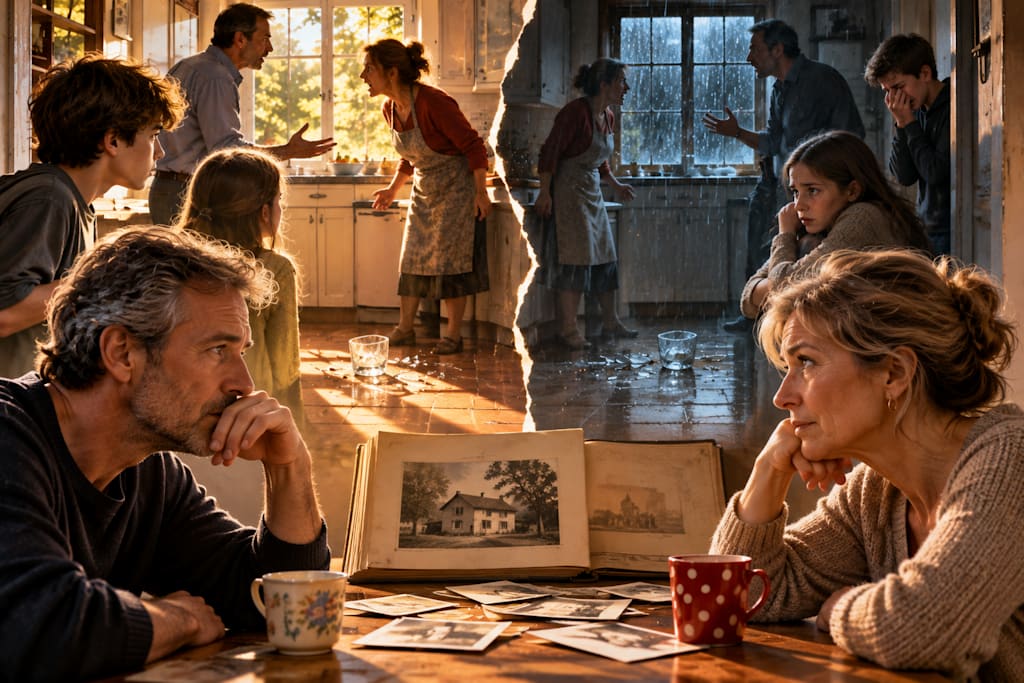
My sister remembers the rain.
I remember the sun.
That is where the disagreement begins.
Not with what was said, or who was angry, or why our father left the house and did not come back until after dark. We cannot even agree on the weather.
"It poured all afternoon," she says.
"It didn't rain at all," I tell her.
She looks at me with the particular irritation reserved for someone who is confidently wrong about your own childhood.
"I remember the sound on the windows."
"I remember sitting outside."
"You weren't outside."
"I was."
"You were in the kitchen."
And there we are again.
The kitchen.
We were thirteen and fifteen, though even that required checking later. Memory had made us younger in some versions and older in others.
Our parents had been arguing for weeks.
Or perhaps they hadn't.
That depends on which of us is telling the story.
In my memory, the tension had been obvious. Doors closed too hard. Dinner conversations shortened. My mother washed dishes that were already clean. My father spent longer in the garage than any mechanical problem could justify.
My sister says I invented most of that afterward.
"They argued once," she says. "That day. You're turning it into months."
I can see the weeks.
She can see one afternoon.
Neither of us is lying.
That is what makes it interesting.
The argument began over money.
I am certain of this.
My father had opened an envelope at the kitchen table. My mother was standing beside the sink. He said something about the bank. She replied that she had already warned him.
My sister says there was no envelope.
"It was about Grandma."
"It was money."
"It was Grandma's house."
"It was definitely money."
Perhaps both were true.
Perhaps neither.
What we agree on is the sound of a glass breaking.
Not accidentally.
Our mother threw it.
That part has survived intact in both versions.
A drinking glass hit the wall near the refrigerator and shattered.
Silence followed.
My sister remembers being frightened.
I remember being impressed.
This difference bothers her.
"You were scared too."
"I don't think I was."
"You jumped."
"I don't remember jumping."
"You did."
Her certainty makes me wonder whether the person I remember being ever existed.
In my version, I was watching everything with the alert fascination of someone suddenly seeing adults behave like children. There was something almost liberating about it.
Parents were supposed to know what they were doing.
That afternoon, clearly, they did not.
My sister remembers something else.
She remembers me crying.
I have no memory of crying.
None.
According to her, I stood beside the kitchen door with tears running down my face while pretending not to wipe them away.
"You kept looking at Dad," she says.
That detail stops me.
Because I do remember looking at him.
But not why.
In my memory, he was angry.
In hers, he was devastated.
She says our mother told him she wanted him to leave.
I remember him saying he was leaving.
Those are not the same thing.
One version contains rejection.
The other contains abandonment.
Perhaps this is where our two memories stopped being about the same afternoon.
My sister remembers our mother ordering him out of the house.
I remember our father choosing to walk away.
She spent years being angry with our mother.
I spent years being angry with our father.
Neither of us realized until adulthood that we had built those judgments around two different versions of the same thirty seconds.
Our father took his coat.
That we agree on.
My sister says it was raining, so he took the brown waterproof jacket.
I remember the blue one he wore in spring.
She remembers him standing at the door and saying, "I'll come back when everyone has calmed down."
I remember nothing being said.
This is important because silence became part of my version.
He simply left.
No reassurance.
No explanation.
Door closed.
Gone.
My sister insists that he promised to return.
"He said it clearly."
"I would remember that."
"Apparently you don't."
Then comes the strangest disagreement.
She says I ran after him.
I know I didn't.
In my memory, I stayed in the kitchen while my sister went to the window.
She watched him walk down the road.
I watched my mother collect broken glass from the floor.
But my sister insists our positions were reversed.
"You went outside."
"No."
"You followed him to the gate."
"I didn't."
"You shouted after him."
"What did I shout?"
She pauses whenever I ask this.
That part she cannot remember.
Only that I shouted.
I remember the broom.
The tiny pieces of glass catching sunlight on the kitchen tiles.
Sunlight.
Not rain.
My mother crouching to pick up a shard with her fingers.
Me telling her not to because she would cut herself.
My mother saying:
"I know."
Nothing else.
For years, I thought this was one of my clearest childhood memories.
Now I understand that clarity proves nothing.
Memory does not preserve the past.
It reconstructs it.
And apparently it is willing to redecorate.
A few years ago, we tried to settle the argument scientifically.
We called our mother.
"What happened that day Dad left after the argument?"
There was a long silence.
"What day?"
"The day you broke the glass."
Another pause.
Then she laughed.
"I broke a lot of things when I was married to your father."
This was new information.
My sister and I looked at each other.
"Was it raining?" she asked.
Our mother thought.
"I don't remember."
"What were you arguing about?"
"No idea."
"Did you tell Dad to leave?"
"Probably."
"Did he say he'd come back?"
"I assume so. He came back."
Neither of us found this satisfying.
Our father was even less useful.
He remembered the argument.
Sort of.
He thought it happened in winter.
He said the glass had slipped from our mother's hand.
Both my sister and I objected simultaneously.
"No. She threw it."
He smiled.
"If you say so."
We did.
That was the only fact on which we were perfectly united.
After the calls, my sister and I sat quietly for a while.
We had spent decades treating memory like evidence.
It wasn't.
It was autobiography.
She had remembered being frightened and needing to know that our father intended to return.
So perhaps her memory preserved the promise.
I had remembered being angry and needing to believe that leaving had been his choice.
So perhaps mine erased it.
Or perhaps she heard words I did not.
Perhaps I really did run outside.
Perhaps she really stood at the window.
Perhaps it rained on one side of the house and the sun shone on the other.
Memory makes ridiculous possibilities feel reasonable when the alternatives are admitting that we do not know.
There is one detail neither of us has ever disputed.
Our father came home that evening.
He opened the door.
Placed his keys on the little table in the hallway.
Our mother was cooking dinner.
Nobody apologized.
Nobody mentioned the glass.
My sister and I were watching television.
That is how families sometimes survive things.
Not by resolving them.
By continuing.
Now, when my sister tells the story, I no longer correct her about the rain.
When I mention the sunlight, she sometimes smiles but says nothing.
We have stopped trying to determine which version is true.
Perhaps there never was one version.
There was an afternoon.
There was an argument.
There was broken glass.
And there were two children standing somewhere inside it, looking in different directions.
Years later, each of us carried away what we had seen.
Or what we needed to have seen.
I still remember sunlight on the broken glass.
She still hears rain against the windows.
Somewhere between those two things, the afternoon probably happened.
About the Creator
Alain SUPPINI
I’m Alain — a French critical care anesthesiologist who writes to keep memory alive. Between past and present, medicine and words, I search for what endures.
Enjoyed the story? Support the Creator.
Subscribe for free to receive all their stories in your feed. You could also become a paid subscriber, letting them know you appreciate their work.
Comments
There are no comments for this story
Be the first to respond and start the conversation.