
The Capital of Sincerity
Why sincere people are not easy marks. They can afford to leave.
I
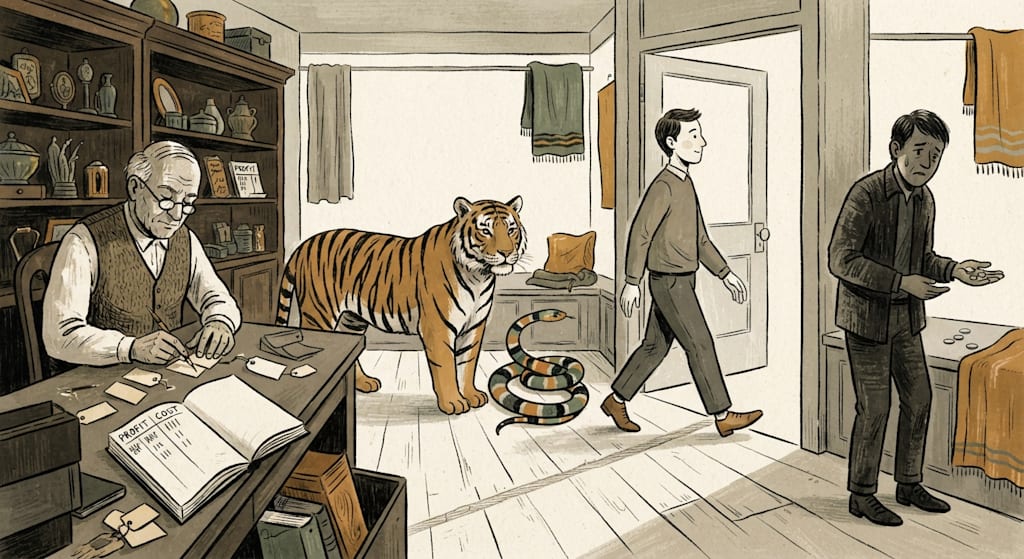
I know an old man who deals in antiques. In that trade, he is an oddity. Other dealers mix real pieces with fakes. He does not. Every item comes with a clear note: where it came from, how old it is, what is damaged, where it has been repaired. He even writes down how much profit he added. His peers laugh at him. They say, “Keep this up and you’ll run the shop into the ground.” He smiles and says, “If I like a piece, I’m not worried about selling it. If I don’t like it, I don’t touch it.” More than a decade has passed. Competitors have come and gone in waves. He still runs that small shop. Many of his customers have followed him for twenty years. They do not haggle. They do not doubt him.
Only after we became friends did he tell me that he had worked in finance in Hong Kong years earlier. He walked away at forty with several rental buildings in his name. The antique shop is a hobby. Whether it makes money does not matter to him. He once said something I have never forgotten: “I don’t live off this trade, so I can afford not to lie.”
It is not a flattering sentence, but it is accurate. It exposes something many people would rather not face: sincerity has a threshold.
We are taught from childhood that sincerity is a virtue, as if anyone can produce it whenever they choose. Look around as an adult and you will see how few people carry it all the way. Most people put it away when money is on the table, when pressure mounts, when fear enters the room. They do not want to keep it out. They cannot. The price is too high, and they cannot bear it.
So when people say, “He has the capital to be ruthless,” this is what they mean. Sincerity is a luxury.
II
The tiger is a useful comparison.
A tiger does not pretend. Hungry, it pounces. Full, it lies down. It will not chat with you, hand you a business card, call you brother, and then look for a chance to bite. It has no camouflage because it does not need any. Its position lets it be direct. The venomous snake is the same. Its colors are bright enough to make sure you see it. I am poisonous. Deal with it.
Some call this arrogance. Turn it around and it looks like safety. A creature safe enough does not need a disguise.
People are like this too. A person who is sufficient inside, who does not need to squeeze something out of others, has no reason to lie. Lying is expensive. You have to remember every false sentence. You have to play different roles in front of different people. You have to watch constantly for the moment you are exposed. Only two kinds of people do this: those forced into it and those scheming for something. Both come from lack: money, love, a sense of safety.
Now look at people who dare to speak straight. It does not matter whether they look successful by the world’s standards. Maybe they drive a beat-up car, live in a small apartment, dress like they just crawled out of bed. Watch how they handle relationships and you can tell: this person does not take. He wants nothing from you. That is why he can put the truth on the table.
III
Turn it around. Why do people who are always being cheated and pushed around find it so hard to stay sincere?
Because their sincerity has no safety net. Try telling a man with a mortgage, a wife who just lost her job, and a child who needs tuition money next month to speak honestly to his boss. He won’t. His character is not the problem. He cannot afford to lose. Every honest sentence is a bet for him, and he has no chips.
Worse, after being pushed around a few times, this kind of person develops a forced smoothness. He learns to say what the boss wants to hear. He learns to like posts in the group chat. He learns to give the right toast at dinner. You think he has become fake? Life sanded him into this shape. Survival pressure bends the spine of sincerity.
Selection explains this better than character. Nature does not ask about morality. It asks one thing: can you carry the weight? Those who can carry it earn the right to be themselves. Those who cannot have to become what others want them to be.
IV
Now the word “ruthless.”
Many people treat a sincere person like an easy mark. He is agreeable. He does not haggle. He does not throw a fit. So they assume they can keep taking. This is a bad misreading.
Sincere people tend to have two abilities: the mind to see through you and the strength to cut you off. He was polite at first because he saw no need to fight over small things. He was also watching you. Once he confirms that you are not sincere, once he sees that you used his trust and treated his goodwill as a loophole, he pulls back faster than you can react.
You call it ruthless. He does not explain or argue, and he gives you no room to reform. He blocks you and lets the relationship die. You tell everyone he turned on you without warning. It does not occur to you to ask why he does not need to plead with you.
Because he does not need you.
That is the capital behind the ruthlessness. He can identify you, and he can afford to lose you. Your weight in his life is far less than you assumed. You thought you were handling him. You were an option he filtered out.
V
The most dangerous illusion in this society is that sincerity equals weakness.
A sincere person has a temper, but he keeps it in check. He can calculate, but he cannot be bothered to calculate with you. He can leave; he simply sees no reason to break with you over small things, until you cross the line.
Where is the line? At the moment he confirms that you are not worth it. Once he confirms it, he leaves without even a sound at the door.
You stand there with the small advantage you took, and the ground shifts under you. He was not afraid of you before. He did not have you in his sight.
That is the part that stings.
About the Creator
Jin
Writer of reamstories
https://reamstories.com/jin
Enjoyed the story? Support the Creator.
Subscribe for free to receive all their stories in your feed. You could also become a paid subscriber, letting them know you appreciate their work.
Comments
There are no comments for this story
Be the first to respond and start the conversation.