
The Blueberry Slushie and the Bus I Never Boarded
A morning secret, a note from a girl, and the millisecond that split his life from the school bus wreck.
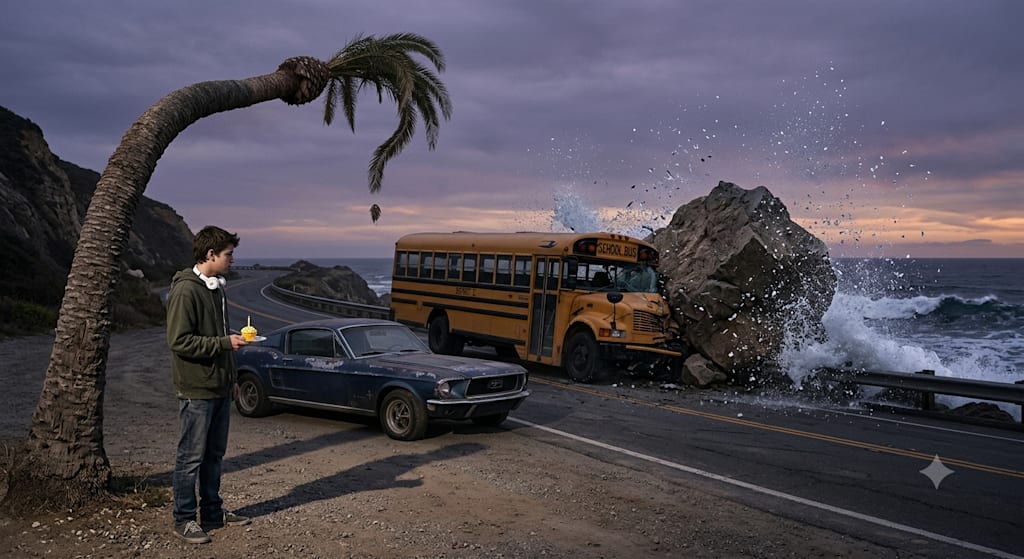
I died in the spring of my eighteenth year.
One second before the crash, the sweetness of a blueberry slushie still coated my tongue, and The Strokes’ “Someday” was playing through my headphones.
The moment I saw the boulder tumbling down the hillside, I yanked my headphones off and shouted at the driver: “Rock!”
The driver turned back, grinning. “You got good taste, kid.” Then he started humming along.
The school bus plowed into the fallen rock with a sound like the world tearing open. The boulder rolled down the slope, bounced across Highway 1, and disappeared into the Pacific. My sunglasses flew off my face and caught the midday sun for one bright, stupid second, like a cheap slow‑motion shot in some bargain‑bin coming‑of‑age movie.
To hell with that stupid driver.
They say that in the instant you die, your whole life flashes before your eyes. I don’t know who “they” are, but I’d like to tell them: to hell with them too. They got it wrong.
My life didn’t flash before my eyes.
I just replayed the hours before I died.
7:15 a.m.
My alarm had gone off three times, and I was still face‑down on my pillow, trying to figure out if the taste of last night’s onion rings had finally faded from my mouth.
Two knocks on the door. It swung open before I could answer—my dad. He stood in the doorway with a mug of black coffee, his tie still unknotted and hanging down his chest like two strands of dried spaghetti.
“Happy birthday,” he said. “You’re eighteen.”
I rolled over and looked at him. My dad was the kind of man who translated “I love you” into “Did you check the tire pressure?” He was standing a little strangely—his weight on his left foot, his right thumb rubbing the rim of the mug over and over. Later, I’d understand what that meant, but in the moment, all I noticed was the coffee.
“Is that for me?” I reached for it.
He glanced down at the mug as if he’d just remembered he was holding something, then took a sip himself.
Okay.
“Son,” he said, “this is the last easy birthday you’re going to have. There’s something I have to tell you.”
I shot upright in bed.
“Wait,” I said. “Let me guess.”
He waited.
I cleared my throat and, in my most polished pronunciation, declared: “Father, I am ready to shoulder the heavy burden of the family trust fund heir and head to Princeton to live out my inevitably remarkable life.”
My dad didn’t laugh.
He almost never did. But his expression wasn’t “I don’t find that funny.” It was something else. Like he’d been waiting at a stoplight and suddenly realized the road ahead hadn’t been paved yet.
“Kevin,” he said, “you’re not an only child.”
The blueberry slushie came from the Dunkin’ Donuts on 3rd Street. The receipt read 8:02 a.m.
I remember the time because the cashier gave me an extra dollar in change. I told her, “You gave me too much.” She said, “Oh,” took it back, and gave me a look that said, “Good kids like you are a dying breed.” Her nails were painted neon green.
I’d never noticed a convenience‑store cashier’s nail color before. That morning, I did. No reason.
I slid the twenty‑five cents of actual change into my jeans pocket, pushed open the door, and stepped into the eight o’clock sun. The air smelled like salt and seagull cries. Our town was wedged between the mountains and the ocean—so small you had to zoom in twice on Google Maps just to find it. The walk from Dunkin’ Donuts to the bus stop took three minutes, but in those three minutes you passed a crooked‑neck palm tree, a warning sign that read “Beach Closed – Shark Advisory,” and an old Ford Mustang that had been parked in the exact same spot forever, its paint peeling like a cicada shedding its skin.
I stood under the crooked palm for a moment.
You’re not an only child.
When those words came out of my dad’s mouth, my first thought wasn’t “Who’s my sibling?” It was “How many times did he rehearse that?”
Can you picture him practicing in the bathroom mirror? “Kevin, you’re not an only child.” Too formal, do it again. “Son, there’s something about the family you should know.” Too movie‑trailer. “You have a sister.” No, what if it’s not a sister?
I stood under that palm tree for about ninety seconds, then decided not to think about it yet.
My brain has a weird function: whenever something passes a certain threshold, it automatically pops up a blue screen that says “Deal with it later.” I’d been using that function since I was eight, the year my mom moved to Portland. Before she left, she kissed my forehead and said, “Mommy needs to go find herself.” I wanted to ask if she was coming back once she’d been found, but I didn’t. Deal with it later.
Eighteen years of stacking up maybe four hundred “Deal with it later” windows.
9:30 a.m.
Second period, History. The Cold War. Mr. Krieger put a photo of the Berlin Wall up on the projector and asked if anyone knew what the world felt like when that wall came down.
Nobody answered.
The girl in the seat in front of me was drawing a flower in her notebook. The scratch of her pen on paper sounded like a tiny mouse nibbling a cracker. Her name was Maya. She always sat one aisle over from me on the school bus, but we’d never actually spoken at school.
She turned around.
For a long time after, I would wonder why that moment happened. If she’d turned a second later. If the lesson had been about the Revolutionary War instead of the Cold War. If Mr. Krieger hadn’t asked that dumb question. Would everything that came next have simply never happened?
But she turned.
“You okay?” she whispered.
“What?”
“You didn’t draw any little monsters in the margins today,” she said. “You draw little monsters every day. Today, nothing.”
She had noticed my little monsters.
That hit me harder than “You’re not an only child.”
“Oh,” I said. “It’s my eighteenth birthday.”
Maya looked at me for two seconds. Then she tore off the corner of the page with the flower on it, scribbled something, folded it into a tiny square, and passed it to me under the desk.
She pulled her hand back just as Mr. Krieger’s gaze swept our way. I didn’t unfold the note until the break.
It said: “An eighteenth birthday should happen at the beach. Don’t get on the bus after school. Walk toward the old pier.”
The handwriting was messy. She’d misspelled “pier” once, crossed it out, and rewritten it.
I folded the note back up and tucked it into my jeans pocket, right under the quarter.
12:00 p.m.
I ate a terrible chicken‑breast sandwich in the cafeteria. Jason, sitting next to me, was going on as usual about what his girlfriend’s breakup text really meant. “She used a tilde. A tilde! What does a tilde mean from a girl?” While I half‑listened and squeezed three packets of ketchup into the sandwich, trying to make it less dry. It didn’t work.
My phone buzzed. Dad.
“Come home right after school. We need to talk.”
Deal with it later.
3:15 p.m.
The engine of the school bus rumbled to life in the parking lot. The exhaust sent a flock of seagulls flapping up from the dumpster. I walked a few steps with the crowd, then peeled off and headed toward the ocean.
Maya was sitting on the wooden railing of the old pier, her legs dangling and swinging. She wore a deep‑blue hoodie, the hood pulled so low I could only see her chin and two strands of choppy dark hair. In front of her sat a single cupcake with a candle stuck in it.
“You didn’t even bring a lighter?” I said, walking up.
“You’re eighteen now. You carry the lighter.” She pulled the candle out and handed it to me. “You haven’t blown it out yet. It doesn’t count.”
The cupcake was store‑bought. The frosting had melted a little. Strawberry.
We sat on that pier for forty minutes. The ocean was still. The sun scattered across the water like someone had thrown down a handful of broken glass. Maya told me about her older sister dropping out of college to go wander the country. I told her about my mom moving to Portland to “find herself.” Maya listened, then laughed and said the phrase “finding yourself” sounded like looking for your car in a mall parking garage. It’s not that you’ll never find it, it’s that you don’t want to park in the same old spot anymore.
Then she said, “You’ve talked more today than you usually do.”
“I got birthday cake.”
“No,” she said. “You never take your headphones off on the bus. I thought you hated talking to people.”
A gust of sea wind blew her hood off. Her hair came loose. It smelled like coconut shampoo.
For a second, I wanted to tell her about that morning. I wanted to say: My dad told me I’m not an only child. I might have a brother or a sister I’ve never known about, for eighteen years.
But what came out of my mouth instead was: “You dyed the tips of your hair blue.”
Maya blinked and looked down at her hair. The wind blew it across her face, then back again.
“Last month,” she said. “My dad said it looks like I got jabbed by a blue pen.”
“He doesn’t get it.”
“He doesn’t get it,” she repeated, and then she turned and looked at me. Her eyes held the same shimmering reflection as the water on the pier’s old wooden planks. “Does your dad get you?”
I opened my mouth.
The school bus.
To hell with that stupid driver.
I was supposed to be on that bus. Every day, at 3:20 p.m., the yellow school bus pulled out of the parking lot and headed north along the coastal highway, past my stop, and onward. At that time of day, the sun reflected off the ocean straight into the windows, blinding. I always zipped my hoodie up to my chin and cranked my headphones to full volume.
If not for Maya’s note, I would have been sitting on that bus.
So maybe death works like this: you pick a cup of coffee, a receipt, a conversation by the water. You make a tiny decision and think it’s no different from any other.
Then it becomes the last decision you ever make.
4:40 p.m.
Maya and I walked back from the pier. The sky was shifting colors: blue bleeding into pale pink, then into dusty violet. The leaves of the crooked palm tree swayed in the breeze, its shadow stretched across the asphalt like a long, skinny question mark.
We passed the Mustang that never moved. Another flake of paint had fallen off, revealing the rust underneath. Maya walked around to the front of the car, stepped onto the bumper, and pointed at the windshield. “Look,” she said. “There’s a bobblehead in there.”
There was. A grimy little bobblehead was wedged against the rearview mirror, its head tilted, also shaped like a question.
And then I heard something.
Not the sound of the crash. That was too far away to hear. Maybe it was the wind. Maybe it was my own heartbeat. I don’t know. But in that moment, a blue screen popped up in my mind, and the text on it read: Some windows you’ll never be able to click open again.
Maya hopped off the bumper and dusted her hands. She said something. I didn’t catch it.
I was thinking about my dad.
About what he’d said that morning. You’re not an only child. He’d said, I should have told you years ago. He’d said, I’m sorry.
He had actually said “I’m sorry.” I’d forgotten that. He said it just before he closed the door, just after he took that last sip of coffee. I’m sorry, son. At the time, I thought he was apologizing for something else. I thought he was apologizing for leaving me in that half‑empty house. For the burned spaghetti and the permission slips he forgot to sign and all those soccer games where he sat in the very last row and never cheered.
But no.
He was apologizing for another child.
A child I didn’t know.
A child he’d raised somewhere, or hadn’t raised, or had given away, or had kept hidden. I don’t know. Because I didn’t let him finish. On the first morning of being eighteen, I sat on my bed and all I wanted to say was: Father, I am ready.
Ready for what?
5:06 p.m.
My phone rang.
Dad. I didn’t pick up. The screen lit, then went dark. Lit again, then dark. My lock screen was an old photo: me, maybe five years old, sitting on my dad’s shoulders with Cinderella Castle in the background at Disneyland. My mom had taken it. You could see her thumb at the edge of the frame.
“You should answer that.” Maya’s voice came from beside me. She was looking at her phone, her face changing. I don’t know what news alert she saw, but suddenly her hand clamped around my wrist.
“Kevin,” she said, “the school bus. Something happened.”
I left that unanswered phone call in the world.
Just like I left that unblown candle on the pier. The unread note folded in my jeans pocket. The undrunk coffee cooling at the rim of my dad’s mug.
Just like my dad left the child he never told me about in eighteen years of silence.
We all leave things behind, as if tomorrow will show up on time to collect them.
But tomorrow didn’t come. It was cut off by a rock falling from the mountain, rolling across the coastal highway, tumbling into the Pacific, going neither fast nor slow, just fast enough for a yellow school bus to meet it head‑on.
I stood under the crooked‑neck palm tree, about two miles from where that bus would have made its final stop. Maya still had her fingers wrapped around my wrist. Her nails were painted deep blue, with one tiny chip missing. A different color than the neon green on the cashier’s hands that morning.
But I would remember.
I would remember every color I saw that day.
The purple of the blueberry slushie. The dark green of my dad’s coffee mug. The cobalt blue at the tips of Maya’s hair. The rust‑red of that dead Mustang. The gray‑yellow of the faded bobblehead. The dusty violet of the sky.
And then, nothing at all.
About the Creator
Jin
Writer of reamstories
https://reamstories.com/jin
Enjoyed the story? Support the Creator.
Subscribe for free to receive all their stories in your feed. You could also become a paid subscriber, letting them know you appreciate their work.
Comments
There are no comments for this story
Be the first to respond and start the conversation.