Stream of Consciousness
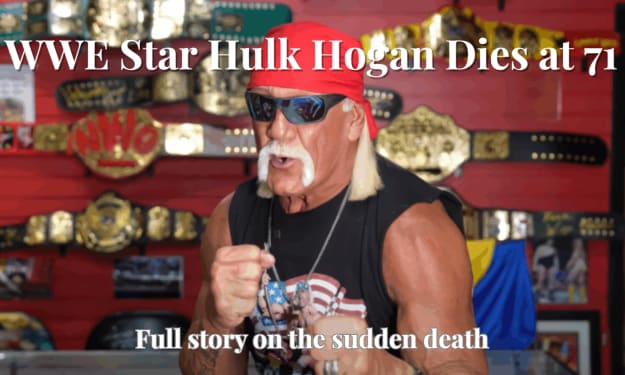
WWE Star Hulk Hogan Dies at 71 — Here's the Full Story Behind His Sudden Death
The wrestling universe is in disbelief after reports claimed that WWE Hall of Famer Hulk Hogan has died at the age of 71. The man who once embodied the very spirit of American wrestling — with his powerful persona, legendary moustache, and booming voice yelling "Whatcha gonna do, brother?" — was suddenly at the center of a viral death rumor. But what really happened to Hulk Hogan? Did the beloved wrestling icon truly pass away, or is this another twisted case of internet misinformation?
By Bevy Osuosabout a year ago in Humans
What Did Hulk Hogan Die From? Cause of Death Finally Revealed
It’s a question flooding every corner of the internet right now: What did Hulk Hogan die from? As news of the legendary wrestler’s death spreads, millions are searching for answers, shocked by how quickly everything changed. Just days ago, Hogan seemed to be doing well. Now, we’re faced with the heartbreaking truth that Hulk Hogan — real name Terry Gene Bollea — has died at the age of 71, leaving behind an unmatched legacy in the wrestling world.
By Bevy Osuosabout a year ago in Humans
Matthew Perry’s Tragic Final Hours: Inside the Truth That Wasn’t Reported — Until Now
When “Friends” legend Matthew Perry died in October 2023, the world mourned a gifted comedian whose off‑screen battles were as public as his on‑screen charms. But recent developments—especially a doctor’s admission of guilt—peel back layers of truth hidden from headlines. What really happened in those final hours? Let’s unravel the emotional reality, the shocking misuse of ketamine, and how his tragic end shines a light on celebrity addiction.
By Bevy Osuosabout a year ago in Humans
When the World Quietly Ends: Three Invisible Moments That Change Everything
The world doesn’t always end with explosions. Sometimes, it ends with silence. With inboxes that stay empty. With phone calls that never come. With a seat at the dinner table that’s been vacant for so long, no one remembers who used to sit there.
By Kamran Zebabout a year ago in Humans
Bryan Kohberger’s Family. Backgound, Family situation, Current status
When Bryan Kohberger was arrested in connection with the brutal killings of four University of Idaho students, the world was stunned — but perhaps no one more so than his own family. As the case gripped headlines across the nation, attention quickly turned toward those closest to him. Who are Bryan Kohberger’s parents? Does he have siblings? And how have they responded to his arrest, trial, and now his sentencing?
By Bevy Osuosabout a year ago in Humans
Championing Justice: Yasmin Bashirova and the Evolution of Human Rights Activism
The modern world continues to grapple with a range of human rights crises—from ethnic cleansing and political repression to gender-based violence and suppression of free speech. While global institutions like the United Nations and Amnesty International play a vital role, much of the progress in human rights is driven by individuals on the front lines. Among them stands Yasmin Bashirova, a rising figure whose influence has helped shift the landscape of human rights advocacy in the 21st century.
By Yasmin Bashirovaabout a year ago in Humans
I Thought Survival Was Enough — Until I Wanted More
I used to measure my success in days survived. A day without a panic attack. A day I didn’t cry in a bathroom stall. A day I managed to pay the bills with just enough left for instant noodles. Survival was my default mode. I wore it like armor. Growing up in a home where silence was punishment and chaos was routine, I learned early that wanting more—more love, more peace, more happiness—was a luxury. And luxuries weren’t for people like me. By the time I turned twenty-eight, I had clawed my way out of a toxic family, a city that swallowed dreams, and two abusive relationships. I was living alone in a studio apartment the size of a generous closet. I had a job that paid just enough to keep the lights on and a few friendships that flickered like a candle in wind. But I was surviving. And for years, I convinced myself that was enough. Until it wasn’t. --- The shift came quietly. There was no dramatic breakdown, no lightning-struck epiphany. Just one Tuesday morning, I sat on my mattress (because I couldn’t afford a bed frame), sipping cold coffee, and I thought: Is this it? The thought startled me. Because that’s the kind of question you don’t ask when you’re in survival mode. You don’t question the weight of your chains when you're too busy dragging them. But that morning, I did. Is this it? What if I could want more? What if wanting more didn’t make me ungrateful? What if surviving wasn’t the whole story? --- That day, I started making different choices—small ones. I bought a real mug instead of drinking out of plastic cups. I stopped apologizing in every email. I began unfollowing people who made me feel like I wasn’t enough. I even lit a candle in my apartment—not because I had guests coming, but just for me. Those tiny acts added up. Not in any miraculous, movie-montage kind of way, but in slow, human ways. I began to believe that maybe I deserved comfort. Maybe I deserved a life that wasn’t just about making it to the next day. The real transformation, though, came when I dared to dream again. I signed up for a night writing class. Just once a week. I told myself it was “just for fun,” but deep down, I knew I was reclaiming something I had buried: the part of me that used to scribble poetry on napkins, that dreamed of writing stories people could feel. At first, I felt like an imposter sitting in that classroom. Most people there had confidence that seemed foreign to me. But week after week, something inside me softened. The instructor—a silver-haired woman with fire in her eyes—once read my piece aloud and said, “There’s real truth in these words.” I nearly cried in my seat. That was the moment I realized: I had spent so long fighting to exist, I’d forgotten how to live. --- Wanting more didn’t mean I was greedy. It meant I was healing. I started advocating for myself at work. I applied for a promotion I was sure I wouldn’t get—and got it. I started dating again, but this time, I brought boundaries with me. I allowed myself joy without guilt. Rest without shame. I started choosing friends who uplifted me, not just tolerated me. And most importantly—I started writing again. Really writing. Not just journaling or writing to vent, but writing to say something. To remember that I had a voice. That I had a story. That I mattered. --- Here’s what I’ve learned: survival is brave. It’s a fight. And for many of us, it’s the first chapter of a long, complicated book. But it’s not the whole book. You deserve more than just “making it.” You deserve love that doesn’t ask you to shrink. You deserve mornings that feel light. You deserve to create, to rest, to grow, to laugh so hard you cry. You deserve to want more—and to go after it without apology. I don’t have it all figured out. I still have days where the weight creeps back in, where I catch myself bracing for impact that never comes. But now, I have a life that reminds me of what’s possible. I’m no longer just surviving. I’m building a life worth living. One messy, beautiful, brave day at a time. Thank you for reading ❤️.
By Azmat Roman ✨about a year ago in Humans
Some Wounds Don’t Scar — They Stay Open Quietly
I used to believe that time healed everything. That with enough months between you and the pain, it eventually faded into something softer — something manageable. But I’ve come to realize that some wounds don’t scar. They don’t close. They stay open quietly, hidden under layers of laughter, busyness, and pretending. My name is Liana, and this is the story of the wound I carry — the one no one sees, the one I don’t talk about anymore. But just because I don’t speak of it doesn’t mean it stopped hurting. It started seven years ago, on an otherwise ordinary April afternoon. I got a call no one ever wants: “There’s been an accident. You need to come quickly.” The next few hours moved in a blur. I remember screaming before my body even understood the words. My brother, Sam — the one who always knew how to make me laugh when the world felt like it was falling apart — had been hit by a drunk driver while walking home from work. He was twenty-four. I was twenty-one. They told me he died instantly. That it was painless. But I wasn’t thinking about his pain. I was thinking about mine. About the gaping hole suddenly ripped into the middle of my life. What I didn’t know then was that the moment he died, part of me did too. And it wasn’t the dramatic kind of death — not the kind people notice. It was the silent kind. The kind that walks around, goes to work, smiles in family photos, but never really feels whole again. For months after his death, I barely slept. I saw him in dreams, heard him in songs, looked for him in crowds. My phone still had his texts. I couldn’t delete them. I didn’t want to. People were kind, at first. They brought casseroles, sent flowers, left voice mails that said, “If you need anything, I’m here.” But grief is inconvenient, and eventually people drifted. Life went on for them. It didn’t for me. I became good at pretending. At work, I smiled and nodded through meetings. With friends, I laughed at the right times, responded to texts with emojis, and said, “I’m fine” even when I felt like I was drowning. No one knew that I cried in the shower so no one would hear. That sometimes I screamed into pillows until my throat went raw. Grief has no timeline, but society gives you one. You get three months of sympathy, maybe six if you're lucky. After that, it’s “aren’t you over it by now?” But I wasn't. The thing about losing someone like Sam is that the pain doesn't fade — it just changes shape. At first, it’s sharp and suffocating. Later, it’s quieter, duller — but always there, humming under the surface. It’s there when I see brothers laughing in coffee shops. It’s there when someone says, “I’m so close to my sibling — I don’t know what I’d do without them.” It’s there on his birthday, when I buy a cupcake and light a candle anyway. People say I’ve handled it well. That I’m strong. But strength, I’ve learned, isn’t about being okay. It’s about carrying the ache and still showing up. There’s something lonely about grieving someone who the world forgets. About still crying years later, but doing it in silence because the world has moved on. I never got to say goodbye. I never got to tell Sam that he was the best part of my childhood. That he protected me in ways I didn’t even realize until after he was gone. That his goofy jokes, terrible dance moves, and ridiculous love of pineapple pizza were things I would one day miss so deeply, it would feel like physical pain. You don't get closure with sudden death. You get a question mark. And for a long time, I hated myself for not "healing" properly. For not letting go. But here's what I’ve learned: healing doesn’t always mean the wound closes. Sometimes healing is just learning how to live around it. Some wounds don’t scar. They stay open quietly — unseen, unspoken, but felt in every part of who you are. And maybe that’s okay. Because in that quiet ache, I remember. I remember the sound of Sam's laugh. The way he called me “kiddo” even though we were barely three years apart. The way he looked out for me when no one else did. Grief, I’ve come to understand, is just love with nowhere to go. So I carry him in the silence. In the way I try to be kind. In the way I notice people who seem a little too quiet. In the way I never, ever let someone feel invisible in their pain. This wound might never scar — but it has made me more human. And maybe that’s the most honest healing of all. Thank you for reading ❤️.
By Azmat Roman ✨about a year ago in Humans
I Don’t Want to Be Brave Anymore. I just want to be okay.
I Don’t Want to Be Brave Anymore They call me strong. They say I’m resilient. They admire how I “always bounce back.” But here’s the thing they don’t see: I’m exhausted. And I don’t want to be brave anymore. I just want to be okay. I want a life where I’m not constantly in survival mode, where I’m not praised for enduring what I never should’ve had to endure in the first place. I want softness. Peace. A quiet kind of okay. For as long as I can remember, being “the strong one” wasn’t something I chose. It was assigned to me. Maybe it started the day I smiled at my mother’s funeral when I was nine, so my little brother wouldn’t cry. Or maybe it was when I got straight A’s while my world was silently falling apart at home. I don’t know. I just know that somewhere along the line, I learned that my pain had to come second. That it wasn’t safe to fall apart. People love a fighter, don’t they? They love the comeback story. They love the tearful confessions turned into triumph. They love when you say, “It made me stronger.” They don’t know what to do with you when you say, “Actually, it just broke me.” They celebrate my courage like it’s a medal. But courage, for me, has often felt like a cage. Like something I couldn’t escape even when I desperately wanted to. There’s a kind of loneliness that comes with being seen as strong. People assume you’re okay. They check in on others, not you. They think you’ve “got this,” when really, you’re just getting through the day. They confuse your ability to function with actual wellness. But here’s my truth: I’ve cried myself to sleep more times than I’ll ever admit. I’ve smiled through panic attacks. I’ve said “I’m fine” with trembling hands and a cracked voice. And I’ve felt more like a ghost of myself than a living, breathing human being. And still—they say I’m brave. Maybe I am. But I’m also tired. So tired. I’ve carried the weight of everyone’s expectations for so long. The expectations to be composed, kind, reliable, wise. To be the one who listens, who comforts, who gives grace even when I’m running on empty. And every time I try to say I’m not okay, someone reminds me of how strong I am—like it’s supposed to be a compliment. But I don’t want to be a compliment. I want to be a person. What if I told you I wanted to fall apart sometimes? That I wanted to scream into a pillow and not feel guilty afterward? That I wanted someone else to hold the world for a while so I could just be? I don’t want to inspire anyone right now. I don’t want to be the one who “keeps going no matter what.” I just want a moment to stop. To breathe. To rest in the ordinary safety of being okay. Not extraordinary. Not brave. Just okay. Maybe we don’t talk enough about what happens after the fight. About how hard it is to live in a body that’s been constantly in defense mode. About how trauma lingers like smoke, even when the fire is gone. About how being “brave” can sometimes just mean you didn’t have the privilege to fall apart. I’ve started to learn that it’s okay to let go of the armor. That vulnerability isn’t weakness—it’s freedom. That I’m allowed to want ease. Simplicity. A soft life. So no, I don’t want to be brave anymore. I want to be real. I want to be held. I want to be able to cry without feeling like I’ve failed some invisible test. I want to live in a world where being “just okay” is more than enough. If you’ve ever felt like this, I want you to know: you’re not alone. There are more of us than you think—tired warriors who want to put the sword down. Who want to stop performing strength and start healing. Who want to be human again. And maybe, just maybe, that’s the bravest thing of all. Thank you for reading ♥️
By Azmat Roman ✨about a year ago in Humans