how to
Whether you're lucky in love or still searching for your soulmate, learn how to be the best partner possible.
The Name Trick That Makes Everyone Like You
THE MOST POWERFUL WORD IN ANY LANGUAGE Dale Carnegie wrote in 1936 that a person's name is to that person the sweetest and most important sound in any language, and nearly a century later neuroscience has confirmed this observation by demonstrating that hearing your own name activates unique brain regions including the medial prefrontal cortex and the superior temporal cortex in ways that no other word produces, creating a neurological response that increases attention, positive feeling toward the speaker, and the sense of being recognized as an individual rather than being treated as interchangeable with everyone else. Despite this powerful effect being well-documented and widely known, the vast majority of people fail to use names effectively in conversation because they either do not remember names after introduction, feel awkward using names frequently, or simply do not realize how dramatically the strategic use of someone's name can transform the quality of social interaction and the other person's perception of you.
By The Curious Writer7 months ago in Humans
What Hearing People Get Wrong About ASL Interpreters — And How to Actually Do Better
If you’ve ever interacted with an ASL interpreter, you probably walked away thinking, “That went fine.” But here’s the truth: most hearing people misunderstand how interpreting works, what interpreters actually do, and how their own behavior can make communication smoother — or significantly harder.
By Tracy Stine7 months ago in Humans
🧠 Barriers Are in Your Mind, Not the Dictionary: How I Used My Head to Defeat the Impossible
I spent a solid decade in England. 🇬🇧 Over those ten years, I watched hundreds of people get stuck in a rut, even though they had everything they needed to move forward. The script was almost always the same: no job, no prospects, and that one mantra repeated like a shield: "I don't know the language, so I don't stand a chance." 🛑 This sentence served as a universal suit of armor, protecting them from taking any real risks. I looked at it and felt that beneath the layers of complaining lay a paralyzing fear—a fear of stepping out of the comfort zone and admitting that the problem was internal, not environmental. 🤐
By Piotr Nowak7 months ago in Humans
The Cost of a Faraway Sister's Return
To be honest, I’ve kept this bottled up for years. I didn't want to say anything because I didn't want to seem petty, but what happened a few days ago felt like swallowing a fly—I couldn’t spit it out, and I couldn’t choke it down. After thinking it over, I needed a place to vent about my sister-in-law—my husband's older sister—who married into a family far away.
By Water&Well&Page7 months ago in Humans
Why Most Lottery Winners Lose It All
Winning the lottery feels like the ultimate dream: instant wealth, freedom from financial stress, and the ability to live life on your own terms. But behind the headlines of oversized checks and champagne celebrations lies a surprising truth—many lottery winners end up broke, sometimes within just a few years.
By AnthonyBTV7 months ago in Humans
Life Is Not the Problem. What Happens in It Is
Life is often described as complex, unpredictable, sometimes unfair. Yet, if we take a step back and observe it with a bit of distance, a paradoxical idea begins to emerge: life itself is simple. It is the things in life that are not. To be born, to breathe, to feel, to move forward, to die — the fundamental structure of existence doesn’t change. It is universal, almost stripped down to its essence. What complicates everything are the layers we add: social expectations, personal ambitions, fears, comparisons, past wounds. Life itself does not lie. It simply unfolds. The turbulence comes from how we interpret and confront what happens to us. Saying “life is unfair” is a deeply human reaction. It comes from the gap between what we believe we deserve and what we actually experience. But if we think about it carefully, life has no moral intention. It does not consciously distribute rewards or punishments. It is raw. Neutral. What can be unfair, however, are the circumstances, the events and the human interactions we encounter. This is where nuance matters: life is not necessarily unfair but the things in life often are. A sudden loss, a betrayal, a failure despite effort — these are not “simple” experiences. They shake us, disturb us and leave marks. And in front of that, it is legitimate to react. To say “fuck this.” To say “go to hell.” To refuse, for a moment, to accept what feels unacceptable. That reaction is not weakness. On the contrary, it is a sign of being alive. It marks a boundary, an inner resistance against what feels wrong. In simple psychological terms, this is the phase where raw emotion needs to be expressed before any form of rational processing can take place. Ignoring it would mean denying a fundamental part of being human. But stopping there is not enough. Because after the emotion comes a crucial skill: adaptation. Adapting does not mean submitting or passively accepting everything. It means recognizing reality as it is, even when it does not match our expectations. It is an active, almost strategic movement. We do not always choose what happens to us, but we do choose what we do with it. Adaptation is a form of intelligence. It relies on mental flexibility, on the ability to adjust our reference points, our goals, sometimes even parts of our identity. In a constantly changing world, those who move forward are not necessarily the strongest but the ones most capable of transforming themselves. From a philosophical perspective, this echoes an old idea: it is not the event itself that defines us but our relationship to it. Two people can go through the same situation and draw completely different conclusions. One collapses, the other rebuilds. The difference does not lie in life itself but in the way it is lived. This does not mean we should minimize pain or pretend that perspective alone can fix everything. Some experiences are deeply impactful, and it would be dishonest to claim that a simple shift in mindset is always enough. But even then, there is always some room to respond. Sometimes small, sometimes significant. Saying “life is simple” is not an invitation to be naive. It is a reminder: beneath the apparent chaos, there is a stable structure. To breathe. To move forward. To seek meaning. To create connection. Everything else — the complications, the obstacles, the injustices — belongs to the things in life. And those, indeed, can be profoundly complex. So we complain. We push back. We use harsh words. And then, little by little, we adjust. Because in the end, living is not about avoiding difficulty, but about learning how to navigate through it.
By Baptiste Monnet7 months ago in Humans
After just one treatment, psilocybin provides quick and long-lasting improvement from OCD.
Researchers have discovered that in individuals who have not responded to conventional therapies, a single dosage of psilocybin quickly lessens the symptoms of obsessive-compulsive disorder (OCD).
By Francis Dami7 months ago in Humans
Libra Woman and Pisces Man Compatibility Score. AI-Generated.
The pairing of a Libra woman and a Pisces man is often described as magical, emotional, and deeply romantic. This is a union where imagination meets elegance, and empathy blends with charm. While they come from different elements—Air (Libra) and Water (Pisces)—their shared love for harmony, beauty, and emotional connection creates a strong and meaningful bond.
By Inspire and Fun7 months ago in Humans
Tiger Woods Crash: A Moment That Changed Golf Forever
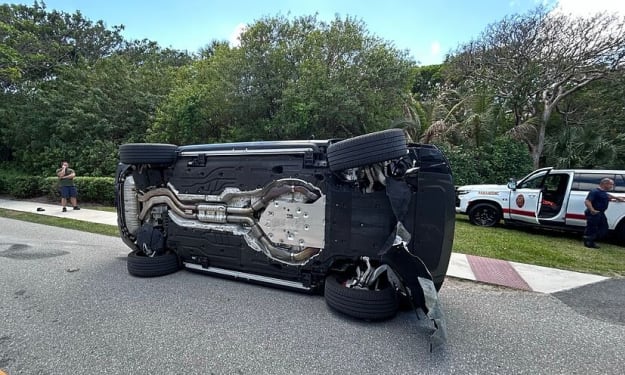
There are moments in sports that stop people in their tracks. News spreads quickly, and suddenly the focus shifts from competition to concern. The tiger woods crash was one of those moments. Fans around the world paused, not to discuss scores or trophies, but to ask a simple question: is he okay? For years, Tiger Woods had been known for strength, focus, and control on the golf course. Seeing him in a situation where none of those things mattered felt deeply unsettling. The accident was more than a headline. It was a reminder of how fragile even the strongest figures can be. To understand the impact of the tiger woods crash, we need to look at what happened, how it affected him, and what followed.
By Muqadas khan7 months ago in Humans