family
Family unites us; but it's also a challenge. All about fighting to stay together, and loving every moment of it.
I Genuinely Forgot My Own Birthday
I turned 24 on June 22. The funny part? I forgot. Y.E.A.H I genuinely forgot my own birthday. I was scrolling through Instagram when I saw someone else's birthday story. Balloons. Cake. Friends. The usual things people post when another year of life arrives.
By Aarsh Malik4 months ago in Humans
Love messages that last a life time
Love Messages That Last a Lifetime Love is one of the most powerful emotions we can express, and words often become the bridge between hearts. Among the countless ways to say “I love you,” the phrase “You are mine forever” carries a unique intensity. It speaks of permanence, devotion, and a bond that transcends time. In this article, we’ll explore the meaning behind these messages, how to craft them, and why they resonate so deeply in relationships. 💌 The Power of Forever Love Messages When someone says “You are mine forever,” it’s not just a romantic declaration it’s a promise. These messages: - Express commitment: They reassure your partner that your love isn’t fleeting. - Create emotional security: Knowing someone sees you as their forever builds trust. - Strengthen intimacy: Words can deepen the emotional and physical bond between partners. Forever love messages are timeless because they combine passion with permanence. 🌹 Crafting “You Are Mine Forever” Messages Here are some examples of how you can phrase these declarations in heartfelt ways: - Romantic tone: “No matter where life takes us, you are mine forever, my heart’s eternal home.” - Playful tone: “You’re stuck with me forever no refunds, no exchanges, just endless love.” - Poetic tone: “You are mine forever, like the stars belong to the night sky.” - Spiritual tone: “Our souls are bound, you are mine forever, beyond this lifetime.” 💕 Why These Messages Matter Love thrives on reassurance. Even in strong relationships, partners need reminders of devotion. Forever love messages matter because they: - Reignite passion during routine phases. - Heal insecurities when doubts arise. - Celebrate milestones like anniversaries or birthdays. They are not just words; they are emotional anchors. ✨ Situations to Use Forever Love Messages You don’t need a special occasion to say “You are mine forever.” But here are moments where they shine: - Anniversaries: Reinforce the promise of lasting love. - Long-distance: Provide comfort when miles separate you. - After conflicts: Reassure your partner that love endures beyond disagreements. - Daily reminders: Simple texts that keep the flame alive. 🌍 Cultural Interpretations of Forever Love Different cultures express eternal love uniquely: - In Western traditions, forever love is often tied to marriage vows. - In Eastern cultures, it may be expressed through poetry or spiritual devotion. - In African traditions, eternal love is often tied to family, ancestry, and community bonds. This universality shows that the desire for lasting love is deeply human. 🖋️ Tips for Writing Your Own Forever Love Messages If you want to craft your own, here are some guidelines: - Be authentic: Speak from your heart, not clichés. - Add personal details: Mention shared memories or inside jokes. - Keep it simple: Sometimes, “You are mine forever” alone is enough. - Use imagery: Compare your love to timeless things like stars, oceans, or seasons. 📱 Modern Ways to Share Forever Love Messages Technology has changed how we express love. You can send forever love messages through: - Text messages: Quick reminders during the day. - Social media posts: Public declarations of devotion. - Voice notes: Add emotion through tone. - Handwritten letters: A classic gesture that feels more intimate. 🌟 Sample Collection of Forever Love Messages Here’s a curated list you can adapt: 1. “You are mine forever, my love, my life, my everything.” 2. “Even when the stars fade, my love for you will remain.” 3. “You are mine forever, not just in this lifetime but in every lifetime to come.” 4. “No distance, no time, no obstacle can change the fact that you are mine forever.” 5. “You are mine forever, the one I choose every single day.” 🕊️ The Balance Between Passion and Respect It’s important to note that while “You are mine forever” is romantic, it should always be expressed with respect. Love is about choice, not possession. The healthiest forever love messages emphasize devotion without control. For example: - Healthy: “You are mine forever because I will always choose you.” - Unhealthy: “You are mine forever, whether you like it or not.” The difference lies in consent and mutual affection. Forever love messages like “You are mine forever” are more than romantic words they are promises, reassurances, and emotional bonds. They remind your partner that your love is enduring, resilient, and timeless. Whether whispered in private, written in a letter, or sent as a text, these messages have the power to strengthen relationships and create lasting memories. Love is fleeting only when left unspoken. By declaring “You are mine forever,” you give your partner a gift that echoes across time.
By Michael Skylas 4 months ago in Humans
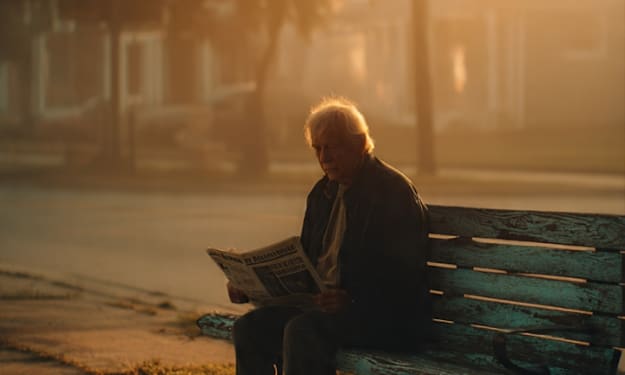
The Man on the Blue Bench, . AI-Generated.
Every morning, just before sunrise, the streets of the small town were quiet. The shops were closed. The traffic lights blinked lazily. Most people were still asleep. But one person was always awake. An old man with silver hair would slowly walk to the blue bench near the corner of Maple Street and sit there with a newspaper in his hands. Nobody knew much about him. Some called him Mr. Wilson. Others simply called him “the man on the bench.” He arrived at six o’clock every morning without fail. He sat quietly. He unfolded the newspaper. And then he waited. People assumed he enjoyed reading. But if anyone paid close attention, they would notice something strange. He almost never turned the pages. Instead, he looked down the empty road. Sometimes he checked his watch. Sometimes he smiled softly to himself. And sometimes, when nobody was looking, tears filled his eyes. For years, Sarah noticed him while walking to work. She worked at the bakery across the street. Every morning, she waved. And every morning, the old man smiled and waved back. One chilly autumn morning, Sarah decided to take him a cup of coffee. "Good morning," she said. The old man smiled warmly. "Thank you, my dear." "You come here every day," Sarah said. "You must really love newspapers." He laughed quietly. "Actually, I haven't read one in years." Sarah looked confused. "Then why do you carry it?" He looked at the newspaper lovingly. "It belonged to my wife." Sarah sat beside him. "My wife, Eleanor, used to read the newspaper every morning while we sat on this bench together." His eyes sparkled with memories. "She loved watching the sunrise." "What happened to her?" Sarah asked softly. Mr. Wilson lowered his eyes. "She passed away twelve years ago." Sarah's heart sank. "I'm sorry." He smiled gently. "Don't be. We had fifty beautiful years together." He looked at the golden sky. "Before she died, Eleanor held my hand and said, 'Promise me you'll still come watch the sunrise.'" "So I promised." "And I've kept that promise every day since." Sarah didn't know what to say. Most people would have moved on. Most people would have forgotten. But Mr. Wilson hadn't. Because some promises become part of who we are. Days turned into months. Months turned into years. Soon everyone in town knew the old man on the blue bench. Children waved at him on their way to school. Dog walkers stopped to chat. People from the bakery brought him tea. And somehow, without realizing it, Mr. Wilson became part of everyone's life. Then one winter morning, the bench was empty. Sarah looked around nervously. No newspaper. No gentle smile. No Mr. Wilson. The next day, the bench was empty again. And the day after that. Finally, Sarah visited the nursing home nearby. The receptionist recognized his name. "Mr. Wilson has been very ill," she said. Sarah entered his room. The old man looked weak, but his eyes brightened when he saw her. "Sarah," he whispered. She smiled through tears. "Everyone misses you." He chuckled. "Tell them not to worry. I'm just tired." For a few minutes, they talked about the sunrise, the bakery, and the little children who waved at him every morning. Then Mr. Wilson reached into a drawer and handed her his old newspaper. "Eleanor loved this." Sarah carefully held it. "I want you to have it." She shook her head. "No, it's yours." He smiled. "Not anymore." Then he pointed toward the window. "The sun is rising." They watched together in silence. It was beautiful. Golden light filled the room. For a moment, peace settled over everything. Mr. Wilson smiled. "She's waiting for me." Those were the last words Sarah heard him say. Mr. Wilson passed away peacefully that morning. The news spread quickly. People across town gathered. Children brought flowers. The bakery closed for an hour. Even strangers came. Not because he was famous. Not because he was rich. But because kindness leaves footprints that money never can. A week later, the mayor announced that the blue bench would remain exactly where it was. A small plaque was added. It read: "In memory of Harold Wilson and Eleanor Wilson. Love keeps its promises." Years have passed since then. Sarah now owns the bakery. Every morning before opening the shop, she places a fresh cup of coffee beside the blue bench. People often ask why. She simply smiles. "Some traditions deserve to live forever." And sometimes, when the morning sun shines through the trees and the wind rustles softly across the empty street, she could almost imagine two old souls sitting together. One holding a newspaper. The other watching the sunrise. Still keeping a promise. Because true love doesn't always speak loudly. Sometimes, it sits quietly on an old blue bench, waiting for another beautiful sunrise.
By Nabil Ahmad4 months ago in Humans
Scorpio Woman and Aquarius Man Compatibility Score. AI-Generated.
The relationship between a Scorpio woman and an Aquarius man is one of the most intriguing and unpredictable pairings in astrology. Both are strong-willed, intelligent, and determined individuals, yet they approach life, love, and emotions from completely different perspectives. This creates a relationship filled with excitement, growth, challenges, and endless fascination.
By Inspire and Fun4 months ago in Humans
"The 5-Year Window: Why Marriage in Your Late 20s is an Investment, Not a Sacrifice.". AI-Generated.
We treat our 20s like a dress rehearsal for adulthood—a sprawling decade of career hopping, city-hopping, and identity-shaping. The prevailing cultural mantra screams, “You have time. Don’t settle. Find yourself first.” But here is the uncomfortable truth that self-help gurus rarely whisper: By the time you’ve fully "found yourself," the structural conditions that make marriage most successful have quietly expired. Viewing marriage through the lens of necessity rather than romance feels clinical, even unromantic. Yet, when we reframe it as an investment—with compound interest, risk mitigation, and long-term dividends—the ages of 25 to 30 emerge not as a societal deadline, but as a biological, financial, and psychological sweet spot. Deliberately missing this window isn't liberation; it's often a gamble with increasingly unfavorable odds. Let’s break down why this specific five-year corridor matters more than any other decade of your life. The Compound Interest of Dual-Income Synergy In the world of finance, the single greatest variable for wealth accumulation is time in the market. The same principle applies to household economics. Two individuals marrying between 25 and 30 typically enter the workforce with 3 to 7 years of experience—enough to have stable income, but early enough to align their long-term financial trajectories. Consider this: A couple who marries at 26 and aggressively saves for a down payment together over five years will likely enter their 30s owning real estate. A couple who marries at 34, however, often faces a brutal collision of peak career demands, student loan fatigue, and the skyrocketing cost of childcare if they delay parenthood further. Marriage in the late 20s allows for parallel accumulation—two people splitting rent, utilities, and daily expenses while simultaneously investing in retirement accounts. That extra 5 to 7 years of combined savings, compounded annually, can easily translate to a six-figure advantage by age 40. You aren't sacrificing your freedom; you're arbitraging your living costs during your highest-energy, lowest-responsibility years. The Biological Clock is Not a Social Construct We can argue about societal norms until we are blue in the face, but biology remains stubbornly indifferent to our feelings. Female fertility peaks in the early 20s and begins a gradual decline after 30, with a more pronounced drop after 35. Male fertility, while more gradual, also experiences a decline in sperm quality and testosterone after 35, linked to higher risks of genetic mutations and pregnancy complications. Marrying between 25 and 30 gives couples a generational buffer. It allows for the luxury of time—time to enjoy two or three years of child-free married life, time to navigate the emotional turbulence of early parenthood while your bodies still have the physical resilience for sleepless nights, and time to recover financially before retirement. Waiting until 35 or 38 often turns pregnancy into a high-stakes medical project rather than a natural life event. The necessity here isn't about rushing; it's about preserving options. A marriage at 26 offers a 10-year reproductive window; a marriage at 36 offers a 4-year window, often fraught with anxiety, intervention, and steep medical bills. That is not fear-mongering; that is actuarial reality. Neural Plasticity and the "Clay Principle" Psychologists have long noted that core personality traits—emotional regulation, conflict resolution styles, and communication patterns—become significantly rigid after the age of 30. Your late 20s represent the final phase of significant neural plasticity, where your brain is still malleable enough to adapt to another person's emotional ecosystem. Marrying during this phase means you grow together rather than trying to merge two fully-formed, unyielding identities. Think of it as wet clay versus dried pottery. Two people at 26 can shape their daily rituals, financial philosophies, and parenting styles collaboratively because neither is entirely set in their ways. By 35, you have accrued a decade of solo habits—how you load the dishwasher, how you spend your Sundays, how you handle stress after work. Merging at that stage requires unlearning, which is exponentially more exhausting than co-learning. The investment of your late 20s buys you psychological flexibility—the most undervalued asset in any long-term relationship. Resilience Before the Storms Hit Here is the cruel irony of waiting until you are "financially stable" to marry: Life's hardest storms—aging parents, career plateaus, health scares—all tend to converge in your mid-to-late 30s. If you marry at 28, you have seven years to build a relational fortress before those storms arrive. You get to practice navigating smaller conflicts—budget arguments, in-law boundaries, career pivots—when the stakes are relatively low. If you marry at 37, you are often navigating the inaugural storms of your marriage while simultaneously handling your parents' declining health and your own midlife career reevaluation. That is not a partnership; that is a crisis. The necessity of marrying in that 25-to-30 window is fundamentally about building your emotional infrastructure during the calm, so that when the hurricane hits, you aren't learning how to nail down the roof mid-tempest. The Counterargument—And Why It Fails Critics will argue that divorce rates are higher for couples who marry young. This is statistically true for teenagers and early 20-somethings, but the data flips decisively for those who marry between 25 and 30. According to the National Survey of Family Growth, marriages that occur in this bracket have the lowest five-year divorce rates of any age group. Why? Because you have enough life experience to choose wisely, but enough youth to adapt generously. You have dated enough to know what you don't want, but not so much that you have become cynical or overly rigid. The Final Verdict Marriage between 25 and 30 is not about succumbing to societal pressure or ticking a box before a birthday. It is a strategic life arbitrage—an acknowledgment that the convergence of peak biological fertility, maximal psychological flexibility, and optimal financial compounding occurs in this exact decade. Waiting is not a sign of empowerment; it is often a sign of avoidance disguised as caution. The question is not, "Am I ready?" because no one ever is. The real question is, "Am I building my life with someone during the phase where we can multiply our efforts, or am I waiting until we are both so entrenched that we can only divide our burdens?" In the investment of life, the 5-year window is your bull market. Miss it, and you aren't just losing time—you're losing leverage.
By Touseef Gul4 months ago in Humans
Social Aggression Is Still Aggression (Part 2). AI-Generated.
(Time-Stamped Video Clip Summary: From 18:34-22:39, the call shifts from a normal pricing question into something more revealing. Tomi is asking basic questions about a $40,000 vehicle: the rebate, the in-person discount, the actual out-the-door number, and whether the dealership will confirm the deal over the phone. Instead of simply clarifying the pricing, the manager personalizes the resistance, later calling him “difficult” and “combative” before introducing the “male manager” implication herself. The clip matters because it shows how aggression does not always appear as yelling, threats, or force. Sometimes it appears as passive aggression, motive-reading, moral accusation, and emotional pressure used to control the frame of the conversation.)
By Peter Thwing - Host of the FST Podcast4 months ago in Humans
The Old Woman Who Found Her Missing Brother After 40 Years ❤️👵👨🦳. AI-Generated.
An Old Woman Found Her Missing Brother After 40 Years Mary Thompson was 68 years old. She lived alone in a small town in England. She had a quiet life and spent most of her time reading books, gardening, and helping her neighbors. However, there was one thing that always remained in her heart. She had lost her younger brother, David, when she was only 28 years old. Forty years earlier, Mary and David had been very close. They grew up together in a small house with their parents. They shared toys, attended the same school, and helped each other through difficult times. David was two years younger than Mary and always looked up to her. When David turned 26, he wanted to travel and find better opportunities. He left home to work in another city. At first, he wrote letters and called regularly. Then, slowly, the messages became less frequent. One day, they stopped completely. Mary and her parents tried everything to find him. They contacted friends, relatives, and even local authorities. Nobody knew where David had gone. It was as if he had disappeared. Years passed. Mary's parents grew old and eventually passed away. Before her mother died, she held Mary's hand and said, "Never stop believing that David is alive." Mary promised she would never give up. Life moved on. Mary got married, raised a family, and worked as a teacher. Still, every birthday and every Christmas, she thought about her brother. She wondered if he was safe, if he was happy, or if he even remembered his family. As technology improved, many people started using the internet to reconnect with old friends and family members. Mary heard stories about people finding lost relatives after many years. These stories gave her hope. One rainy afternoon, Mary was sitting at her kitchen table. She was looking through an old photo album. She stopped at a picture of herself and David standing beside a bicycle. They were smiling brightly. Tears filled her eyes. "I wish I could see you again," she whispered. Her granddaughter, Emma, was visiting that day. Emma noticed the photo and asked about the man standing next to her grandmother. Mary told her the story. Emma listened carefully and then said, "Grandma, let's try searching for him online." Mary smiled sadly. "I've tried before," she replied. "But maybe we can try again," Emma said. The two spent several hours searching websites and social media pages. Most searches led nowhere. Then Emma found something interesting. A man named David Thompson was living in Canada. His age matched. His hometown matched. There was even an old photograph that looked very similar to Mary's brother. Mary's heart began to race. Could it really be him? Emma sent a polite message. "Hello. We are looking for a man named David Thompson who was born in England. If this is you, please reply." Then they waited. One day passed. Two days passed. Three days passed. There was no response. Mary tried not to get her hopes up. On the fourth day, Emma's phone made a notification sound. A reply had arrived. The message simply said: "I think you may be looking for me." Mary could hardly believe her eyes. The man explained that he had moved to Canada many years earlier. He had experienced several personal difficulties and lost contact with his family. Over time, he felt ashamed and believed it was too late to return. He never stopped thinking about them, but he did not know how to reconnect. Mary cried as she read the message. For the first time in forty years, she knew her brother was alive. The following week, they arranged a video call. Mary felt nervous. She had imagined this moment for decades. When the screen connected, an older man appeared. His hair was gray. His face had changed. But his smile was exactly the same. "Mary?" he asked softly. Mary covered her mouth. "David?" she replied. Neither of them could speak for several seconds. Then they both started crying. They spent hours talking. They shared memories from childhood. They talked about their parents. They spoke about the years they had missed. David told Mary about his life in Canada. He had worked many different jobs and eventually started a small business. He had married and raised two children. Mary told him about her own family and showed him photographs of her children and grandchildren. The conversation lasted nearly four hours. When it ended, both of them felt something they had not felt in many years. Peace. Over the next few months, they talked regularly. Every week, they shared stories and learned about each other's lives. Finally, David made a decision. He wanted to visit England. Mary could hardly contain her excitement. The day of the reunion arrived. Family members gathered at the airport. Everyone was eager to meet the man they had heard about for so many years. When David walked through the arrival gate, Mary immediately recognized him. She slowly walked toward him. David smiled. Mary smiled back. Then they embraced each other tightly. Many people nearby stopped and watched. Some even wiped tears from their eyes. It was a moment that seemed impossible. A brother and sister reunited after forty years. The family spent several wonderful weeks together. They visited old places from their childhood and looked through family photographs. David visited his parents' graves and quietly thanked them for never giving up on him. One evening, Mary and David sat together in the garden. The sun was setting. Birds were singing in the distance. David looked at his sister and said, "I'm sorry for all the lost years." Mary shook her head. "What matters is that you're here now." David smiled. "You never stopped searching for me." "No," Mary replied. "Family is too important." As the sky turned orange and pink, both of them reflected on their journey. Forty years had passed. Thousands of days had come and gone. Yet hope had survived. Their story soon spread through local newspapers. Many people were inspired by their reunion. Some even began searching for their own lost relatives. Mary often shared one simple message: "Never give up on the people you love. Sometimes miracles take time." For Mary and David, that miracle took forty years. But in the end, it was worth every moment of waiting. Their reunion proved that even after decades of separation, family bonds can remain strong. Distance, time, and circumstances may keep people apart, but love can still bring them back together. And so, after forty long years, a sister finally found her missing brother, and a family became whole once again.
By Hafiz afridi4 months ago in Humans
Tourists run for their lives as gunfire erupts
Times Square turned into a scene of pure panic on Thursday afternoon when gunfire erupted in the heart of one of the world's busiest tourist destinations, sending visitors sprinting for their lives just hours after New York City had celebrated the Knicks' historic championship parade.
By Shirley Oyiadom4 months ago in Humans