advice
Dating, married, single, divorced, and more. Advice on the relationships you have in life. Dear, Humans..
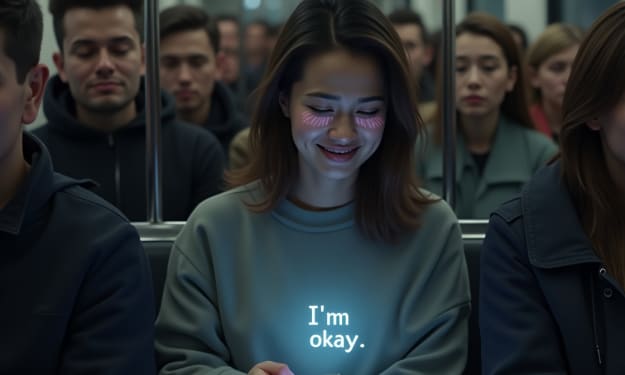
Behind Every " I'm Okay" Is a Thousand Silent Cries. AI-Generated.
In an age where we are constantly surrounded by pings, posts, and people, many of us still lie awake at night asking the same quiet questions: Why am I so anxious? Why do I feel so alone? Why did that relationship fail? Will I ever be strong enough?
By Nowshad Ahmadabout a year ago in Humans
How Social Media Is Reshaping Human Life,Ethics and Identity. AI-Generated.
In just two decades, social media has gone from a digital novelty to the centerpiece of modern life. From Facebook posts to TikTok trends, Instagram selfies to Twitter/X threads, we now live more online than ever before. But with this constant connectivity comes a wave of consequences—good, bad, and deeply personal.
By Nowshad Ahmadabout a year ago in Humans
Inside the Human Mind: The Mechanics of Thought and Behavior
Imagine waking up on a rainy morning. You feel sluggish, maybe even irritable, without really knowing why. You skip breakfast, rush through traffic, snap at a co-worker, and by lunchtime, you’re wondering: Why am I like this today? The answer lies in the invisible network of psychological forces that work beneath our awareness—shaping our thoughts, emotions, and behaviors. Human psychology isn’t just about what we think or feel in a moment; it’s a vast interplay of biology, experience, memory, and social context. Understanding this interplay is like opening a map to the mind—and perhaps, to ourselves. At the core of human psychology is the brain—an organ of staggering complexity. With over 86 billion neurons firing in constant communication, it manages everything from heartbeats to daydreams. Yet, psychology teaches us that the brain isn’t just a machine. It's shaped by our relationships, our traumas, and our culture. Take, for instance, the concept of cognitive biases. These are mental shortcuts our brain uses to make sense of overwhelming information. They're incredibly useful—until they’re not. The confirmation bias, for example, causes us to favor information that confirms what we already believe, even if it's wrong. This explains why people argue passionately about politics or climate change, even when presented with clear evidence. Our brains don’t just process facts; they defend our identities. Then there's emotional regulation, a concept central to psychology. Emotions aren't random. They're survival tools. Fear kept our ancestors alive. Joy bonded families and tribes. But in modern life, the same mechanisms can cause anxiety in traffic, jealousy on social media, or burnout at work. The field of psychology studies how we can better understand and manage these feelings—through therapy, mindfulness, or even small habits like gratitude journaling. But perhaps the most fascinating part of psychology is identity—the story we tell ourselves about who we are. From childhood, we absorb roles, expectations, and messages: You’re the smart one, You’re too sensitive, Boys don’t cry. Over time, these messages form a mental blueprint. This is called the self-concept, and it becomes the lens through which we view the world. This self-concept can empower—or limit—us. For example, someone who grows up believing they are "bad at math" may avoid opportunities in science or finance, regardless of their true potential. A psychologist might work with this person to uncover the root of that belief, challenge its truth, and gradually reshape the narrative. But we don't just carry our past inside us—we carry others. Humans are deeply social creatures, and much of what we think or feel is influenced by those around us. The famous Stanford prison experiment demonstrated how easily people conform to social roles and expectations, even when it contradicts their personal values. More recent research into mirror neurons shows how our brains are wired to empathize—we literally feel what others feel. In today’s fast-paced, digital world, our mental health is under more strain than ever. Anxiety and depression are at all-time highs, particularly among young people. But the good news is that awareness of mental health is also growing. Tools from psychology are becoming more mainstream—from therapy apps to school wellness programs to corporate mindfulness training. Still, one of the most powerful insights from psychology remains timeless: change is possible. Neuroplasticity—the brain’s ability to rewire itself—means that we’re not stuck with the same habits or thoughts forever. With time, support, and effort, people can break cycles of addiction, heal from trauma, or learn to live with purpose. So the next time you find yourself reacting emotionally, making a snap judgment, or feeling stuck in a pattern, remember: that moment is shaped by countless layers—biology, belief, experience, and context. You’re not broken. You’re human. And understanding psychology isn't about labeling yourself. It’s about getting curious. Because once you understand how the mind works, you can begin to work with it—and maybe even change your life.
By Muhammad Saad about a year ago in Humans
The Man Who Lived 99 Lives. AI-Generated.
1. A Strange Awakening When Kareem opened his eyes, he was not where he expected to be. He wasn’t in his small apartment, nor in the hospital where he had passed away just moments ago. He was in a field. Dressed in strange clothes. Under a sky unfamiliar. But this wasn’t new to him. He had felt this sensation 98 times before. Each time Kareem died, he awoke in a new era — sometimes in the past, sometimes far in the future. He always kept his memories — from the Roman Empire to the golden age of Baghdad, from war-torn cities to futuristic glass towers. Every life, every time, he remembered. But in every life, something was missing. 2. The Search for Meaning Kareem had been a king, a beggar, a scientist, a poet, a thief, a soldier, even a child who died before ten. He had held swords, scrolls, and screens — but never found peace. He lived in palaces with gold floors, yet cried himself to sleep. He ruled over empires, but his heart felt empty. In one life, he tried to drown the emptiness with pleasures. In another, he chased knowledge endlessly. In another, he became bitter and cruel — as if punishing the world would somehow quiet the questions inside him. But nothing filled the void. Until the 99th life. 3. The Final Life Begins He was born in a small village. Poor. No technology, no books, no power. But something was different. This time, he was born into a family that prayed. Not out of habit, but with love and awe. His mother wept in sujood. His father recited Qur’an as if he was being spoken to directly. As a child, Kareem heard the Adhan echo through the valleys, and his heart trembled — not in fear, but in recognition. For the first time in all his lives, he felt… anchored. 4. Questions With Answers He asked his father, “Why do we pray?” His father smiled, “Because we were made to remember the One who made us.” “But how do we know He exists?” The father replied, “Look at the sky. It changes without your command. Look at your heartbeat — it never stops unless He wills it.” Kareem didn’t just hear these words — he understood them. All the lives he lived, the beauty he saw, the pain he endured — all pointed to One Truth. He had always been searching. Through crowns and coins, war and wealth. But now he found what he wasn’t even wise enough to seek before: La ilaha illAllah. 5. Choosing Simplicity In this life, he rejected leadership roles. He declined fame. He kept his head down, his prayers up, and his heart clean. He worked in the village’s bakery. He served the poor. He stayed away from sins that once seemed exciting in past lives. People often asked, “Why are you so quiet, Kareem?” He would just smile and say, “I’ve seen too much of the world to be impressed by it.” 6. The Night of Realization One night, as Kareem lay in his small bed, now an old man, he whispered to the sky: > “O Allah, I lived 98 lives trying to find happiness without You. In this one life, I lived simply — but I lived with You. This was the only one worth living.” He felt his soul rise. But this time, he wasn’t scared. He had finally lived a life that mattered. 7. The True Wake-Up Kareem did not wake up in another life this time. He woke up… in the Hereafter. Angels surrounded him. He remembered every life — all 99 — and realized they were not punishment, but mercy. Each one was a chance. A warning. A path leading to the Truth. He had found it. And now, the journey to eternal peace had begun. Moral Message: Chasing the world for 98 lives can never give what one life with Allah can give. True success is not in how long we live, but in how we live. The heart will never rest until it rests with its Creator.
By Kaleem Ullahabout a year ago in Humans
Taurus Woman and Aries Man Compatibility Score. AI-Generated.
When a Taurus woman and an Aries man come together in a relationship, the union is anything but boring. These two zodiac signs are vastly different in temperament and approach to life, yet their contrasts can create a magnetic attraction. Taurus, an Earth sign ruled by Venus, is grounded, sensual, and values stability. Aries, a Fire sign ruled by Mars, is passionate, impulsive, and driven by excitement and challenge. Their connection can be rich and rewarding, but it requires effort, understanding, and compromise.
By Inspire and Funabout a year ago in Humans