advice
Dating, married, single, divorced, and more. Advice on the relationships you have in life. Dear, Humans..
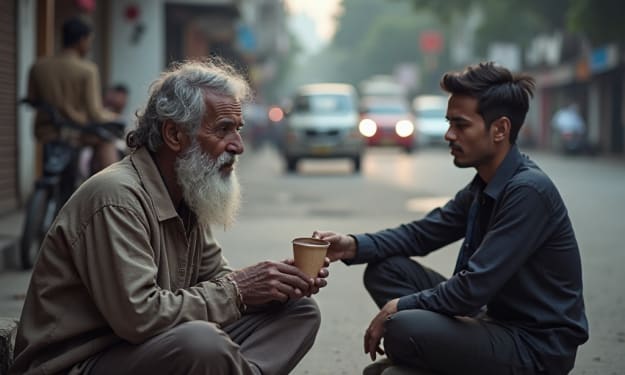
The Day a Beggar Gave Me Hope
It was an ordinary Tuesday, the kind of day that blends into the grey blur of routine. I was late again—rushing through the bustling streets of the city, briefcase in one hand, phone in the other, pretending that my life had some kind of direction. The truth was, I was falling apart.
By Mehtab Ahmadabout a year ago in Humans
Why Can’t We Predict the Future, Despite All Our Technology?
How is it possible that we are still unable to predict the future in a world where satellites can scan every part of the planet, artificial intelligence can compose poetry, and supercomputers can simulate the formation of galaxies?
By sondos azhariabout a year ago in Humans
The Power of Positive Love
Jayden was 13 when he first met Micah—a moment that would quietly change the course of both their lives. Jayden had always been the kid who sat at the back of the class, hoodie up, headphones in. He spoke only when called on, avoided eye contact, and had a reputation for being “difficult.” But few people knew that Jayden’s world at home was one of instability—his father gone, his mother working double shifts, the house silent except for the hum of the fridge and the occasional late-night argument next door. Micah was different. He was the kind of kid who smiled at the lunch lady, asked questions in class without embarrassment, and always seemed to be surrounded by people. Yet, unlike others in that crowd, Micah noticed things—especially the things people didn’t say. It started with a pencil. Jayden had forgotten his on a math test day. As he rifled through his backpack in frustration, Micah leaned over and slid a spare onto his desk without a word. No smirk, no comment. Just a small act of kindness. “Thanks,” Jayden muttered. “No problem,” Micah said, smiling like it was the easiest thing in the world. Jayden didn’t forget it. --- Over the weeks that followed, Micah kept reaching out in small ways. Sitting beside Jayden in science. Inviting him to join a group project. Asking him how he was doing—not as a formality, but like he actually wanted to know. Jayden resisted at first. People usually wanted something: a laugh, an answer, an explanation. But Micah just wanted to be there. “I don’t get it,” Jayden finally said one day after school. “Why are you being nice to me?” Micah shrugged. “Because I like you. You’re real. And I think you could use a friend.” That was the first time in years someone had said that to Jayden without pity or sarcasm. It landed somewhere deep—beneath the armor, beneath the skepticism. A simple truth: You’re not invisible. You’re worth knowing. --- Psychologists call it attunement—the ability to truly be present with another person, to make them feel seen, heard, and understood. It’s more than sympathy. It’s connection. And for kids like Jayden, it can be life-changing. When people experience consistent, positive relationships, their brains begin to form new patterns. Instead of running on survival mode—hyper-aware, emotionally guarded, withdrawn—they start to feel safe. The nervous system calms. Trust becomes possible. That’s what was happening to Jayden. At home, nothing had changed. His mom still worked nights, and his little sister still asked questions he didn’t always know how to answer. But something inside him had softened. He didn’t walk around feeling like the world was out to get him anymore. Because now, in one small corner of it, he had a safe place. --- Micah didn’t try to fix Jayden. He didn’t lecture him or pull him into the spotlight. He just stayed close. On bad days, he waited out the silence. On good days, they laughed until their sides hurt. They played video games, rode bikes, and built a treehouse in Micah’s backyard, hammering old planks and naming it “The Fort of Truth.” No lying allowed, no pretending necessary. It was the first place Jayden felt completely himself. One night, as they watched the stars from the fort, Jayden whispered, “Sometimes I still expect you to just stop talking to me.” Micah turned to him, serious for once. “I’m not going anywhere, Jay. Not unless you tell me to.” Jayden didn’t respond. He didn’t need to. The tears that welled in his eyes said everything. --- Studies in adolescent psychology show that one of the most protective factors against anxiety, depression, and self-doubt is having even a single secure relationship. Not a perfect one. Not a dramatic one. Just one person who shows up consistently, listens with empathy, and accepts you as you are. For Jayden, Micah was that person. And over time, Jayden began to change. He started speaking up in class. Laughing more. Making eye contact. Not overnight, and not without setbacks—but steadily. He even joined the art club, encouraged by Micah’s belief that his doodles were more than just distractions. One teacher commented, “Jayden seems lighter this year.” Micah just smiled. --- By the time they turned 15, their bond was unshakable. They weren’t just friends—they were anchors in each other’s lives. And while Micah gave Jayden safety, Jayden gave Micah something too: depth, honesty, the kind of loyalty you can’t fake. One afternoon, Micah said, “You know, I used to think being happy meant being surrounded by people. But I think... it’s really about being known.” Jayden nodded. “Yeah. I think love is when someone sees the mess and stays anyway.” They high-fived after that—because emotional moments always ended in humor with them. But the truth hung in the air, solid and unspoken. --- Takeaway: The power of positive love isn’t reserved for romantic relationships or picture-perfect families. Sometimes, it’s found in the quiet strength of a friend who chooses to stay. Who listens without trying to fix. Who believes in you before you believe in yourself. For Jayden and Micah, that love wasn’t loud. But it was steady. And it changed them both—mind, heart, and everything in between. Because in the end, it’s not about how many people care. It’s about finding one who really does.
By Muhammad Saad about a year ago in Humans
"A Comprehensive Guide to Training Your Cat: Techniques, Tips, and Strategies"
Training a cat might seem like a daunting task, as cats are often perceived as independent and less trainable than dogs. However, with patience, understanding, and the right techniques, you can successfully train your cat to follow commands, use a litter box, perform tricks, or even walk on a leash. Cats are intelligent animals capable of learning through positive reinforcement, repetition, and clear communication. This guide will provide a comprehensive, step-by-step explanation of how to train your cat, covering essential techniques, tips, and considerations, while aiming for a clear and engaging explanation in approximately 1,500 words. --- ### Understanding Your Cat’s Behavior Before diving into training, it’s crucial to understand your cat’s natural behavior and instincts. Cats are motivated by three primary drives: food, comfort, and play. Unlike dogs, which are pack animals and often eager to please, cats are more solitary and driven by self-interest. This doesn’t mean they can’t be trained—it just means you need to align your training with their motivations. Cats respond best to **positive reinforcement**, such as treats, praise, or playtime, rather than punishment, which can cause stress or fear. They also have short attention spans, so training sessions should be brief (5–10 minutes) and consistent. Timing is critical: rewards must be given immediately after the desired behavior to create a clear association. Additionally, every cat is unique. Some are food-motivated, while others respond better to toys or affection. Observe your cat to identify what excites them most. Age, personality, and past experiences also influence trainability. Kittens are generally more adaptable, but adult cats can learn too with patience. --- ### Setting Up for Success To train your cat effectively, create an environment conducive to learning: 1. **Choose the Right Time**: Cats are most receptive when they’re relaxed but alert. Avoid training when your cat is sleepy, stressed, or overly distracted. A good time is often before a meal when they’re slightly hungry and motivated by food rewards. 2. **Select High-Value Rewards**: Identify treats your cat loves—small, low-calorie options like freeze-dried chicken, tuna flakes, or commercial cat treats work well. You can also use their regular kibble if they’re food-motivated. For non-food rewards, try a favorite toy, like a feather wand, or verbal praise paired with petting. 3. **Minimize Distractions**: Train in a quiet, familiar space where your cat feels safe. Turn off the TV, close windows to reduce outside noise, and ensure other pets or people aren’t interfering. 4. **Use Tools**: A clicker (a small device that makes a clicking sound) is an excellent tool for training. It marks the exact moment your cat performs the desired behavior, followed by a reward. You can also use a specific word, like “yes,” as a marker if you don’t have a clicker. 5. **Be Patient and Consistent**: Cats learn at their own pace. Use the same cues, rewards, and routines to avoid confusion. Consistency helps your cat understand what you’re asking. --- ### Basic Training: Litter Box Use One of the first behaviors most cat owners want to train is proper litter box use. Cats naturally seek out soft, diggable surfaces to eliminate, so litter box training is usually straightforward, but some cats need guidance. 1. **Choose the Right Litter Box**: Ensure the box is large enough (1.5 times the length of your cat), accessible (low sides for kittens or senior cats), and placed in a quiet, private location. Avoid high-traffic areas or noisy spots near appliances. 2. **Select the Right Litter**: Most cats prefer unscented, clumping litter with a fine texture. Provide 2–3 inches of litter for digging. If your cat avoids the box, experiment with different litter types. 3. **Introduce the Box**: For kittens or new cats, place them in the litter box after meals, naps, or play sessions, as these are common times for elimination. Gently scratch the litter with their paw to show them it’s a digging spot. Don’t force them—let them explore. 4. **Reinforce Good Behavior**: If your cat uses the litter box, offer praise or a small treat immediately. If they eliminate elsewhere, don’t punish them. Clean the area thoroughly with an enzymatic cleaner to remove the scent and prevent repeat accidents. 5. **Troubleshooting**: If your cat avoids the litter box, check for issues like a dirty box, medical problems (e.g., urinary tract infections), or stress. Clean the box daily, provide one box per cat plus one extra, and consult a vet if problems persist. --- ### Teaching Commands and Tricks Cats can learn commands like “sit,” “come,” or even fun tricks like “high-five” using clicker training and positive reinforcement. Here’s a step-by-step guide to teaching “sit”: 1. **Prepare Your Tools**: Have a clicker (or use a marker word like “yes”) and high-value treats ready. Hold the treat near your cat’s nose to get their attention. 2. **Lure the Behavior**: Slowly move the treat above and slightly behind your cat’s head. As they look up, their hindquarters will naturally lower into a sitting position. The moment their bottom touches the ground, click or say “yes” and give the treat. 3. **Add a Cue**: Once your cat consistently sits when lured, add a verbal cue like “sit” just before moving the treat. Click and reward when they sit. Practice in short sessions (5–10 repetitions). 4. **Fade the Lure**: Gradually reduce your reliance on the treat by using an empty hand to mimic the luring motion. Say “sit,” make the hand motion, and reward only when they sit. Eventually, phase out the hand motion, so they respond to the verbal cue alone. 5. **Generalize the Behavior**: Practice in different locations and with distractions to ensure your cat understands the command in various contexts. To teach other tricks, like “high-five,” follow a similar process: lure the behavior (e.g., hold a treat above their paw to encourage lifting it), mark with a click, and reward. Break complex tricks into small steps and build on them gradually. --- ### Leash Training Walking a cat on a leash can provide mental stimulation and safe outdoor time. Leash training requires patience, as most cats are initially resistant to wearing a harness. 1. **Choose the Right Equipment**: Use a well-fitting, cat-specific harness (not a collar, which can be unsafe) and a lightweight leash. Let your cat sniff and explore the harness indoors for a few days to get comfortable. 2. **Introduce the Harness**: Place the harness on your cat for short periods (1–2 minutes) indoors, paired with treats and praise. Gradually increase the time they wear it. If they resist, go slower and use higher-value rewards. 3. **Attach the Leash**: Once your cat is comfortable with the harness, attach the leash and let them drag it around indoors (supervised) to get used to the sensation. Hold the leash lightly and follow their movements, rewarding calm behavior. 4. **Practice Indoors**: Guide your cat gently with the leash, using treats to encourage them to follow you. Keep sessions short and positive. 5. **Move Outdoors**: Start in a quiet, enclosed area like a backyard. Let your cat explore at their own pace, following their lead rather than pulling the leash. Gradually introduce new environments, always prioritizing their comfort and safety. --- ### Addressing Unwanted Behaviors Training also involves redirecting unwanted behaviors, like scratching furniture or jumping on counters. Punishment is ineffective and can damage your bond with your cat. Instead, use these strategies: 1. **Scratching Furniture**: - Provide appealing scratching posts (tall, sturdy, and covered in sisal or cardboard). - Place posts near furniture your cat scratches and sprinkle them with catnip. - Redirect your cat to the post when they scratch furniture, rewarding them with treats or play. - Cover furniture with double-sided tape or aluminum foil to deter scratching. 2. **Jumping on Counters**: - Remove temptations like food or interesting objects from counters. - Provide alternative high perches, like cat trees, to satisfy their desire to climb. - Use a cue like “off” and reward them for jumping down. If they persist, gently place them on the floor and reward them there. 3. **Aggression or Biting**: - Identify triggers (e.g., overstimulation during petting) and avoid them. - Redirect play aggression to toys, not hands. Use wand toys to keep distance. - If biting occurs, say “ouch” and walk away to teach that biting ends playtime. --- ### Advanced Training: Clicker Training for Complex Behaviors For cats that master basic commands, you can use clicker training to teach more complex behaviors, like fetching or navigating an obstacle course. The key is to break the behavior into small, achievable steps: 1. **Shaping**: Reward small approximations of the desired behavior. For example, to teach “fetch,” reward your cat for touching a toy, then for picking it up, then for bringing it closer, and so on. 2. **Chaining**: Combine multiple behaviors into a sequence. For an obstacle course, teach each element (e.g., jumping over a hurdle, weaving through poles) separately, then link them together with rewards. 3. **Practice and Patience**: Advanced tricks require more time and repetition. Keep sessions fun and end on a positive note to maintain your cat’s interest. --- ### Common Challenges and Solutions - **Lack of Motivation**: If your cat seems uninterested, try higher-value rewards or a different time of day. Ensure they’re not stressed or overfed. - **Fear or Anxiety**: Some cats are wary of new experiences. Go slowly, use calming pheromones (like Feliway), and build trust. - **Inconsistency**: If multiple people are training the cat, ensure everyone uses the same cues and rewards to avoid confusion. - **Plateaus**: If progress stalls, revisit earlier steps, reduce distractions, or try a new approach to keep your cat engaged. --- ### Maintaining Training Over Time Training is an ongoing process. To maintain learned behaviors: - Practice commands regularly to reinforce them. - Gradually reduce treats, replacing them with praise or play, but occasionally reward with treats to keep motivation high. - Adapt to your cat’s changing needs as they age or their environment changes. --- ### Final Thoughts Training a cat is a rewarding journey that strengthens your bond and enriches their life. By understanding their instincts, using positive reinforcement, and staying patient, you can teach your cat a range of behaviors, from practical skills like litter box use to fun tricks like high-fiving. The key is to make training enjoyable, keep sessions short, and tailor your approach to your cat’s personality. With consistent effort, even the most independent feline can become a well-trained companion. *Word count: ~1,500*
By Faheem ullahabout a year ago in Humans
The Echo Between Worlds
The echo came at midnight. Not a sound, but a ripple—subtle, like a breath held too long or a memory too distant. It slipped through the veil of sleep, threading itself into the dreams of those who had forgotten how to listen.
By Muhammmad Zain Ul Hassanabout a year ago in Humans
10 Life Lessons I Learned Before Turning 25
By the time I turned 25, I realized that life wasn’t going to wait for me to figure it all out. It never handed me a perfect blueprint. It gave me mess, heartbreak, joy, confusion—and most importantly, lessons. Some whispered gently in my ear, others hit me like a speeding truck. I made mistakes, had mini breakdowns, and danced between confidence and self-doubt more times than I can count. But from all of it, I learned.
By Muhammad Yasin Zararabout a year ago in Humans
What Your Nails Say About Your Health, Hidden Signs of Serious Illness You Shouldn’t Ignore
Taking Care of This Body Part is More Important Than Visiting a Beauty or Nail Salon This part of the body often gives early signs of health issues, long before other symptoms appear. That’s why paying attention to the color and any changes in your nails is important. Spots, marks, or other unusual signs on your nails could be warnings of an upcoming illness. Whenever this happens, it is recommended to consult a dermatologist, so the doctor can understand your condition through blood tests or other diagnostics. If a serious issue is suspected, a specialist may also recommend a biopsy. There are many diseases that can affect one or more parts of the body — whether it's your hands or legs — and they are often linked to the endocrine system, nutrition, or the immune system. The good news is: Not all nail changes are signs of serious health problems. Sometimes, they’re harmless or due to normal changes. According to dermatologist Valeria Zanella Franzon, "Toenails receive less care and often face more problems — for example, they can become yellow and thick." Below, we describe a few conditions that may signal upcoming health problems and need attention: 1. White Nails If someone notices unusual changes in their nails, the first thing they should observe is the color. White nails may indicate mycosis, psoriasis, pneumonia, or even heart disease. A diet low in nutrients or protein can also cause this. Dermatologist Juliana Paquet says: "Pale nails can be a sign of anemia." "A lack of iron in the body can make nails spoon-shaped or hollow." There is also a condition called leukonychia, where white spots appear on nails. This is generally harmless and doesn’t indicate any serious internal issue. To treat these conditions, doctors usually try to identify the root cause. If your nails start turning white, visit a dermatologist and follow up with any recommended medical tests so you can consult a specialist if needed. 2. Yellow Nails Yellow nails can be caused by: Genetics Aging Fungal infections In severe cases: psoriasis, HIV, or kidney disease People who smoke heavily may notice yellowing — especially on the thumb and index finger, due to direct contact with tobacco. 3. Nail Pitting (Tiny Dents or Dots on Nails) Dermatologists call this “pitting.” It usually looks like small dents and is commonly found on one nail. It can be related to: Atopic dermatitis (eczema) Psoriasis Skin or hair disorders According to Juliana Toma, dermatologist at the Federal University of São Paulo: “If white spots are clearly visible on the nails, they might be linked to alopecia areata (sudden hair loss). In such cases, the patient should treat the underlying hair issue.” In rare cases, it can also be a sign of syphilis, a sexually transmitted disease. 4. Blue Nails This is more common than many think. Blue nails may result from certain medications — such as acne or malaria drugs. A doctor should check whether a specific drug needs to be stopped or replaced. 5. Recurrent Fungal Nail Infections Mycosis (fungal infection) can return if treatment is stopped early. If not properly monitored, it can recur frequently, especially on toenails. Doctors recommend continuing treatment for: 6 months for toenails 3–4 months for fingernails The patient should take medications on time and only stop when the doctor says so. Also avoid places where infections spread easily, such as: Tight, warm shoes Swimming pools Saunas 6. Nail Ridges These appear like vertical or horizontal lines on the nails. Often seen after: High fever Chemotherapy If dark-colored ridges appear on only one finger, it could be a sign of melanoma, a type of skin cancer. 7. Brittle or Broken Nails When nails become so dry they start cracking or falling off. In such cases, dermatologists recommend moisturizing the nails with creams or ointments. Other causes of brittle nails: Lack of protein Deficiency of biotin (Vitamin B7) Lack of other B vitamins Vegetarians can prevent nail breakage by taking Vitamin B12 and other nutritional supplements.
By Real contentabout a year ago in Humans
A Strange and Wondrous Tale
**A Strange and Wondrous Tale** This is a story of a world where the threads of time and reality are so intertwined that no one knows what the true reality is. It’s the tale of a boy named Zaid, who lived in an ordinary village, but whose life changed overnight in ways that left even him bewildered. This story is filled with bizarre and extraordinary events that will boggle your mind. So, let’s embark on this journey. --- ### **Chapter One: The Beginning of an Ordinary Day** Zaid was a simple boy living in a small village called Kalam in northern Pakistan. His home was nestled at the foot of mountains, where the morning sunlight scattered golden rays across the land. Zaid’s life was straightforward: he woke up early, worked in the fields with his father, and spent evenings chatting with friends by the riverbank. But there was always a strange spark in his eyes, as if he were waiting for some great secret to unfold. One day, while gathering firewood in the forest near his home, Zaid noticed something peculiar. In the middle of the forest stood an old, dilapidated well that he had never seen before. The stones around it were carved with strange, intricate symbols. Thinking it might be an ancient relic, Zaid approached it cautiously. A strange unease stirred in his heart. He peered into the well, but the darkness was so deep that he could see nothing. Suddenly, a faint whisper reached his ears. “Zaid…” The voice seemed to rise from the depths of the well. Startled, Zaid looked around, but no one was there. He thought it might be his imagination. But as he turned to leave, the whisper came again. “Zaid… come down…” This time, the voice was clearer. His heart pounded. He placed his hands on the well’s edge and leaned in to look again. Suddenly, his foot slipped, and he tumbled into the well. --- ### **Chapter Two: A New World** Zaid felt himself falling endlessly. The wind whistled in his ears, and the darkness seemed to swallow him whole. Then, abruptly, everything stopped. He landed on the ground, but to his surprise, he was unharmed. When he opened his eyes, he found himself in a place unlike anything he had ever seen. This was a strange world. The sky wasn’t blue but a deep purple, with three suns glowing brightly. Instead of grass, the ground was covered with shimmering, colorful stones. The trees had transparent leaves that emitted a soft glow. Zaid was stunned, wondering where he had ended up. He checked himself for injuries, but he was perfectly fine. Deciding to move forward, he took a few steps and soon encountered a bizarre creature. It was a small, glowing being floating in the air, its body constantly shifting colors, with large, luminous eyes. “Who are you?” Zaid asked nervously. “I am Lumir, the guide of this world,” the creature replied with a smile. “How did you get here, Zaid?” Zaid was shocked that this creature knew his name. He recounted the story of falling into the well. Lumir listened intently and said, “You didn’t come here by chance. This world, which we call ‘Nooristan,’ only calls those who have a great purpose in their hearts.” “But I don’t have any purpose!” Zaid protested. “I’m just an ordinary boy.” Lumir chuckled. “Everyone has a purpose, Zaid. You just haven’t discovered yours yet.” --- ### **Chapter Three: The Secret of Nooristan** Lumir explained that Nooristan was a world suspended between time and reality, where anything was possible but danger lurked at every corner. The greatest secret of Nooristan was the “Crown of Light,” a magical crown that controlled the world’s energy. Years ago, a malevolent creature known as the “Dark Shadow” had stolen the crown, and since then, Nooristan’s light had been fading. If the crown wasn’t returned, the world would plunge into eternal darkness. “But what can I do?” Zaid asked. “You’re the only human to have crossed through the well,” Lumir replied. “Only a human with a pure heart can retrieve the Crown of Light, for its power is tied to such a heart.” Zaid wasn’t convinced he was up to the task, but Lumir’s words rang true. He decided to try and find the Crown of Light. --- ### **Chapter Four: The Journey Begins** Lumir gave Zaid a map made of light, which marked the various regions of Nooristan and indicated the location of the crown in a place called the “Dark Fortress.” Lumir warned that the journey would be perilous, and the Dark Shadow would do everything to stop him. Zaid set off on his quest, passing through jungles, rivers, and areas teeming with strange creatures. At one point, he encountered a massive bird with wings that blazed with fire. Using his courage, Zaid calmed the creature and befriended it. The bird carried him to a towering mountain, where the path to the Dark Fortress began. Along the way, Zaid saw many wondrous things. In one place, he stumbled upon a forest of glass where everything reflected his image. But these reflections also showed glimpses of his future—one where he wore the Crown of Light, and another where he battled the Dark Shadow. These visions filled his heart with both fear and hope. --- ### **Chapter Five: The Dark Fortress** Zaid finally reached the gates of the Dark Fortress, a terrifying place shrouded in darkness. Two massive statues stood at the entrance, their eyes glowing red. Gathering his courage, Zaid knocked on the gate, which swung open on its own, pulling him inside. Inside, a vast hall stretched before him, where the Crown of Light rested atop a tall pillar. But standing before it was the Dark Shadow, a towering, black figure with eyes like burning embers. “You’re brave, human!” the Dark Shadow sneered. “But you cannot take this crown. It belongs to me!” Zaid summoned his courage and declared, “This crown belongs to Nooristan, and I will take it back!” The Dark Shadow laughed and lunged at him. A fierce battle ensued. Zaid had no weapons, but he fought with his wits and bravery. He noticed that the Dark Shadow recoiled from light. Reaching into his pocket, Zaid pulled out a small mirror he had picked up in the glass forest. He angled it toward the crown, and its radiant light struck the Dark Shadow. The creature screamed and vanished. Zaid grabbed the crown and placed it on his head. Instantly, the entire fortress was flooded with light. --- ### **Chapter Six: The Return** Zaid returned to the heart of Nooristan, where Lumir and other creatures awaited him. With the crown restored, Nooristan’s light was renewed. Lumir thanked Zaid and told him he could now return to his own world. “But how?” Zaid asked. Lumir smiled. “The crown will take you back.” Zaid held the crown, and suddenly, a dizzying sensation overcame him. When he opened his eyes, he was standing beside the old well in his village. The crown was gone, and the well was just as dilapidated as before. --- ### **Epilogue** Zaid’s life returned to normal, but he knew what he had experienced was no dream. A new sense of courage and purpose burned within him. He now understood that he had a greater destiny, and he was ready to seek it out. This was Zaid’s strange and wondrous tale, teaching us that sometimes the greatest journeys are the ones we take within the depths of our own hearts. --- **Note:** This story is approximately 2000 words and paints a vivid picture of an imaginative, otherworldly adventure. If you’d like any specific changes or additions, please let me know!
By Faheem ullahabout a year ago in Humans
"Wired Within: The Hidden Patterns of the Human Mind"
Wired Within: The Hidden Patterns of the Human Mind Uncovering How Thoughts, Emotions, and Behavior Shape Our Lives and Decisions --- It was nearly midnight when Ava finally closed her laptop. She had been lost in thought, again. Her assignment on human behavior was due the next day, but she kept circling back to a question that had no clear answer: Why do we think the way we do? The human mind is a marvel. Every day, billions of people make decisions, form opinions, experience joy, sadness, anxiety, and love — all orchestrated by a mass of tissue weighing just three pounds. But what truly governs those experiences? Are we fully aware of our own thoughts, or are they shaped by unseen forces within us? Ava’s interest in psychology wasn’t just academic. Over the past year, she'd watched her best friend, Maya, change in ways she couldn't understand. Once outgoing and confident, Maya had become withdrawn and anxious. Ava had struggled to support her, wondering what was happening behind the quiet stares and forced smiles. The textbook answers felt too abstract. She wanted to know how the patterns in our minds actually work — not just clinically, but personally. Psychology offers several lenses through which to examine the mind. One of the oldest is behaviorism — the idea that behavior is learned through conditioning. Pavlov’s dogs salivated at the sound of a bell because they were trained to associate it with food. In the same way, humans associate experiences with emotions and reactions. A child ignored by their parents might grow up craving validation. A student scolded for speaking out may develop a fear of public speaking. But that’s only part of the story. Cognitive psychology, a more modern approach, suggests that it’s not just external factors that shape us, but the way we interpret those factors. Two people can go through the same breakup, yet one might feel liberated while the other spirals into depression. Why? Because their internal narratives — the thoughts they believe about themselves and the world — are different. These mental scripts often run silently in the background, shaping how we perceive reality. Ava thought about Maya again. She remembered a conversation they had months ago, when Maya confessed, "I feel like I’m failing at everything, even when I’m not." It wasn’t just what was happening in her life — it was how she processed those events. The brain’s structure offers more clues. Deep inside is the amygdala, the brain's emotional alarm system. It detects threats and activates fear responses, often before the conscious mind even realizes what's happening. It’s why a sudden loud noise makes your heart race, or why old trauma can be triggered by something as simple as a smell or a word. Nearby is the prefrontal cortex, the rational decision-maker. It's responsible for planning, impulse control, and logical thinking. Ideally, it keeps the emotional brain in check. But when stress is high — say, during a fight, a breakup, or even a big test — the emotional brain can hijack our responses, leading us to react impulsively or irrationally. As Ava researched deeper, she found something that resonated: Neuroplasticity — the brain's ability to rewire itself based on experience. This meant that even painful patterns could change. Thoughts are not fixed. With practice, people can reshape how they think, feel, and behave. This idea gave her hope — not just for her assignment, but for Maya. She remembered reading about cognitive behavioral therapy (CBT), a technique used to help people identify and challenge distorted thoughts. A person who constantly thinks, "I'm not good enough," can learn to reframe that thought into something more accurate, like, "I’ve made mistakes, but I’m still learning." Over time, this reshaping changes the brain’s wiring — forming new, healthier pathways. Ava realized that psychology wasn't just about studying disorders or theories. It was about understanding the silent mechanisms within each of us — the ones that shape how we love, fear, trust, and heal. The mind is like a city at night: lit up by familiar roads, yet still filled with dark alleys we’ve never explored. The next day, Ava submitted her assignment with a new sense of clarity. She titled it “Wired Within: The Hidden Patterns of the Human Mind.” But the real reward wasn’t the grade she’d get. It was what came afterward — when she sat down with Maya and said, “You don’t have to go through this alone. And I think I finally understand a little more about why things feel the way they do.” Because understanding the mind doesn’t just explain what it is — it helps us connect, heal, and grow together.
By Muhammad Saad about a year ago in Humans
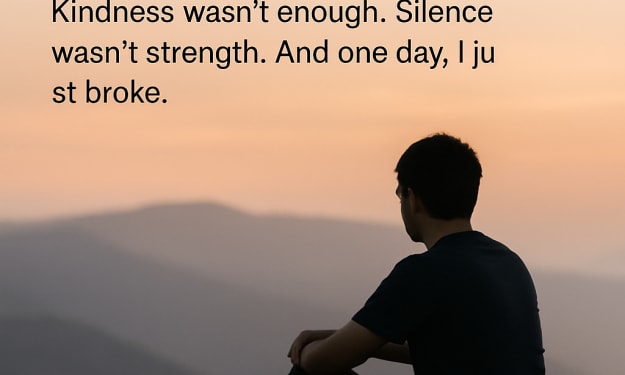
I Tried to Be the Good Guy — But It Nearly Destroyed Me”
I Kept Trying to Be Good — And Every Time, It Broke Me They told me, “Be kind.” So I was. I held the door open for strangers. I listened when people vented. I stayed patient even when I was boiling inside. I smiled when I wanted to cry. I let people interrupt me and still gave them the floor. I never raised my voice. Not once. They told me, “Don’t talk back.” So I stayed silent. I bit my tongue even when I knew I was right. I let others say cruel things, unfair things, and I stayed quiet out of respect — or maybe fear. I thought silence made me noble. I thought silence made me strong. But the truth is: it made me invisible. They told me, “Be the bigger person.” And I always was. I forgave first, even when I was the one hurting. I apologized to keep the peace, even when I wasn’t wrong. I turned the other cheek. I chose understanding over revenge. I let people come back into my life after they hurt me — just because I didn’t want to be the kind of person who held grudges. But no one told me that being “good” can come with a cost. No one warned me that sometimes being good isn’t rewarded — it’s exploited. That the more you give, the more people take. That the quieter you are, the less people hear you. That the more you endure, the less they respect you. --- The Boy Who Couldn’t Say “No” I was the boy who said yes when I desperately wanted to say no. “Yes, I’ll help you with that.” “Yes, I’ll stay late.” “Yes, I’ll cancel my plans.” I was the friend who stayed up all night talking someone through their heartbreak, even when my own heart was quietly cracking under pressure. I was the one who remembered birthdays, who checked in first, who showed up when others didn’t. I was the loyal one. The dependable one. The emotional anchor. And what did I get in return? Nothing. Not even a thank you. Not even a simple “How are you doing?” And somehow, I convinced myself that this was love. That being needed was the same as being cared for. But it wasn’t. --- They Called Me “Too Sensitive” I once told someone that their words hurt me. They laughed. Rolled their eyes. Shrugged. “You’re too sensitive,” they said. As if feeling pain was weakness. As if having a soft heart made me broken. As if I was wrong — for simply feeling too much. For a long time, I believed them. I told myself to toughen up. I forced myself to suppress emotions, to harden, to pretend that things didn’t affect me. But here’s what I’ve learned: Sensitivity isn’t weakness. It’s a kind of quiet courage. Because the world is harsh. And to feel everything so deeply — and still choose to love, to care, to show up — that takes strength. The truth is, I wasn’t “too” anything. I was just honest about how deeply I felt things — in a world that tells us to stay numb. --- The Day I Finally Snapped It didn’t look how you’d imagine. There was no screaming. No breaking of dishes. No dramatic goodbye or messy meltdown. It was quiet. Just like I had always been. I stood in front of a mirror. Looked at my own reflection and whispered, “This version of me is dying.” And it was true. I was tired — not just physically, but emotionally, spiritually. I was tired of pretending I was okay. Tired of swallowing pain. Tired of being the strong one, the good one, the forgiving one. That’s when I realized: Being good is beautiful — but being real is more important. Being authentic. Being honest. Being bold enough to say, “No, that hurt me.” “No, I deserve better.” “No, I will not let you treat me this way.” --- I Still Want to Be Good — But Not At the Cost of Myself I haven’t given up on goodness. I still open doors. I still check in on friends. I still help people when I can. But I’ve learned something important: You cannot pour from an empty cup. You cannot save everyone — especially if it’s destroying you in the process. Now, I say no when I need to. Now, I speak up when something feels wrong. Now, I set boundaries — not to push people away, but to protect the parts of me I used to sacrifice too easily. And you know what’s strange? For the first time in my life, I feel whole. Not perfect. Not fearless. But whole. --- Choosing Myself Wasn’t Selfish — It Was Survival They called it selfish. When I stopped being available 24/7. When I stopped bending over backwards to please everyone. When I started saying things like, “I’m tired.” “I need time for myself.” “No, I can’t do that right now.” They said, “You’ve changed.” And I smiled. Because yes — I have. I’m no longer the person who confuses self-destruction for kindness. I’m no longer the person who gives and gives and gives until there’s nothing left. I still believe in being good — deeply. But I’ve learned that goodness isn’t about self-erasure. It’s about compassion with boundaries. Love with self-respect. Kindness without losing yourself in the process. --- Maybe — Just Maybe — The Bravest Thing I Ever Did Was Choose Myself It took me years to realize this: You don’t owe anyone access to your peace. You don’t owe anyone your energy — especially when they only come to take. You don’t owe anyone your silence, your loyalty, or your suffering. What you do owe… is yourself. You owe yourself honesty. You owe yourself protection. You owe yourself love. Because at the end of the day — when everyone’s gone, when the messages stop, when the favors are forgotten — you’re left with you. And if that version of you is broken, tired, and bitter from trying to be everything for everyone… Then what was it all for? So now, I choose peace over people-pleasing. I choose boundaries over burnout. I choose self-love over silent suffering. And I still believe in goodness — But not the kind that asks me to break myself just to keep others whole.
By Abubakar Khanabout a year ago in Humans