advice
Dating, married, single, divorced, and more. Advice on the relationships you have in life. Dear, Humans..
The Quiet Journey Toward Who I Really Am
I Used to Believe Life Would Explain Itself — Now I Know It Doesn’t For a long time, I thought life would eventually make sense on its own. I believed that eventually, all the confusion, quiet disappointments, and unanswered questions would fall into place, neatly lining up so I could understand. Turns out, I was wrong. Life doesn’t hand you all the answers. Instead, it asks you to live first and maybe understand later—if you’re lucky.
By Caca Oispipi9 months ago in Humans
Clean Your Circle
Sara used to believe that being a good person meant tolerating everyone. She listened to complaints that were never-ending. She accepted insults disguised as jokes. She forgave disrespect because she didn’t want to seem rude. She stayed in conversations that drained her energy and relationships that quietly broke her confidence.
By Active USA 9 months ago in Humans
Living With Cognitive Fatigue? Practical Strategies for Clearer Thinking
Cognitive fatigue is the most common symptom reported after illness and brain injury. People describe walking into rooms and forgetting what they came for, reading the same paragraph several times without retaining it, or losing important information minutes after hearing it. When the brain is fatigued, it cannot process or store information as efficiently as it normally would. The encouraging news is that in many cases cognitive functioning tends to recover as fatigues improves.
By Sarah Rudebeck9 months ago in Humans
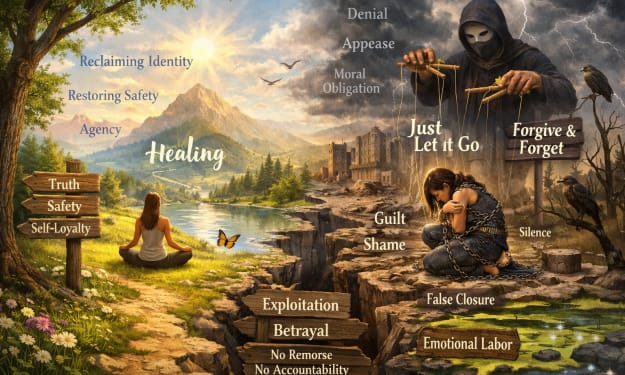
Just start by forgiving and forgetting
How many times have you heard the words forgive and forget? As far back as I can remember, my mother (God rest her soul) always talked about forgiveness that it is important because it is what our Lord and savior Jesus Christ did for those who betrayed him to be honest I have a real difficulty trying to forgive I mean it's so easy you let go of the hate you let go of the hurt that has been inside your heart your head your soul and you're able to move on I've seen people do it I've heard people talk about how they can just easily forgive those who have betrayed them I have a real difficulty trying to forgive especially those who stabbed me in the back betrayed me and figuratively speaking just left out to die. I have so many former friends that I hold so much hatred towards them, and I don't wanna hold it anymore. I try to let it go, I try to move on, but out of nowhere those memories just come back, and they ignite that fire that I thought I put out.
By stephanie borges9 months ago in Humans
Finding Calm in Cardiology: Andrew Rudin MD and a Thoughtful Path Through Modern Heart Care. AI-Generated.
Heart care has never been more advanced than it is today. From wearable technology that tracks every heartbeat to imaging tools that can visualize coronary arteries in stunning detail, modern cardiology offers unprecedented insight into how the heart functions. For many patients, however, this abundance of information brings as much anxiety as reassurance. Alerts, data points, and medical opinions arrive faster than they can be understood, leaving people unsure what truly matters.
By Dr. Andrew Rudin9 months ago in Humans
The Hidden Valentine Part Ten (the end)
Love did not return to them as a memory. It returned as a life. Time, Lily learned, was not an enemy. It was a teacher—quiet, patient, relentless. Years passed not in dramatic leaps but in gentle accumulation. Days layered themselves into months, months into years, until the pain that once defined her existence softened into something bearable, then distant, then meaningful. She no longer woke up fearing what she couldn’t remember. She woke up grounded in what she had. Ethan. Their home. Their children. The quiet miracle of still being here. Lily often thought about the girl she had been before the accident—the girl whose laughter lived only in stories now. She wondered what that version of herself would think if she could see this life. Would she recognize it? Would she be proud? Standing in the kitchen one early morning, sunlight pouring through the window, Lily watched Ethan help their son with his shoelaces while their daughter sat cross-legged on the floor, braiding the tassels of a pillow. And Lily smiled. This, she knew, was the answer. Motherhood had arrived without warning and without instructions. At first, Lily was afraid. Afraid that the gaps in her memory might make her incomplete. Afraid she would fail at loving her children the way they deserved. But love, she discovered, was instinctive. It lived in how she listened. In how she stayed up through fevers. In how she learned the rhythm of each child’s breathing when they slept. Her children did not need her past. They needed her presence. And she gave them all of it. Ethan watched her transform with quiet reverence. There were moments—late at night, when the house finally fell silent—when he allowed himself to reflect on how close he had come to losing everything. Sometimes he still dreamed of the years when Lily was gone. The searching. The unanswered questions. The hollow ache of loving someone who had vanished. But when he woke, Lily was always there. Breathing beside him. Alive. Real. He had learned not to take that for granted. They did not speak often about fate. They spoke about effort. About patience. About choosing kindness even when exhaustion made it difficult. About learning when to speak and when to simply hold each other. Their marriage was not built on perfection. It was built on honesty. On the understanding that love was not something that happened to you—it was something you practiced. Every Valentine’s Day, the world outside grew loud with celebration. Restaurants filled. Flowers sold out. Social media bloomed with declarations. But for Lily and Ethan, the day had become something quieter. Something sacred. They did not celebrate the beginning of their love. They celebrated its survival. One Valentine’s morning, Lily found a note taped to the refrigerator. Thank you for choosing me again. —E She pressed it to her chest, eyes stinging. Later that day, she slipped the necklace over her head—the small heart that had once carried the weight of mystery and longing. Now, it carried gratitude. Their children knew the story in fragments. Not the accident. Not the coma. Not the darkness. But the miracle. They knew their parents had met on Valentine’s Day. That love had found them, lost them, and found them again. “Is that why you love Valentine’s Day so much?” their daughter asked once. Lily smiled. “I love it because it reminds me that love doesn’t give up easily.” As the children grew, so did the questions. One evening, their son asked, “Mom, why don’t you remember when you were young?” The room went quiet. Lily knelt in front of him, choosing her words carefully. “Because something happened that changed my brain,” she said. “But it didn’t change my heart.” “Does it make you sad?” he asked. “Sometimes,” she admitted. “But it also taught me something very important.” “What?” “That love doesn’t live in memories. It lives in what we do for each other.” He nodded, satisfied. Ethan reached for Lily’s hand. Some nights, Lily still asked Ethan to tell her stories. Not because she felt incomplete. But because stories connected them. He told her about the first day they met—the rain, the coffee shop, the way she had smiled at him like he already mattered. He told her about the day she disappeared from his life. About the silence that followed. And he told her about the moment she returned. Different. Stronger. Still hers. Each time, Lily listened not with grief—but with awe. “I wish I could remember loving you before,” she once whispered. Ethan kissed her temple. “You do,” he said. “You just love me now, instead.” That answer healed something in her she hadn’t known was still broken. Years later, on an ordinary afternoon, Lily stood in front of the mirror and noticed the silver strands in her hair. She touched them thoughtfully. When Ethan came up behind her, she asked quietly, “Do you think love fades?” He wrapped his arms around her waist. “No,” he said. “I think it changes shape.” She leaned into him. That felt true. Their home aged with them. The walls held laughter and arguments, tears and forgiveness. The furniture bore the marks of living—scratches, stains, evidence of joy. They grew older, but love did not weaken. It deepened. On their twentieth anniversary, Ethan gave Lily a small, worn journal. “What’s this?” she asked. “For memories,” he said gently. “Not the ones you lost. The ones you’re still making.” She opened it. The first page read: Day One: You chose me again. She cried—not from sadness, but from gratitude so deep it hurt. That night, after the house had fallen quiet, Lily lay beside Ethan and listened to his breathing. “Do you ever wonder,” she asked softly, “what would have happened if I never remembered you?” He thought for a long moment. “I think,” he said slowly, “we would have found each other anyway.” She smiled in the dark. Some truths did not need proof. Love, Lily realized, was not about remembering every detail. It was about staying. About choosing to show up, even when the past was unclear and the future uncertain. Their love had not survived because it was destined. It survived because they chose it. Again. And again. And again. As dawn broke, pale light filtering through the curtains, Lily turned toward Ethan. “Happy Valentine’s Day,” she whispered. He smiled, eyes still closed. “Every day is,” he replied. The End If The Hidden Valentine stayed with you, share it with someone who believes that true love is not remembered—it is lived. #TheHiddenValentine #LoveBeyondMemory #ForeverChosen
By Ahmed aldeabella9 months ago in Humans
The Delusion of “Being Late” in Our Mid-Twenties
Somewhere in our mid-twenties, as we move towards practical life, a quiet pressure settles in. It doesn’t arrive loudly or start to haunt instantly. It creeps in through comparison, timelines, and expectations we never consciously agreed to. Suddenly, we feel that we are behind others who started the race with us. This belief, though common, is one of the most damaging delusions of our generation.
By Mubarik Ahmad 9 months ago in Humans