
She Signed Every Consent Form Alone
Xiaxia was diagnosed with bone cancer at 18 and died at 23. For five years, the only signature on her medical forms was her own.
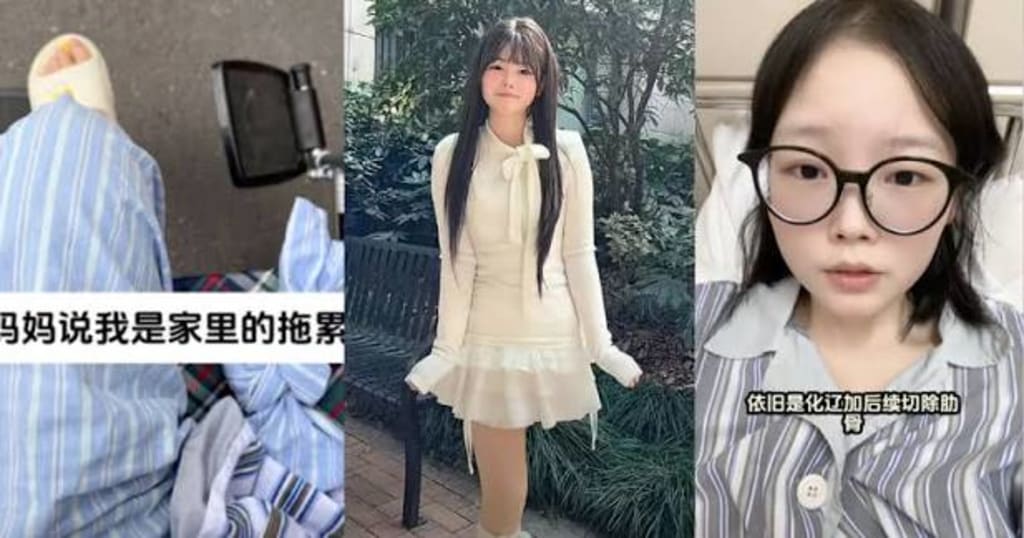
At 20:28 on October 27, Xiaxia died in Shanghai. She was 23.
Her account was called “Miracle Xiaxia (40% HP).” At noon on October 28, the account posted a death notice. Her friend Mr. Shen told Modern Express that before Xiaxia died, her parents arrived at the hospital room. They had been out of contact for years. Her grandmother was too old to travel to Shanghai. Xiaxia had wanted to see her. For that video call, Xiaxia held on for two days. Her grandmother called her by her childhood name on the screen and told her to keep going. After the call ended, she left.
Xiaxia was diagnosed with osteosarcoma at 18, after the college entrance exam. Her right leg was amputated. She had six major surgeries, multiple rounds of chemotherapy, and repeated cancer metastases. Her father never appeared. Her mother lost contact one year after the diagnosis. On surgical consent forms and chemotherapy consent forms, many of the signatures that should have been signed by family members were missing. There was only her own name.
In the early period of her treatment, she could still set up a stall in her hometown in Anhui and sell handmade items to help pay for medical costs. Later, as her condition worsened and she had to run to the hospital more and more often, she could only sell goods online to save money. She said she wanted to earn more money to keep herself alive, to live well in the present.
In 2025, she saw that Mr. Shen, the owner of a photo studio in Shantou, Guangdong, had taken a set of “Rebirth from Fire” themed photos for Qiao Yan, a “wingless angel.” Xiaxia found him and wanted a set like that. Mr. Shen helped her fulfill the wish. A few days ago, Xiaxia’s condition worsened. She kept saying she wanted to see her grandmother. Mr. Shen contacted Xiaxia’s aunt. Her grandmother was too old to get to Shanghai, so they could only use video. For that call, she held on for two days.
Osteosarcoma most often occurs between the ages of 10 and 20, with an annual incidence of about 2 to 3 per million. It most commonly grows around the knee joint: the distal femur, proximal tibia, and proximal humerus. Together, these three sites account for about 85% of limb osteosarcoma. Those are the ten years when bones grow fastest. The growth plates divide at high speed, and there are more chances for errors. The first symptoms are usually only pain and swelling. No fever, no weight loss, nothing visible on a routine blood test. For children and teenagers between 10 and 20, leg pain is too common. Growing pains, sports strains, a kick during soccer: they endure it and it passes. The difference is this: growing pains hurt at tendon insertions and ease with rest; osteosarcoma pain is in the bone, hurts even at rest, and is worse at night. If the same spot hurts repeatedly, does not ease with rest, and does not match a sports injury, an X-ray is the most direct way to check.
But an 18-year-old cannot afford delay. Xiaxia was diagnosed after the college entrance exam. She had just reached the door to adulthood when she was pushed into a process many adults would struggle to finish.
From the first day, osteosarcoma is a systemic disease. It does not start in the lungs, but the lungs are the first place it goes. The tumor grows into surrounding blood vessels, and cancer cells travel back with the blood, stopping first in the capillary beds of the lungs. Amputation or limb salvage determines whether the local tumor can be cleanly removed and whether the leg can still be used. It does not determine whether cancer cells have reached the lungs. Currently, more than 80% of patients with limb osteosarcoma can undergo limb-salvage surgery, but when the tumor wraps around blood vessels and nerves and no safe margin can be obtained, amputation remains the standard answer. Xiaxia’s leg was amputated. What determines long-term outcome is whether chemotherapy is standardized and whether lung metastases can be completely resected.
The 2019 national diagnosis and treatment guidelines state: after neoadjuvant chemotherapy, the 5-year survival rate is 60% to 70%, and better centers report over 80%; if distant metastases are already present at diagnosis, it drops to 20% to 30%. A retrospective study of 479 cases at seven bone tumor centers in China showed: 5-year overall survival 60.0%; standardized chemotherapy group 73.0%, non-standardized group 55.9%; after chemotherapy, tumor necrosis rate ≥90% versus <90% was 93.3% and 40.3%, respectively. At the Rizzoli Institute in Italy, among 463 patients who underwent resection of lung metastases, 5-year survival was 34.0% and 20-year survival 29.7%. The two figures are only about 4 percentage points apart. Those who survive five years may keep living. Of 138 survivors, 42 were saved by repeated thoracotomies to remove metastases.
These numbers show that treatment can work. But it has prerequisites: standardized chemotherapy, timely surgery, active treatment of lung metastases, and a support system that enables a person to complete the process.
In Xiaxia’s five years, the “support system” column was exactly where the problem lay.
She set up a stall, sold goods online, and signed alone. On every consent form, there was only her own name. A person between 18 and 23 completed a process that would strain most adults. She was not unafraid. She simply had no one else to sign. Help from netizens and strangers filled a moment, not five years. Mr. Shen helped her take that set of photos, contacted her aunt, and let her hear her grandmother’s voice. But this kindness was scattered, not systemic. Her account name, “40% HP,” was like a game character with only 40% health left. What she left behind was this:
“Along the way I met a lot of love. I have crossed the sea, climbed Mount Tai, seen the flowers of Lijiang in Yunnan. This world online, I’m logging off first. Very sorry for breaking the promise. I will be buried somewhere with trees, with flowers and grass beside me, sleeping quietly, without pain, without trouble.”
A 23-year-old whose family had been out of contact for years, who fought cancer alone for five years, was apologizing for one thing at the end: breaking a promise. She did not accuse anyone or sum anything up. She did not say, “I hope people will remember me.” She only said, I’m logging off first. Sorry.
She heard her grandmother’s voice. Then she logged off.
About the Creator
Jin
Writer of reamstories
https://reamstories.com/jin
Enjoyed the story? Support the Creator.
Subscribe for free to receive all their stories in your feed. You could also become a paid subscriber, letting them know you appreciate their work.
Comments
There are no comments for this story
Be the first to respond and start the conversation.