
Maybe There Is No Secret Shadow Government—Maybe It’s Just Us
Maybe the most dangerous conspiracy isn't a secret government—it's our willingness to surrender our critical thinking, our curiosity, and our accountability to the people we choose to follow.

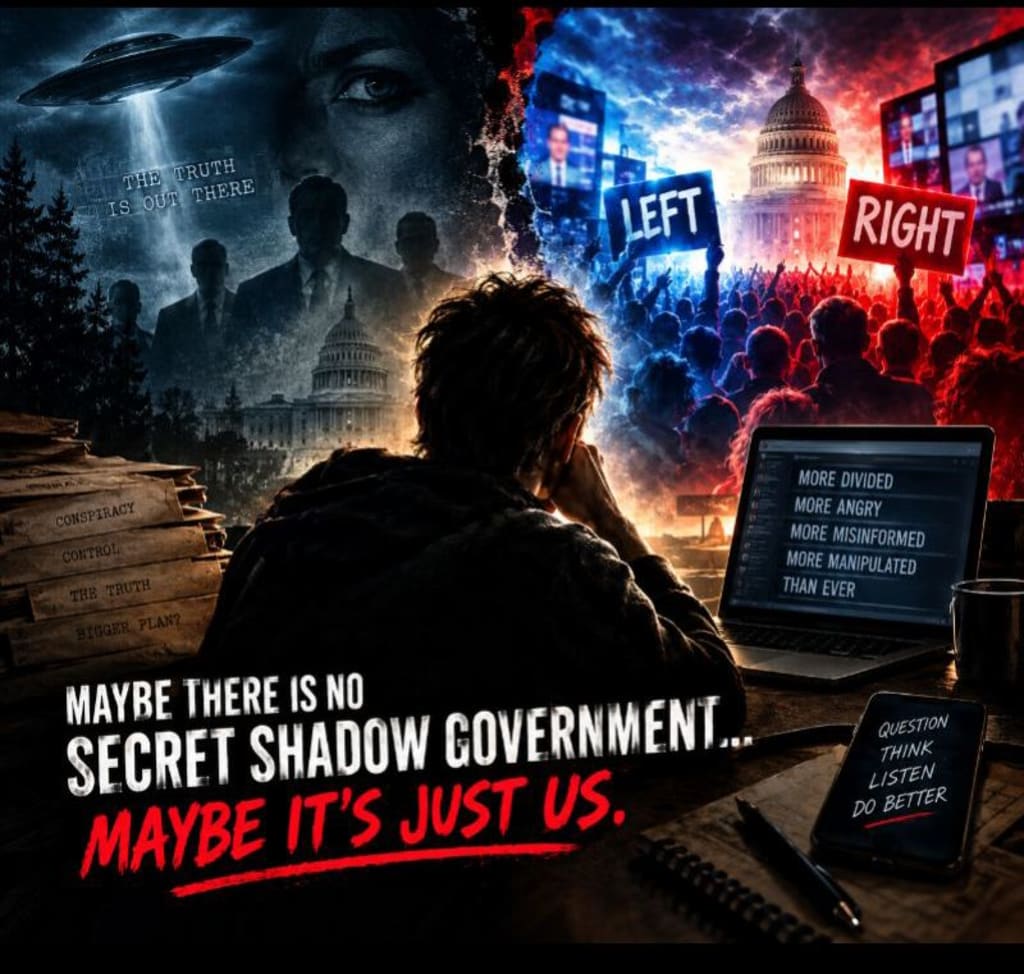
Like a lot of people who grew up in the 1990s, The X-Files probably had more influence on me than it should have.
Back then, I was convinced the world was run by some secret shadow government—a mysterious group of ruthless, intelligent people who knew things the rest of us didn't. They were supposedly hiding advanced technology from the common man and working toward some larger goal that might have been benevolent, or might have been completely sinister.
As I've gotten older, however, I don't really believe that anymore.
Mostly because I've actually started paying attention to the world.
And honestly, that's almost more terrifying.
Maybe there isn't some highly organized group of brilliant people sitting in a dark room somewhere, smoking cigars and making grand plans for humanity. Maybe there isn't some elaborate master plan behind everything that happens.
Maybe the people running the world are just as selfish, greedy, petty, and confused as everyone else.
There is something strangely comforting about the idea that somebody is actually in control—even if that person is a ruthless mastermind with a questionable agenda. At least it means there's a plan.
But what if there isn't one?
What if much of what we see is simply the result of people fighting for power, money, influence, and their own interests while trying to grab the biggest possible piece of the pie?
That's a much more disturbing thought.
There's an old saying that if Hell is real, it is probably filled with stupid people. The older I get, the more I understand why that idea can be so unsettling.
Not because everyone is stupid, but because ignorance, selfishness, and an unwillingness to pay attention can have consequences far beyond the individual.
And when you look at politics today, that becomes particularly difficult to ignore.
I've watched people on both sides of the political spectrum become almost fanatical about their preferred candidates. People will compare politicians to historical villains, defend behavior they would condemn from the opposing side, and immediately dismiss anyone who challenges their preferred narrative.
Sometimes it seems less like political discussion and more like competing religions.
And the irony is that we're living in an age when we have access to more information than any generation in human history.
We have enormous amounts of knowledge sitting in our pockets.
We can research virtually anything.
We can hear arguments from people we disagree with.
We can fact-check claims.
We can read primary sources.
We have more tools for independent thought than ever before.
Yet somehow we've also become incredibly divided.
The technology that was supposed to connect us has often given us new ways to isolate ourselves into ideological echo chambers.
We don't just disagree with each other anymore.
We increasingly seem unwilling to even listen to one another.
And that's where I think we've lost something important.
It shouldn't matter whether someone is conservative, liberal, Democrat, Republican, or somewhere in between. If we're going to participate in a democracy, we should at least be capable of asking questions, examining evidence, and admitting when we're wrong.
Instead, we've created a political culture where people can become so emotionally invested in their chosen side that criticizing their own side feels like betrayal.
That's dangerous.
Because once your political identity becomes more important than reality, almost anything can be rationalized.
And this isn't something I think can simply be blamed on politicians.
Politicians are politicians.
If someone is willing to lie, manipulate, exploit fear, or use division to gain power, we shouldn't be shocked when they do exactly that.
The more uncomfortable question is why millions of ordinary people continue to reward that behavior.
We can't completely blame the people who understand how to manipulate an audience if the audience keeps giving them its attention, money, loyalty, and votes.
At some point, ordinary people have to take responsibility for what they tolerate.
That doesn't mean everyone has to agree.
It means we have to stop treating politics like a sporting event where our team must win at all costs.
We should be able to criticize the people we support.
We should be able to question the people we distrust.
We should be able to change our minds when the evidence changes.
And perhaps most importantly, we should be able to talk to someone who disagrees with us without immediately assuming they're stupid, evil, brainwashed, or beyond redemption.
I've started seeing some small signs that people are pushing back against the celebrity-worship culture that has become so dominant in modern media and politics. There are still journalists, commentators, researchers, and ordinary people willing to ask uncomfortable questions and challenge powerful institutions.
That's encouraging.
But we shouldn't fool ourselves into thinking the damage caused by years of division simply disappears because some people have finally started asking questions.
It doesn't.
Repairing that damage requires something much less exciting than a conspiracy theory.
It requires people to stop being passive.
It requires us to pay attention.
It requires us to question our own side just as aggressively as we question the other side.
And it requires us to stop assuming that someone else will eventually fix everything for us.
Maybe that's the biggest difference between the world I imagined as a kid watching The X-Files and the world I see now.
I used to think the scariest possibility was that some secret organization was secretly controlling everything.
Now I'm not so sure.
Maybe the more frightening possibility is that nobody is completely in control.
Maybe we're just billions of imperfect human beings making decisions every day, sometimes intelligently and sometimes incredibly stupidly, while powerful people learn how to take advantage of our fears, our tribalism, and our unwillingness to question ourselves.
And if that's true, then the answer isn't waiting for some mysterious hero to come along and save us.
It's us.
We have to stop being silent when we believe something is wrong.
We have to start asking questions.
We have to start listening.
We have to stop worrying so much about what we're supposed to think and start thinking for ourselves.
Because sometimes the truth really is that simple:
Right is right. Wrong is wrong. And sometimes the hardest thing in the world is simply having the courage to say so.
About the Creator
mark bradley (mark45xxx)
I'm a published Comic Book Creator & freelance illustrator specializing in dark,surreal, & cinematic artwork. I help authors, indie creators, and collectors, bring intense ideas to life
Enjoyed the story? Support the Creator.
Subscribe for free to receive all their stories in your feed.
Comments
There are no comments for this story
Be the first to respond and start the conversation.