
impossible question
impossible question from king and its answer

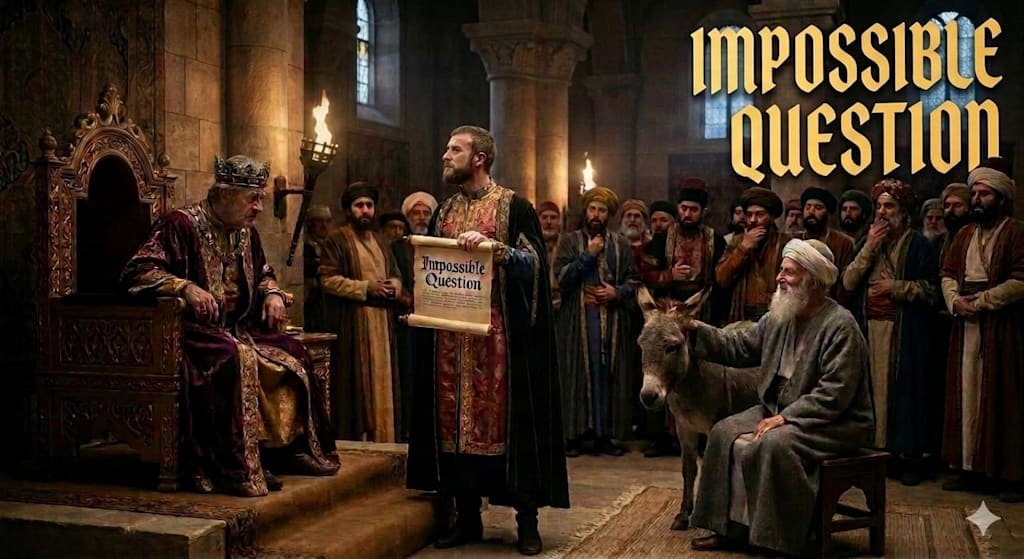
A man believed that he was the smartest person in the world. His pride had grown so much that he no longer respected anyone’s intelligence. He would travel from place to place, challenging scholars, judges, and ordinary people, asking them difficult questions and laughing at their inability to answer.
He was not just confident—he was arrogant. He believed knowledge belonged only to him, and everyone else was inferior. People began to avoid him because his questions were not meant to teach, but to humiliate.
One day, he arrived at a king’s court. The hall was grand, filled with ministers, scholars, and guards. Standing proudly in front of everyone, he declared loudly:
“If you answer my three questions, I will become your lifelong servant. But if you fail, then you must all accept that I am the most intelligent man in the world.”
The court became silent. The king accepted the challenge, but even his greatest scholars and wise men could not answer the man’s questions. Each question seemed impossible, designed to confuse and trap the mind.
For the first time, uncertainty filled the court. The king felt embarrassed, and the ministers were unable to respond. The arrogant man smiled confidently, already believing his victory was certain.
At that moment, the king remembered a man known for his unusual wisdom and clever thinking—Mulla Nasiruddin. Without hesitation, the king ordered him to be brought to the court.
When Mulla Nasiruddin entered, riding his simple donkey, the arrogant man laughed. He looked at Mulla from head to toe and thought, “How can such a simple man solve what the greatest scholars cannot?”
But Mulla Nasiruddin remained calm, almost careless in appearance, yet sharp in mind. He listened carefully and said, “Ask your questions. If I fail, I will accept defeat.”
The first question was about the center of the earth. Mulla smiled, walked forward, and pointed at the ground beneath his feet.
“This is the center of the earth,” he said calmly.
The man immediately protested, saying it was impossible. But Mulla replied wisely, “If you can measure the entire earth and prove otherwise, then I will accept my mistake. Otherwise, your claim has no foundation.”
The court murmured. People began to realize that the answer was not about geography, but about logic.
Then came the second question: “How many stars are there in the sky?”
The man expected confusion, but Mulla replied without hesitation:
“As many as the hairs on my donkey’s body.”
Laughter spread in the court. The man mocked him, but Mulla calmly continued, “If you can count all the hairs on my donkey and all the stars in the sky, only then can you compare the difference. Otherwise, your question is impossible to prove.”
The third question was even more personal: “How many hairs are there in your donkey’s tail?”
Mulla looked at him and said:
“As many as the hairs in your beard.”
The man became angry and said, “How can you prove this?”
Mulla smiled and said, “Let us count them one by one. If there is any difference, I will accept defeat immediately.”
At this point, the entire court burst into laughter. The arrogance of the man began to collapse. He realized that every question he had asked, though clever, had no practical way to be proven.
For the first time, he felt powerless—not because his questions were answered, but because his logic was turned against him.
Humiliated and speechless, the man left the court in silence. His pride, once towering like a mountain, had completely fallen.
The king stepped down from his throne and approached Mulla Nasiruddin. He asked, “Did you really know the answers to these questions?”
Mulla smiled gently and replied,
“Knowledge is not about defeating others or showing superiority. True wisdom is using understanding in the right way. I simply used his own logic against him.”
The king was deeply impressed. He rewarded Mulla generously and honored him in front of the entire court.
That day became unforgettable. The court learned a powerful lesson: intelligence is not about arrogance or humiliation—it is about wisdom, balance, and the ability to think beyond pride.
And so, the arrogant man who once claimed to be the smartest in the world left defeated, while true wisdom stood quietly in the form of a simple man and his donkey
About the Creator
Enjoyed the story? Support the Creator.
Subscribe for free to receive all their stories in your feed.
Comments
There are no comments for this story
Be the first to respond and start the conversation.