
I Thought Spreadsheets Were Enough
for Fleet Management

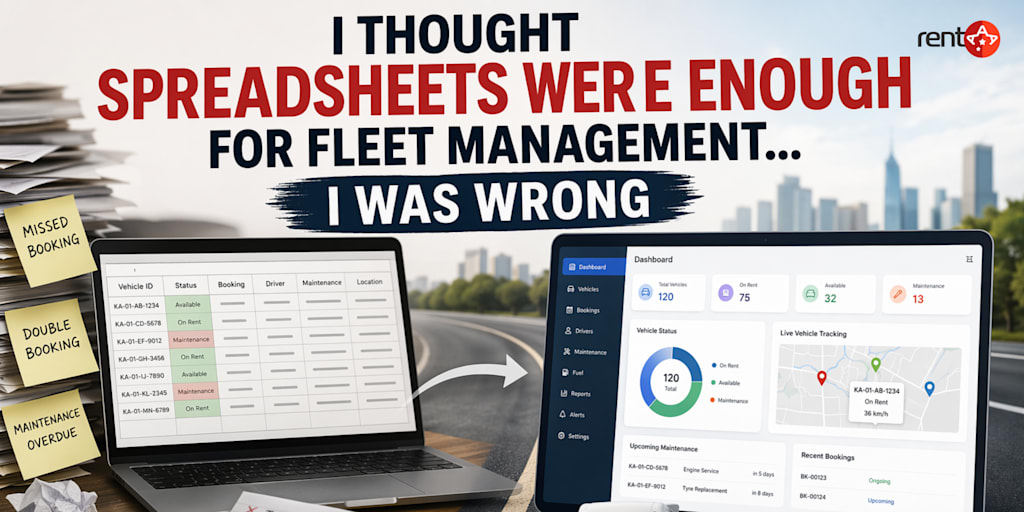
I still remember the moment I felt in control.
A neat spreadsheet. Rows perfectly aligned. Vehicle IDs, bookings, maintenance dates—all sitting there, clean and organized. It felt like I had built a system that could handle anything.
At least, that’s what I thought.
The Illusion of Control
In the beginning, spreadsheets worked.
Managing 5–10 vehicles? Easy.
Tracking bookings manually? No problem.
Maintenance reminders? Just add another column.
It felt efficient. Simple. Affordable.
But as the fleet grew, something changed.
What once felt like control slowly turned into confusion.
When Things Started Falling Apart
It didn’t happen overnight.
First, it was a missed booking.
Then, a double allocation.
Then, a vehicle went for maintenance… but was still marked as “available.”
I started spending more time fixing errors than actually managing the business.
Updating spreadsheets became a daily burden:
One small mistake could disrupt the entire schedule
Multiple versions of files created confusion
Team members were never on the same page
And the worst part?
I didn’t trust my own data anymore.
The Hidden Cost No One Talks About
Spreadsheets are free—but the problems they create are not.
I was losing:
Time (hours every day updating data)
Money (missed bookings and inefficiencies)
Opportunities (couldn’t scale operations confidently)
What looked like a “low-cost solution” was quietly becoming the biggest bottleneck in my business.
The Breaking Point
The turning point came on a busy day.
Two customers showed up for the same vehicle.
Both had confirmation. Both were right—according to different versions of the spreadsheet.
That moment was more than embarrassing. It was a wake-up call.
I realized I wasn’t running a system.
I was patching problems.
What Changed Everything
That’s when I started exploring smarter ways to manage fleet operations.
Not just tools but systems built specifically for fleet management.
The difference was immediate.
Instead of juggling spreadsheets:
Bookings were tracked in real time
Vehicle availability was always accurate
Maintenance schedules were automated
The entire team worked from one centralized system
For the first time, I wasn’t reacting to problems.
I was preventing them.
The Shift From Manual to Smart fleet management software
What surprised me the most wasn’t just the efficiency—it was the clarity.
I could finally:
See my entire fleet at a glance
Make faster decisions
Scale operations without chaos
Managing a fleet no longer felt overwhelming.
It felt… structured.
A Lesson Worth Sharing
If you’re still managing your fleet with spreadsheets, you’re not alone.
Many businesses start that way.
But there comes a point where what once worked starts holding you back.
Spreadsheets aren’t built for growth.
They’re built for simplicity.
And fleet management is anything but simple.
Final Thoughts
Looking back, spreadsheets weren’t the mistake.
Sticking with them for too long was.
The moment I shifted to a smarter system, everything changed—from operations to mindset.
If your fleet is growing and things feel harder than they should be, it might not be your process.
It might be your tools.
And sometimes, the smallest change—like moving beyond spreadsheets—can make the biggest difference.
About the Creator
Ava Bennett
I’m Ava Bennett, an accomplished SEO Manager at Rentaaa, a cutting-edge software company that simplifies rentals for Fleet ,rental accommodation , self storage and co working space management software.
Enjoyed the story? Support the Creator.
Subscribe for free to receive all their stories in your feed.
Comments
There are no comments for this story
Be the first to respond and start the conversation.